
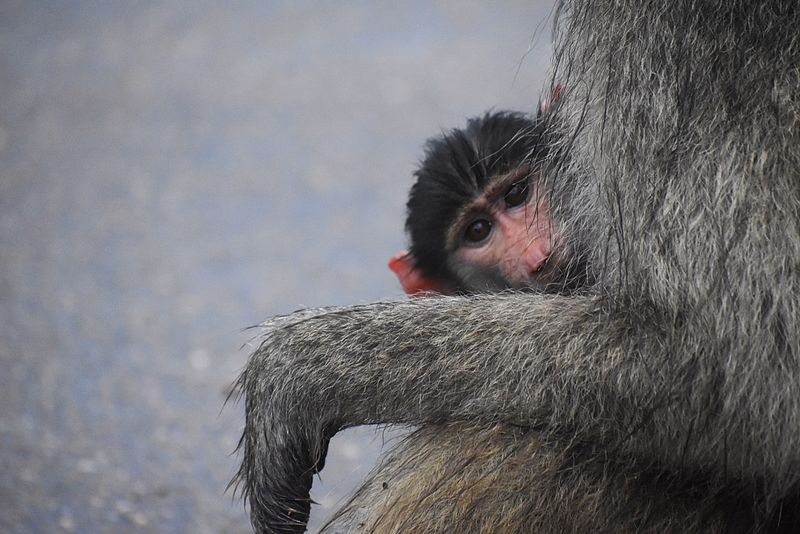
As Cape Town heads towards the 4 November municipal elections, it is also building what primatologist David Gaynor has warned might become a “monument to management failure”.Around 60 chacma baboons from the Waterfall and Seaforth troops in Simon’s Town might soon be removed from the landscape where they have lived for generations and placed into permanent captivity at the City-owned Urban Wildlife Centre at Kogelfontein near Scarborough. The City's Action Plan provides for the animals to be captured, assessed, and moved into purpose-built enclosures, with healthy males vasectomised. A juvenile baboon from the Seaforth troop, with False Bay in the background. (Photo: Joyrene Kramer) Green Group Simonstown NPC (GGST) has since resigned from the Cape Peninsula Baboon Advisory Group (BAG).“We did not join the Advisory Group to lend legitimacy to decisions we fundamentally question. We joined because we believed participation meant that evidence, community experience and viable alternatives would influence the outcome. For approximately seven months, we repeatedly raised the same fundamental concerns. We have not seen those concerns meaningfully reflected in the decisions being implemented. We won’t endorse something that, in our view, amounts to a zoo.”The Wildlife Animal Protection Forum South Africa (WAPFSA), a national network of wildlife, conservation, environmental and community organisations, has repeatedly opposed the permanent captivity of the Simon’s Town baboons. It argues that the plan disregards their natural free-ranging existence and that evidence-based coexistence measures should be implemented, evaluated and transparently monitored before permanent captivity is considered. WAPFSA has also put forward alternatives including secure waste systems, targeted spatial exclusion, non-lethal behavioural management, community coexistence measures and habitat interventions.Francesca de Gasparis, director of the South Africa Faith Communities’ Environment Institute (Safcei) and also a member of the BAG, has also opposed the removals. She has described the response to the crisis as showing “a profound lack of understanding of the important role baboons play in the functioning of our fynbos ecosystem”.People march from Simon’s Town train station to the police station on 19 July 2025 to protest against the euthanasia of baboons. (Photo: GK)The Cape of Good Hope SPCA, also a member of the BAG, has likewise raised welfare concerns. In July, it stated that it did not support placing free-roaming, wild-caught baboons into a sanctuary as a long-term management solution.This is therefore not simply a disagreement between the City and a handful of residents. Different organisations, with different mandates and areas of expertise, are simultaneously objecting and questioning why permanent captivity or death are being proposed as the only solutions before alternatives to removal have been properly advanced. The travesty has now made international news, with Reuters reporting on it last week.A failure of managementAt the heart of this issue is a failure of management and environmental leadership. Management should have been independently scrutinised in each affected area before the permanent removal of any troop was considered. Instead, rangers were moved between troops and areas, approaches changed and the consequences of those changes were never properly examined in public. Those of us who live alongside these baboons do not depend entirely on management reports to understand what is happening. We observe these troops every day. We see when they are settled, when they are being effectively managed, when they are disrupted and stressed, and when management decisions make the situation worse. Baboon management has changed across the years, but the central problem remains: management failure has repeatedly been attributed to the animals themselves.Waste is part of that failureWaste should be treated as an urgent environmental issue rather than merely a baboon problem. The Western Cape has committed to diverting 100% of organic waste from landfill by 2027, following an interim target of 50% by 2022. Yet there has been little visible public education teaching ordinary households why organic waste should not be placed in general refuse.Removing food waste from bins would help reduce wildlife attractants, methane emissions and pressure on dwindling landfill space. In many circumstances, educating and enabling households to separate organic waste would achieve more than simply providing a baboon-proof bin.Wet waste from Simon’s Town is emptied into a truck by Brandon Overmeyer. This wet waste in turn keeps baboons out of town, pigs fed and reduces the pressure on landfill sites. (Photo: © Gunnar Oberhoesel) The roll-out of baboon-proof bins was announced in early September, with the first 2,200 of a planned 6,000 bins due to be distributed from mid-September. Simon’s Town is excluded from that roll-out because the City instead intends to capture the Waterfall and Seaforth troops and place them in permanent captivity. That sequencing should concern everyone. If the underlying attractants remain, removing one set of baboons does not remove the conditions that will keep on drawing wildlife into the urban environment.The irreversible stepFor years, baboons have been chased, paintballed, harassed and subjected to increasingly intensive forms of disruptive management. Have these methods solved the underlying problem? The persistence of the conflict suggests they have not.Instead of addressing this failure, the Seaforth and Waterfall chacmas are planned to be trapped and removed. We strongly reject the repeated use of health and welfare concerns to justify permanent confinement or worse, without transparent, independent veterinary evidence that can be trusted. If welfare were genuinely the determining consideration, the first response would have been to scrutinise management, address attractants, protect access to natural habitat and implement every reasonable coexistence measure before taking the most extreme and irreversible step.What kind of city?South Africa’s Constitution does not treat environmental protection as an optional luxury to be pursued when convenient. Section 24 recognises the right to an environment that is not harmful to health and wellbeing and requires reasonable measures to prevent pollution and ecological degradation.The City is also increasingly confronted with difficult questions about sewage, coastal pollution, water, herbicides and contaminants, biodiversity loss and large-scale developments such as data centres. These issues are different in nature and scale, but they point to a common challenge: how Cape Town grows and develops while respecting the ecological limits and public interests that sustain the city.Its mountains, coastline, fynbos and wildlife are not obstacles to development. They are part of the ecological foundation of the city and a heritage that underpins much of its cultural and economic worth. Baboons are social beings with a very strong hierarchy. There is a massive long-term impact when certain troop members die or are killed. (Photo: © Gunnar Oberhoesel) Cape Town is approaching a municipal election at a moment when its relationship with the living landscape around it deserves serious scrutiny. The baboon issue is more than the fate of two troops. It reflects a choice about how a biodiversity city responds when human development conflicts with the natural systems that sustain it.A city that derives so much of its identity, beauty and prosperity from its natural gems and their intricate relationships has a responsibility to protect them. That means addressing the human conditions that create conflict, investing in coexistence and adapting the city itself rather than singling out and removing, in one way or another, wildlife that has become inconvenient.The decision now being made on these baboons will become part of Cape Town’s environmental record. As the city goes to the polls, it also offers a measure of the kind of city Cape Town is choosing to become. DMDaily Maverick will, in the next week, publish a number of in-depth articles by Don Pinnock, looking at the issue from all sides, including Jane, the Baboon. If you have an expert view on the matter, please send it to Opinion@dailymaverick.co.za
BABOONS OP-ED: Cape Town risks ‘monument to management failure’ just before municipal elections
Full Article
Original Source
Read the full article at Dailymaverick →KhanList aggregates and links to publicly available news content. We do not host full articles from third-party sources. Always verify important information with original sources.