
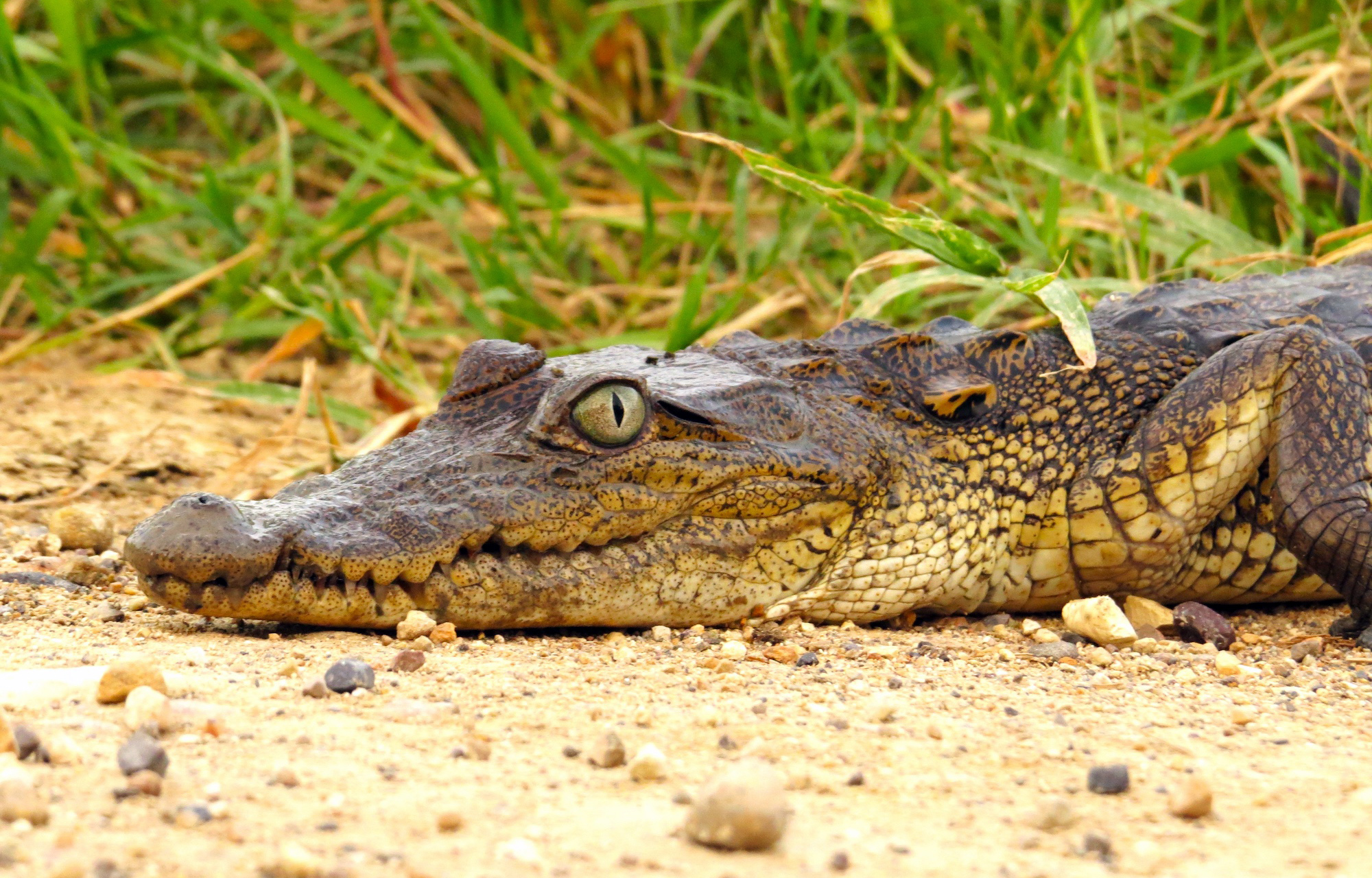
A nonprofit is reintroducing crocodiles as part of a mangrove restoration project in Veracruz, Mexico.The project also involves using an Aztec technique for reforestation by planting mangrove seedlings on raised mounds called chinampas.Practitioners in Veracruz, as well as in Colombia, say crocodiles help mangroves function by moving sediment as they swim and keeping channels open so water flows.However, others point to a lack of research supporting claims that crocodiles perform a structural role in their habitat. In 2017, Omar Trujillo Santos was sitting in a small wooden boat holding a crocodile, its skin soft like a snake. He helped untie the reptile, a juvenile Morelet’s crocodile, and carefully guided it into the dark water. It swam off to find a new home in the Alvarado Lagoons System in Veracruz, southeastern Mexico, completing the final phase of a mangrove restoration project. Studies suggest Mexico, a country rich in mangroves, has experienced the highest degree of mangrove loss in the Americas. Conservation and reforestation efforts seek to reverse this loss, yet many projects fail to restore a mature forest. Seedlings and young trees too often die due to improper planting techniques or unsuitable sites. Led by REVIVE, a nonprofit that works to boost biodiversity in the region, the Veracruz project aims to restore not just trees, but the mangrove ecosystem as a whole by employing Aztec-inspired planting methods to rebuild forests and using crocodiles to help maintain them. According to REVIVE, this technique has resulted in a fully restored forest. Conservationists involved in the project say they hope this success encourages others to consider how crocodiles could be used to benefit future mangrove restoration projects. Omar Trujillo Santos stands in front of a chinampa planted with mangrove seedings grown in a nursery. Image from Soto et al., 2026 (preprint) (CC BY 4.0). An ancient technique In 2006 when biologist Aníbal Ramírez Soto began working with mangroves in the wetlands around the Alvarado lagoons, he planted mangrove seedlings in rows, like corn. They died. He remembers climbing up a nearby healthy mangrove tree, more than 16 years ago, to escape the depressing scene of another failed planting. From that vantage point, Ramírez Soto noticed the mature mangroves nearby grew in elevated clumps and though, could he plant that way? Using wetland soil, Ramírez Soto made a small planting mound. This technique, building a tiny island in a shallow lake, was how the Aztecs once farmed around their capital city. In homage to that history, Ramírez Soto refers to the mounds as chinampas, just as the Aztecs did. Throughout the region, mangroves have been cut and burned to make room for cattle. This caused the soil to collapse and sink, which prevented new mangroves from taking root. Ramírez Soto, now director of REVIVE, said the chinampas helped undo this damage to the land. “It’s a simple idea: Just put the soil back like it was,” Ramírez Soto told Mongabay in a video call. The mangrove seedlings survived. For the next few years, the Mexican team worked with local communities in the region to hone the technique and expand it to larger areas. Aerial view of a mangrove area reforested by REVIVE using chinampas. Mangrove trees are adapted to live at the interface of land and sea, and can tolerate variable water levels. Image from Soto et al., 2026 (preprint) (CC BY 4.0). The team planted around 2,000 trees into hundreds of hand-built mounds, he said. When they came back to count the trees, more than 4,000 had taken root. It turned out mangrove seedlings from elsewhere had floated in on the tides and rooted into the chinampa, according to Ramírez Soto. The forest was healing itself. It was a lot of work, 40but in the end it was worth it, he added: Just two years into the project the trees began growing outside of their planting mound; by the eighth year, the canopy cover was 80%. Now, the restoration work is largely invisible, he said, “The mangrove has simply taken over.” That success led to a larger project: 15,000 chinampas over 40 hectares (99 acres). The projects are now so large in scale that the team uses machines to build the mounds. They published the results of 17 years of data in a preprint paper in the EcoEvoRxiv online research repository. Community members from La Guadalupe, Tlacotalpan, Mexico and their newly-built chinampa. Image from Soto et al., 2026 (preprint) (CC BY 4.0). Return of the crocodiles The mangroves were growing well, but a healthy mangrove forest is more than trees. “In nature, animals and plants exist together; you can’t separate them,” Ramírez Soto said. He added that crocodiles are particularly important to mangroves and their long-term health, moving sediment as they swim and keeping channels open so water flows. Yet few mangrove projects consider crocodiles. The Revive team traveled to Colombia to learn the technique from Giovanni Ulloa Delgado, a biologist with the National University of Colombia and the organization Asocaiman. Ulloa Delgado spent 15 years working to conserve the American crocodile (Crocodylus acutus) in Cispatá Bay, northern Colombia, where illegal hunting had nearly driven it to local extinction. Partnering with former crocodile hunters to collect eggs for captive incubation and rearing, they released around 15,000 juveniles in total into the bay. Today, he said, the population is no longer at risk and the local community manages them, running a tourism industry centered around the reptiles. For Ulloa Delgado, it’s important to restore crocodiles to their historic home in mangrove forests, “because once the crocodiles are established, they also become part of the comprehensive restoration effort,” he told Mongabay over the phone. A juvenile Morelet’s crocodile (Crocodylus moreletii) is released into the waters of the Alvarado Lagoon System. Image by Omar Trujillo Santos /REVIVE. The mangroves around Cispatá Bay remain healthy, with flowing currents and increased productivity, Ulloa Delgado said. He attributes this to the crocodiles, though he hasn’t done a formal study — an undertaking that would require resources and personnel he doesn’t have, he said. Back in Veracruz, the REVIVE team surveyed the lagoons and wetlands around their restoration site in Alvarado: no crocodiles. They’d been hunted out years before and would need reintroduction. Since 2017, the team has released around 80 Morelet’s crocodiles (Crocodylus moreletii), far fewer than the 15,000 in Colombia, but they hope it is enough. When they first started restoration in the area, water channels in the wetland were clogged with plants, which is “like having clogged veins,” Rafael Rodríguez Mesa, a biologist and restoration coordinator with REVIVE, told Mongabay. It harms the mangroves. At first REVIVE cleared channels by hand, and later with machines. “But now crocodiles can do that work,” he said. The teams in Mexico and Colombia have no doubt that crocodiles help the mangroves, but research investigating these claims is lacking. One 2020 review paper in Biological Reviews surveyed the scientific literature and didn’t find enough research to either prove or disprove that crocodiles play a role as ecosystem engineers. A crocodile in the wetlands near Centla, Tabasco, Mexico. Image by Omar Trujillo Santos /REVIVE. Crocodile specialist Charlie Manolis said he is skeptical of assertions he’s heard that crocodiles are necessary for mangrove health. Manolis, chief scientist at Wildlife Management International in Australia and the co-chair of the IUCN Crocodile Specialist Group, has worked with these reptiles all over the world. “There’s absolutely no evidence whatsoever that, for example, habitats will collapse if crocodiles are removed,” he told Mongabay in a video call. Another unsupported claim he has heard, he said, is that having crocodiles will increase the number of fish,. Manolis uses northern Australia as an example. There, he said, saltwater crocodiles (Crocodylus porosus) were hunted to near extinction and were absent from the mangroves for decades without any apparent ill effects. Their populations have since rebounded due to conservation efforts of which Manolis was a part. Manolis strongly supports crocodile conservation in general and thinks it’s fantastic if the reptiles benefit the mangrove project in Mexico; however, he wants to see the research to back this up. He also pointed out the potential impact to nearby communities when crocodiles return. “The reality is that they’re often large, dangerous predators, and it’s no good sugarcoating it,” he said. Part of the success in northern Australia was the robust education campaign that taught people how to safely live with saltwater crocodiles, which are considered the most aggressive crocodilian species in the world. Chinampas keep young mangrove trees above the water level, protecting them from being washed away by the changing tides. Image from Soto et al., 2026 (preprint) (CC BY 4.0). Forests, food and crocodiles In the Alvarado lagoons, the crocodiles aren’t officially monitored, REVIVE’s Rodríguez Mesa said, but local fishers that visit the area where they were released give updates, including sightings of hatchlings and a friendly relationship between one man and a crocodile he’d toss fish to. REVIVE team members told Mongabay they have not heard any complaints about crocodiles, and at the time of writing, neither has the local government, according to a representative of the local municipal office in Tlacotalpan. The REVIVE team also works at a ranch near Tuxpan, Veracruz, restoring forests while integrating food production, agroforestry and crocodile conservation. The ranch was once a shrimp farm, said Javier Meza, a former worker at the farm who has stayed on as the ranch manager. In addition to planting trees and caring for the livestock, Meza manages the crocodiles that moved into the abandoned shrimp ponds. If they’re not bothering you, he told Mongabay on the phone, just let them be. When they come too close to the livestock, he moves them. On other ranches, some people will kill and eat a problem crocodile, while others will call the government to relocate it, Meza said. A fully restored mangrove forest reestablished with the help of chinampas. Image from Soto et al., 2026 (preprint) (CC BY 4.0). Now, the abandoned shrimp ponds are de facto crocodile breeding sites. Meza finds clutches of eggs and babies small enough to hold in the palm of your hand, as well as full-sized adults. In the future, the team wants to start a breeding program there to raise crocodiles for release into other mangrove restoration projects. To Meza, even with the challenges crocodiles bring, there is no doubt they are important. “They help protect and care for the area,” he said. “They are a fundamental part.” For Ramírez Soto, the overarching lesson of these projects is to first diagnose the problem with the site before embarking on restoration. In Alvarado, the fixes included chinampas and crocodiles. Once the ailment is addressed, Ramírez Soto said, “nature has the capacity to heal itself.” Banner image: A Morelet’s crocodile (Crocodylus moreletii) rests in the wetlands near Tecolutla, Mexico. The species is native to the Atlantic regions of Mexico, Belize and Guatemala. Image by Rafael Rodríguez Mesa. Citations: Bayraktarov, E., Saunders, M. I., Abdullah, S., Mills, M., Beher, J., Possingham, H. P., … Lovelock, C. E. (2015). The cost and feasibility of marine coastal restoration. Ecological Applications. doi:10.1890/15-1077 Lee, S. Y., Hamilton, S., Barbier, E. B., Primavera, J., & Lewis, R. R. (2019). Better restoration policies are needed to conserve mangrove ecosystems. Nature Ecology & Evolution, 3(6), 870–872. doi:10.1038/s41559-019-0861-y Pablo Antúnez, P. (2024), Mangrove Area Trends in Mexico Due to Anthropogenic Activities: A Synthesis of Five Decades (1970–2020). Coasts, 4(4), 726-739. doi:10.3390/coasts4040038 Ramírez Soto, A., García Valencia, A., Sheseña-Hernández, I., Trujillo Santos, O., Villa-Espíritu, J., Pérez Barrera, E., Rodríguez Mesa, R., … López Portillo J. (2026). The Use of Chinampa-like Islets to Restore Mangroves on Collapsed Soil. Preprint on EcoEvoRxiv. doi.org/10.32942/X2RD43 Somaweera, R., Nifong, J., Rosenblatt, A., Brien, M.L., Combrink, X., Elsey, R.M., … Webber, B.L. (2020), The ecological importance of crocodylians: towards evidence-based justification for their conservation. Biological Reviews, 95(4), 936-959. doi:10.1111/brv.12594 FEEDBACK: Use this form to send a message to the editor of this post. If you want to post a public comment, you can do that at the bottom of the page. Credits Topics
Aztec methods and crocodiles: How biologists are restoring mangroves in Mexico
Full Article
Original Source
Read the full article at News →KhanList aggregates and links to publicly available news content. We do not host full articles from third-party sources. Always verify important information with original sources.