
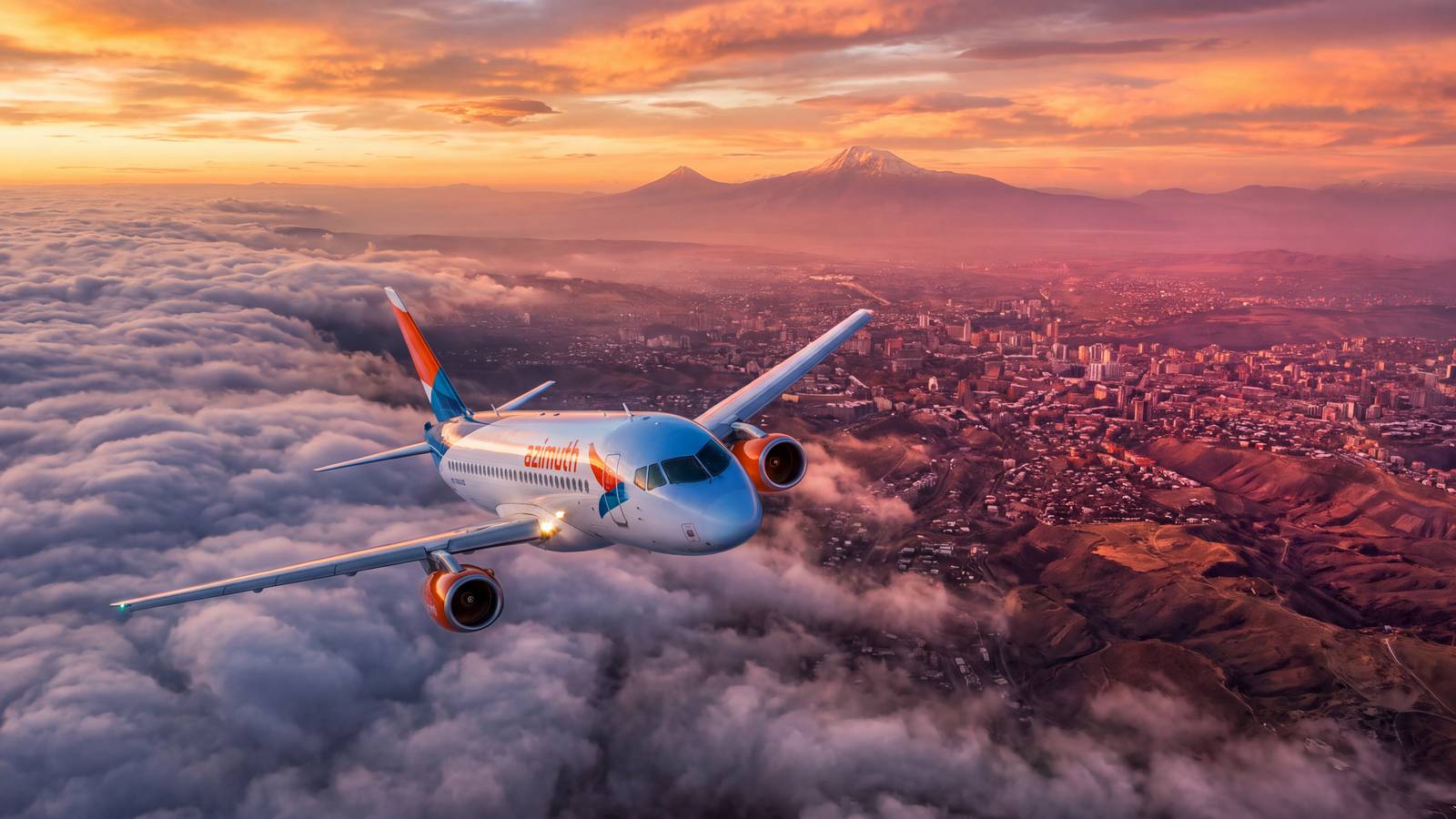
Credit: Simple Flying Published Oct 29, 2026, 12:32 PM EDT Louis is a military historian and the staff writer for History of War magazine, a leading military history monthly. He also has an interest in private and commercial aviation. Sign in to your Simple Flying account A passenger Sukhoi Superjet 100 operated by Azimuth, a Russian airline, has returned to Zvartnots International Airport (EVN) after declaring an emergency shortly after takeoff. It came back to the airport in Yerevan, Armenia, after issuing squawk code 7700 20 minutes after departure. This is the international emergency transponder code that pilots enter to signal a general emergency to air traffic control. Incidents such as this one have struck Azimuth multiple times in recent years. This could be a sign that Western sanctions on the Russian aviation sector amid Vladimir Putin's War in Ukraine are having an impact on Azimuth's ability to operate safely. The Information Has Emerged From A Russian Telegram Channel This news was originally reported by SHOT, a Russian telegram channel. It claimed that a technical malfunction had led to the code being given. This event occurred while the jet was flying near Tsilkar, a tiny village around 31 miles (50 km) to the north of Yerevan. SHOT claims that the Azimuth Airlines aircraft involved is over eight years old. It is unclear exactly which plane from Azimuth's 19-jet fleet of Superjet 100s was involved in the incident. The table below uses Planespotters.net data to show information on each of the airline's six jets aged between eight and nine years old that could have been involved. Each aircraft is named after a location in Russia: Registration Delivery date Aircraft name Age (years) RA-89093 March 6, 2018 Neva 8.9 RA-89096 April 10, 2018 Moskva 8.9 RA-89094 March 28, 2018 Kuban 8.9 RA-89095 April 17, 2018 Irtysh 8.7 RA-89120 October 16, 2019 Oka 8 RA-89121 November 28, 2019 Ob 8 SHOT also says that the same jet also suffered a failed takeoff event at Yerevan in 2025. The aircraft had to return to its parking stand after being unable to get into the sky. Simple Flying has contacted Azimuth for comment. Azimuth Is An Airline Plagued By Incidents Like This In recent years, multiple incidents and one accident have struck Azimuth. The accident occurred on November 24, 2024, when a Superjet 100's engine caught fire following a landing at Turkey's Antalya Airport (AYT). The flight from Sochi had 89 passengers and six crew members on board. Everybody successfully evacuated via the plane's emergency slides. However, the jet suffered substantial damage. Azimuth claimed that the jet suffered substantial "wind shear" on landing, Sky News reported. In another incident, an Azimuth Superjet 100 lost a fan cowl during a flight to Yerevan. Shortly after takeoff from Mineralnye Vody Airport (MRV), the cowling began to break apart. MRV staff later recovered the parts from the airport's grounds. Sanctions Against Russia Have Impacted The Safety Of Russian Aviation It doesn't show up in official reporting, but the weight of sanctions against Russian industry in the wake of Vladimir Putin's ongoing War in Ukraine is doubtless having an impact on Azimuth's ability to operate safely. These sanctions have banned the sale of parts from overseas to the industry, forcing airlines to survive with inferior parts developed and produced domestically. Although Sukhoi is a Russian manufacturer, the jet is built from some parts with a Western origin. Back in 2023, there were cases of United Aircraft Corporation (UAC), Russia's state-controlled aerospace company, fitting old engines on new Superjet 100s awaiting powerplants. The problem extends far beyond Azimuth and the Superjet 100. Geostrata data shows that, since the onset of sanctions, safety incidents have tripled. This includes published emergencies and forced landings caused by engine or hydraulic issues. The inability to carry out deep maintenance tasks, usually conducted every two to six years, has been particularly problematic. There were no certified facilities in Russia for these tasks due to a lack of support from Boeing and Airbus. 2025-2026 was the point where swathes of jets hit a point where they wouldn't continue to fly without this deep maintenance under normal conditions.
Azimuth Sukhoi Superjet 100 Squawks 7700, Returns To Yerevan After Technical Malfunction
Full Article
Original Source
Read the full article at Simpleflying →KhanList aggregates and links to publicly available news content. We do not host full articles from third-party sources. Always verify important information with original sources.