
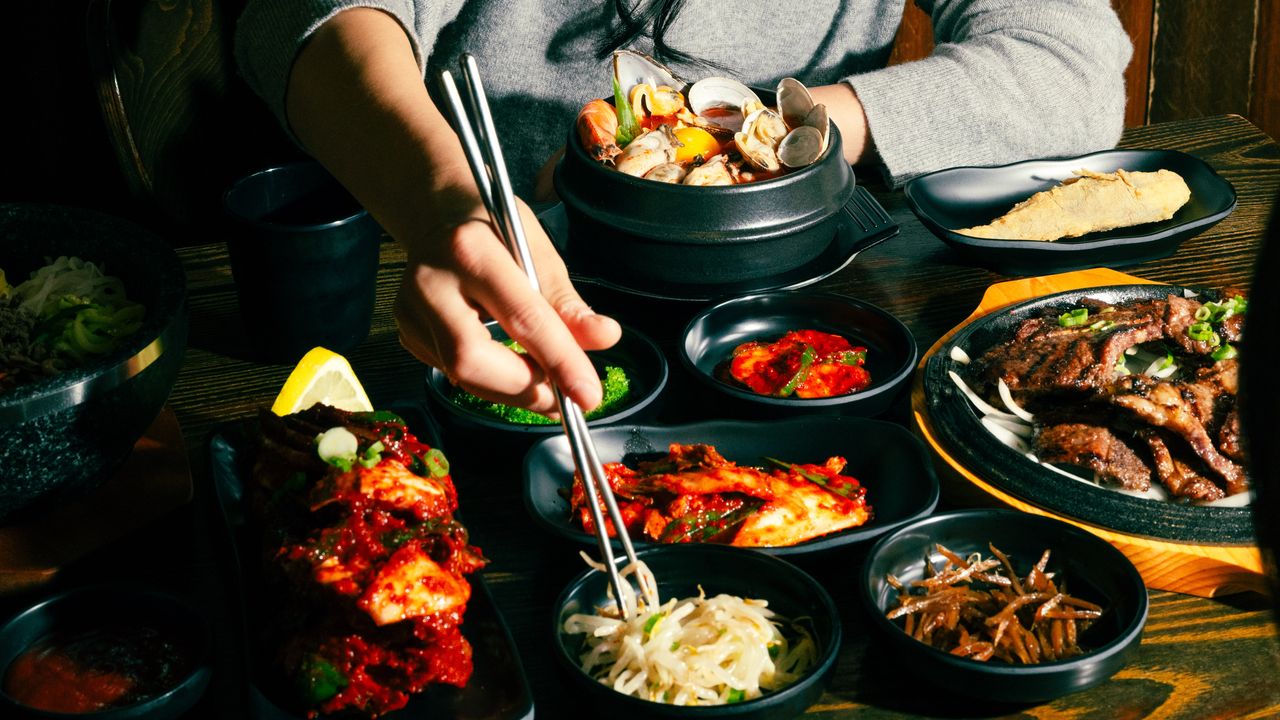
“It's so cool that in this city you have SoHo and Times Square but also these enclaves where you can totally belong,” says Nora Lum, the actor and comedian also known as Awkwafina. We're upstairs at the 24-hour Miss Korea, her go-to spot in Manhattan's Koreatown, picking our way over a lavish Korean barbecue spread of assorted banchan and gleaming chargrilled short ribs. “I love this!” she says, before popping a clump of braised burdock into her mouth.Lum, who is Korean-Chinese American, has just wrapped filming Awkwafina: The Unlikely Cook, an unscripted Apple TV series that she hosts and executive-produces. A descendant of the family behind the legendary Cantonese American restaurant Lum's, which her great-grandfather ran in Flushing, Queens, from 1953 to 1982, she spends eight episodes gathering cooking tips from the nation's Asian communities, particularly its Chinatowns. She heads to America's oldest Chinatown, in San Francisco, to cook with chef Martin Yan, who, using “insane” knife work, “absolutely destroyed a chicken in 16 seconds”; Texas for a barbecue-fueled road trip with comedian Jimmy O. Yang, making pit stops at Korean-American-owned Eaker Barbecue in Fredericksburg and Thai-American Curry Boys BBQ in San Antonio; and Los Angeles to wait tables at the dim sum joint Golden Dragon. All these experiences lead to her own pop-up revival of Lum's in Manhattan's Little Italy, where she serves beloved staples like orange chicken and barbecue beef to friends and family.Lum crosses 32nd Street in the heart of New York City’s Koreatown. Gabriela HermanAt its heart Awkwafina: The Unlikely Cook is about heritage, community, and small-business immigrant entrepreneurship. “After the pandemic so many mom-and-pop shops were closing and Chinatowns were declining,” says Lum. “The show is about exploring that phenomenon but then also seeing who in my generation is keeping it going.”Our first lunch stop is Miss Korea, on 32nd Street between Broadway and Fifth Avenue, the stretch where Koreatown first emerged in the late 1970s. Then home to a Korean-language bookstore and a smattering of restaurants, it's since evolved into an around-the-clock entertainment hub for anyone looking to pick up K-pop memorabilia, sing karaoke, and eat everything from Korean corn dogs at Jongro Rice Hotdog to a Michelin-starred tasting menu at Joo Ok. For Lum it's a nostalgic stretch of the city. “I went to MK, Maru, Circle,” she says in reference to nightlife spots frequented by Korean American party kids coming of age in 1990s and 2000s New York. “Oh man, I've been so messy on this one block.”Patrons fill the tables at the ever-popular BCD Tofu House, which specializes in soondubu. Gabriela HermanWe cross the street to BCD Tofu House for crispy seafood pancakes, spicy marinated crab slicked with red pepper seasoning, and Lum's favorite: the signature soondubu, a tofu stew bubbling in a clay pot. Since opening in 2008, the Los Angeles export has increasingly drawn long lines—a testament to the growing popularity of Korean food across the US. “Twenty years ago customers were 70 to 80 percent Korean,” general manager Alex Kim tells us. “Now it's a lot more non-Korean.”Lum notes that, for a long time in the US, immigrants selling their traditional cuisines were often met with gratitude within the culture yet distrust outside of it. Adaptation followed: the invention of chop suey, for example, and wok-fired cooking of non-Chinese vegetables like broccoli. Her great-grandfather experienced this himself with Lum's, and local appreciation for the restaurant's Americanized Chinese classics like egg rolls and shrimp with lobster sauce has remained long after it closed. “I learned to think about it less as my family's attempt at just making money but rather, ‘Hey, this is the cuisine that we ate growing up,’ ” she says. “It's a fascinating story of belonging and acculturation.”We wander over to Woorijip, a fast-casual institution for snacking and soju drinking to pick up kimbap, and then to food hall Food Gallery 32. “This is where I get the fish!” Lum says of bungeoppang, the fish-shaped pastry introduced to Korea by Japanese colonists in the 1930s and popularized again in the '90s. In Manhattan this is the rare spot to find it.Freshly made bungeoppang lined up at Food Gallery 32 Gabriela HermanWhile filming, Lum prioritized places that are moving the needle forward while still preserving their communities' culture, like Phoenix Palace in Manhattan's Chinatown. The Cantonese American restaurant hosts local elders at affordable rates and buys plates from Wing on Wo & Co., a porcelain shop dating back to 1925. Lum recalls co-owner Cory Ng's father appearing with ingredients sourced from the neighborhood.“Chinatown is totally a local economy,” she says. But it's also where immigrants can speak their native languages, play mahjong, eat dim sum, and celebrate Lunar New Year. “So when you see Chinatowns decline, it's a bigger problem”—a problem she hopes her show can help resolve.Where to eat and drink across the US, according to Awkwafina: The Unlikely CookIn San Antonio, bright pink barbecue spot Curry Boys BBQ run by three childhood friends dishes out Southeast Asian–Texan blends like oak-smoked brisket with green curry. “They're combining their own cultures into something that's so authentic to where they're from,” says Lum.For the show, Lum waited tables at classic banquet hall Golden Dragon in Los Angeles's Chinatown, which, with its traditional dim sum service, has remained a stronghold for 64 years. Step outside, says Lum, and “it looks like a movie set.”Lum stopped by Oahu's Kō Hana Distillers while visiting Hawaii to learn about the tiki culture that inspired her great-grandfather's drinks menu. Come here for its farm-to-bottle selection using homegrown sugarcane.In San Francisco, the nation's oldest Chinatown “serves the community in a different way from elsewhere,” says Lum. She also loves the comparatively younger, yet still landmark, Mister Jiu's for its Western take on Cantonese cooking.Awkwafina: The Unlikely Cook is available to stream on Apple TV on November 6. This article appeared in the December 2026 issue of Condé Nast Traveler. Subscribe to the magazine here.
Awkwafina Takes Us on a Nostalgic Food-Tour of NYC's Koreatown
Full Article
Original Source
Read the full article at Cntraveler →KhanList aggregates and links to publicly available news content. We do not host full articles from third-party sources. Always verify important information with original sources.