
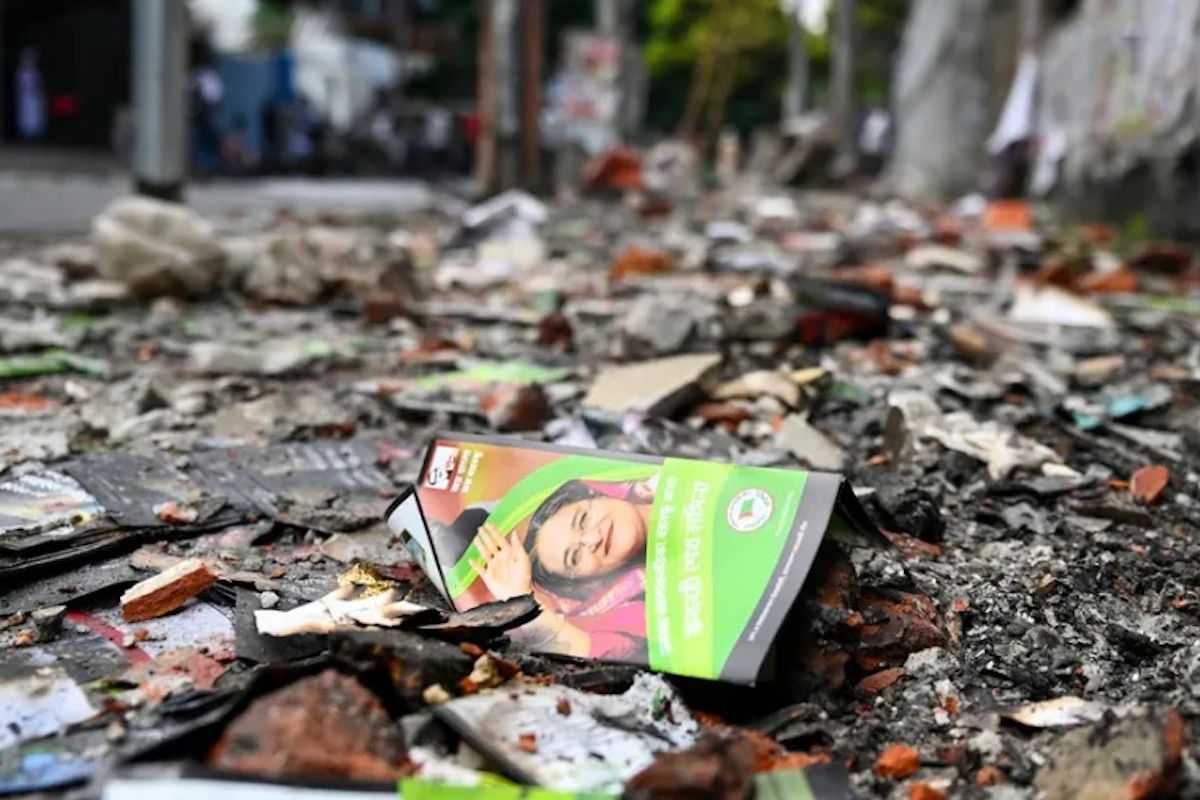
On November 17, armed attackers set fire to the residence of Bangladesh’s ruling party lawmaker SM Zilany in Tungipara, Gopalganj, the ancestral political stronghold of ousted prime minister Sheikh Hasina’s family. They also stormed the local police station, vandalized the premises and set it ablaze. The violence followed a police checkpoint operation in which several people were detained and motorcycles seized. Videos circulating online showed men smashing property and chanting “Joy Bangla” and “Joy Bangabandhu” – the customary slogan of Hasina’s political party, the Awami League. The footage of the attacks has not been independently verified. However, Home Minister Salahuddin Ahmed accused the banned Awami League of instigating the violence from abroad. He said the authorities would identify and prosecute those responsible. Earlier incidents in Gopalganj saw attacks on police vehicles and ordinary businesses. The attacks point to a contradiction at the core of the Awami League’s comeback strategy. A party whose activities were banned under anti-terrorism law in Bangladesh is seeking to recover its political standing through mobilization accompanied by violence. Nothing could be more counterproductive to the party’s standing. A political organization seeking rehabilitation must persuade the public that the conduct responsible for its exclusion belongs to the past. The Awami League’s recent actions, or those attributed to its supporters, are instead strengthening the arguments of people who want the restrictions maintained. The problem extends well beyond Gopalganj. On November 16, Awami League supporters gathered outside the Mayfair Venue in Romford, east London, where National Citizen Party leader and parliamentary opposition chief whip Nahid Islam was attending a reception. Nahid accused Awami League activists of attacking expatriate Bangladeshis and university students attending the event. Five people were reportedly injured and taken to hospital. More significant was the account given by UK-based Awami League figure Akhtar Hossain during a talk show with suspended former ambassador Harun Al Rashid. According to a Daily Waadaa report, Akhtar described how party supporters had assembled before Nahid arrived, positioned themselves around the venue and entered the gathering. He acknowledged the use of eggs and did not deny that sticks had been used. “Our intention was to create a scandal, cause disorder and spread panic,” he said. He also indicated that the campaign would continue until Hasina, now exiled in India, returned to power. That statement suggests that disruption was not merely an unintended consequence of political protest, and at least one participant described it as the objective. The Romford incident was one of many. In September 2025, Awami League supporters protested outside the School of Oriental and African Studies in London during a visit by Mahfuj Alam, then an adviser to Bangladesh’s interim government. Protesters threw eggs at Bangladesh High Commission vehicles, prompting police intervention. Mahfuj had previously faced harassment outside Bangladesh’s consulate in New York. Later that month, members of a delegation accompanying Muhammad Yunus to the United Nations General Assembly faced hostile protesters at John F. Kennedy International Airport. NCP leader Akhter Hossen was pelted with eggs, while Tasnim Jara and Bangladesh Nationalist Party (BNP) leader Mirza Fakhrul Islam Alamgir were also targeted. Similar incidents subsequently involved NCP leader Hasnat Abdullah in London and actress Azmeri Haque Badhon in Italy, where she reported being assaulted and harassed by people identifying themselves as Awami League or Chhatra League supporters. The incidents differ in seriousness and circumstances. But together they suggest a political culture in which intimidating opponents remains an accepted form of mobilization among sections of the Awami League’s supporters. The timing of these incidents is important. In July, Hasina told Reuters that she and senior Awami League colleagues planned to return from exile in India around December and surrender to the courts. She acknowledged the possibility of arrest and said she intended to challenge the legal proceedings against her. Hasina, who fled Bangladesh on August 5, 2024, faces a death sentence imposed in absentia over her government’s crackdown on that year’s uprising. She denies the charges and maintains that the ban on her Awami League party is unjustified. The announced return has given Awami League supporters a political deadline. Demonstrations and efforts to reopen party offices have accompanied renewed mobilization in Gopalganj, where the party retains historical and organizational roots. But violent mobilization will make that recovery harder. And the Awami League’s history helps explain why. On October 28, 2006, Bangladesh witnessed one of its most notorious episodes of partisan street violence during the political confrontation surrounding the end of the BNP-led government’s tenure. The Awami League-led movement became associated with the logi-boitha — the use of boat hooks and oars as weapons. Political activists were beaten in public, and the violence became part of the country’s enduring record of partisan confrontation. The episode showed how political parties could mobilize supporters carrying improvised weapons and present street confrontation as an acceptable means of advancing political demands. The Awami League subsequently returned to office in 2009. Over the next 15 years, the party’s control of state institutions, police and university campuses made the consequences of political violence considerably more serious. Chhatra League, its student organization, became particularly associated with campus intimidation, attacks on political opponents, extortion and allegations of serious criminal conduct. In July 2024, journalist Harun Ur Rashid examined this record in Bangla Outlook, pointing to the extensive documentation of alleged Chhatra League violence on Wikipedia, including a separate article devoted to the subject. He described how the organization’s reputation had deteriorated even among its own members, some of whom resigned after attacks on students protesting government-job quotas. The more authoritative assessment came from the United Nations. In February 2025, the UN Human Rights Office published its investigation into the July-August 2024 uprising and found reasonable grounds to believe that the former government, security agencies and violent elements associated with the Awami League had systematically committed serious human rights violations. The report estimated that as many as 1,400 people were killed between July 1 and August 15, 2024, with thousands more injured. It documented attacks by Chhatra League members on student protesters and found evidence that senior political and security officials coordinated the repression. The findings raised concerns about possible crimes against humanity. This history provides the context for the party’s present legal position. Bangladesh restricted Awami League activities under anti-terrorism legislation in May 2025. Parliament subsequently gave the restrictions statutory backing through amendments in April 2026. The Awami League could acknowledge the documented abuses committed during its years in power. It could reject intimidation, cooperate with credible investigations and establish clear rules against violence by its supporters. It could develop a political program addressing the grievances that contributed to its removal. Instead, its comeback campaign is increasingly associated with incidents that recall the conduct for which it faces public condemnation. Faisal Mahmud is the managing editor of Daily Waadaa.
Awami League’s violent comeback bid affirms its ‘terrorist’ label
Full Article
Original Source
Read the full article at Asiatimes →KhanList aggregates and links to publicly available news content. We do not host full articles from third-party sources. Always verify important information with original sources.