
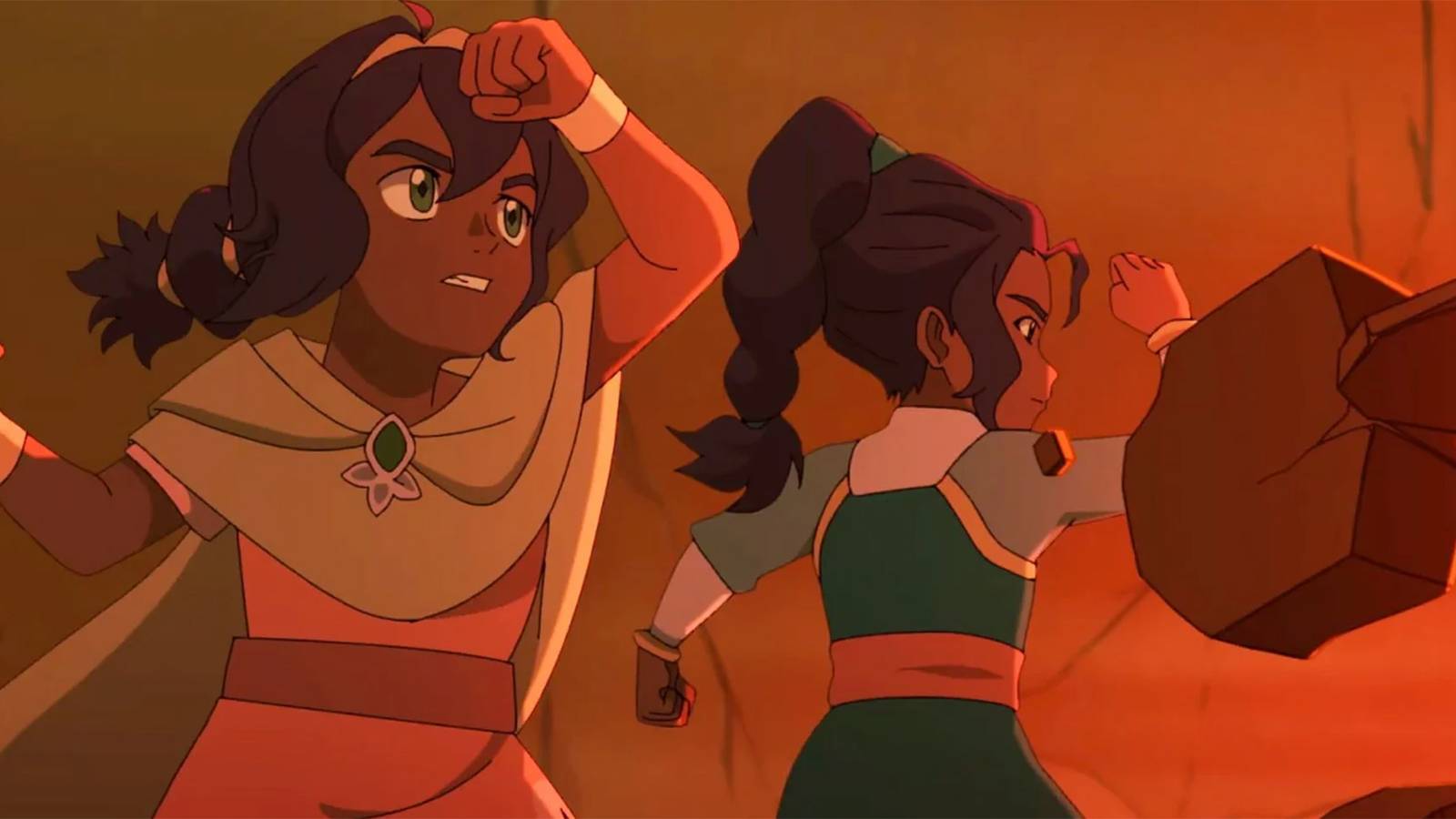
Image via Paramount+ Published Oct 14, 2026, 7:49 AM EDT Julio is a Senior Author for Collider. He studied History and International Relations at university, but found his calling in cultural journalism. When he isn't writing, Julio also teaches English at a nearby school. He has lived in São Paulo most of his life, where he covers CCXP and other big events. Having loved movies, music, and TV from an early age, he prides himself in knowing every minute detail about the things he loves. When he is older, he dreams of owning a movie theater in a small countryside town. Sign in to your Collider account Editor's Note: The following contains spoilers for Avatar: Seven Havens' Episodes 1-3.We are finally back to the world of Avatar, but this time, everything is different. In Avatar: Seven Havens, humanity is completely changed and benders are seemingly on the brink of extinction thanks to a world-ending Cataclysm that was supposedly caused by the Avatar 225 years prior — Avatar Korra (Janet Varney). In its first three episodes, Seven Havens shows how people despise Korra and have come to fear the Avatar because of her, an idea that feels all too familiar for anyone who knows the Avatar fandom on the internet. While it might seem that the new Paramount+ series is siding with fans who see her just like everyone in Ellora does, there is much more to talk about concerning Korra's true role in the Cataclysm, and why her presence is still felt after so long. ‘Seven Havens’ Portrays Korra as Downright Evil in Its First Episodes With only three episodes so far, there is still a lot to learn about what really caused the Cataclysm, but both the marketing for Seven Havens and the citizens of Ellora talk about it as a direct consequence of Avatar Korra's actions. In the teasers, she is briefly shown breathing fire and wreaking havoc on what seems to be Republic City and is apparently completely out of control. Because of her, the Avatar is portrayed as an actual villain for the first time, someone who had to be stopped. Collider Exclusive · Sci-Fi Survival Quiz Which Sci-Fi World Would You Survive? The Matrix · Mad Max · Blade Runner · Dune · Star Wars Five universes. Five completely different ways the future went wrong — or sideways, or up in flames. Only one of them is the world your instincts were built for. Eight questions will figure out which dystopia, galaxy, or desert wasteland you'd actually make it out of alive. 💊The Matrix 🔥Mad Max 🌧️Blade Runner 🏜️Dune 🚀Star Wars TEST YOUR SURVIVAL → 01 You sense something is deeply wrong with the world around you. What do you do? The first instinct is often the truest one. APull on every thread until I understand the system — then figure out how to break it. BStop asking questions and start stockpiling — food, fuel, weapons. Questions don't keep you alive. CKeep my head down, observe carefully, and trust no one until I know who's pulling the strings. DStudy the patterns. Every system has a rhythm — learn it, and you learn how to survive it. EFind the people fighting back and join them. You can't fix a broken galaxy alone. NEXT QUESTION → 02 In a world of scarcity, what resource do you guard most fiercely? What we protect reveals what we believe survival actually requires. AKnowledge. If you understand the system, you don't need resources — you can generate them. BFuel. Everything else — movement, power, escape — runs on it. CTrust. In a world of fakes and informants, a truly reliable ally is rarer than any commodity. DWater. And after water, information — the two things empires are truly built on. EShips and credits. The galaxy is big — you survive it by being able to move through it freely. NEXT QUESTION → 03 What kind of threat keeps you up at night? Fear is useful data — if you're honest about what you're actually afraid of. AThat reality itself is a lie — that everything I experience has been constructed to keep me compliant. BA raid. No warning, no mercy — just the roar of engines and then nothing left. CBeing identified. Once someone with power decides you're a problem, you're already out of time. DBeing outmanoeuvred — losing a political game I didn't even know I was playing. EThe Empire tightening its grip until there's nowhere left to run. NEXT QUESTION → 04 How do you deal with authority you don't trust? Every dystopia has a power structure. Your approach to it determines everything. ASubvert it from the inside — learn its rules well enough to weaponise them against it. BIgnore it and stay out of its reach. The further from any power structure, the better. CAppear to comply while doing exactly what I need to do. Visibility is the enemy. DManoeuvre within it carefully. You can't beat a system you refuse to understand. EResist openly when I have to. Some things are worth the risk of being seen. NEXT QUESTION → 05 Which environment could you actually endure long-term? Survival isn't just tactical — it's physical, psychological, and very much about where you are. AUnderground bunkers and server rooms — cramped, artificial, but with access to everything that matters. BOpen wasteland — brutal sun, no shelter, constant movement. At least the threat is honest. CA dense, rain-soaked city where you can disappear into the crowd and nobody asks questions. DMerciless desert — extreme heat, no water, and something enormous living beneath the sand. EThe fringe — backwater planets and busy spaceports where the Empire's attention rarely reaches. NEXT QUESTION → 06 Who do you want in your corner when things fall apart? The company you keep is the clearest signal of who you actually are. AA tight crew of believers who've seen behind the curtain and have nothing left to lose. BOne or two people I'd trust with my life. Any more than that and someone talks. CNobody, ideally. Alliances are liabilities. I work alone unless I have no choice. DA community bound by shared hardship and mutual survival — people who need each other to last. EA ragtag team with wildly different skills and total commitment when it counts. NEXT QUESTION → 07 Where do you draw the line — if you draw one at all? Every survivor eventually faces a moment that tests what they're actually made of. AI won't harm the innocent — even the ones who'd report me without hesitation. BI do what I have to to protect the people I've chosen. Everything else is negotiable. CThe line shifts depending on who's asking and what's at stake. DI draw a long-term line — nothing that compromises my people's future, even if it'd help now. ESome lines, once crossed, can't be uncrossed. I know which ones they are. NEXT QUESTION → 08 What would actually make survival worth it? Staying alive is one thing. Having a reason to is another. AWaking others up — dismantling the illusion so no one else has to live inside it. BFinding somewhere — or someone — worth protecting. A reason to keep moving. CAnswers. Understanding what I am, what any of this means, before time runs out. DLegacy — shaping the future in a way that outlasts me by generations. EFreedom — for myself, for others, for every world still living under someone else's boot. REVEAL MY WORLD → Your Fate Has Been Calculated You'd Survive In…Your answers point to the world your instincts were built for. This is the universe your temperament, your survival instincts, and your particular brand of stubbornness were made for. The MatrixYou took the red pill a long time ago — probably before anyone offered it to you. You're a systems thinker who can't help but notice the seams in things. You're drawn to understanding how the system works before figuring out how to break it. You'd find the Resistance, or it would find you — your instinct for spotting constructed realities is the machines' worst nightmare. You function best when you have access to information and the freedom to act on it. The Matrix built an airtight prison. You'd be the one probing the walls for the door. Mad MaxThe wasteland doesn't reward the clever or the well-connected — it rewards those who are hard to kill and harder to break. That's you. You don't need comfort, community, or a cause larger than the next horizon. You need a vehicle, a clear threat, and enough fuel to outrun it — and you're good at all three. You are unsentimental enough to survive that world, and decent enough — just barely — to be something more than another raider. In the wasteland, that distinction is everything. Blade RunnerYou'd survive here because you know how to exist in moral grey areas without losing yourself completely. You read people accurately, keep your circle small, and ask the questions others prefer not to answer. In a city where humanity is a legal designation rather than a feeling, you hold onto something that keeps you functional. You're not a hero. But you're not lost, either. In Blade Runner's world, that distinction is everything. DuneArrakis is the most hostile environment in the known universe — and you are precisely the kind of person it rewards. Patience, discipline, and political awareness are your core strengths — and on Arrakis, they're survival tools. You understand that the long game matters more than any single victory. Others come to Dune and are consumed by it. You'd learn its logic and earn its respect. In time, you wouldn't just survive Arrakis — you'd begin to reshape it. Star WarsThe galaxy far, far away is vast, loud, and in a constant state of violent political upheaval — and you wouldn't have it any other way. You find meaning in being part of something larger than yourself — a cause, a crew, a rebellion. You'd gravitate toward the Rebellion, or the fringes, or whatever pocket of the galaxy still believes the Empire's grip can be broken. You fight — not because you have to, but because standing aside isn't something you're capable of. In Star Wars, that willingness is what makes all the difference. ↻ RETAKE THE QUIZ There are many instances when she is depicted as straight-up evil, with Jae (Major Curda) even going as far as saying he is "glad she's gone" when looking at a mural depicting the supposed destruction caused by Korra. During the festival, kids wear monster-like Korra masks, and a play even shows her being beaten up as people claim to have become "their own heroes." Even the scroll kept by the Order of the White Lotus doesn't show her among the past Avatars they protected, featuring only Aang, Roku, and Kyoshi. All that seems harsh, because, knowing Korra as we do, it's hard to imagine how and why she would be seen this way. In The Legend of Korra, we learn that she is indeed a little hot-headed and that people tend to underestimate her character, but her heart is always in the right place, and she is always willing to help and fight even for those who hate her. Her becoming a villain feels strange, then — unless you share certain unfortunately popular opinions about her. Image via Paramount+ Korra's task was monumental both on and off the screen. As Aang's successor, she was never going to meet whatever crazy expectations people may have had about her. She may have her own list of impressive accomplishments in The Legend of Korra, but from the start, people were mostly expecting that her series would be "Avatar: The Last Airbender 2.0" instead of something new, which naturally led to huge disappointment and even hatred for the character among the fans, too. It's important to understand, however, that The Legend of Korra was clearly made for a different, more mature audience than The Last Airbender. On a personal level, Korra's conflicts are all much harder to overcome than Aang's, with her being abused, tortured, and betrayed. It was an overall much darker series, tackling issues like mental health and the often overwhelming pains of coming of age — in other words, it was made for the kids who grew up with Aang to become teens with Korra, but most didn't realize it. In that sense, Korra's apparent role in Seven Havens seems tailor-made for the fans who dislike her, almost as if the series was catering specifically to them. Knowing both Korra and the Avatar franchise, though, this portrayal is actually a very deep commentary on why people hate her. Both on and off the screen, no one really knows what happened to her to supposedly cause the Cataclysm, but those who dislike her felt right away it would be just like Korra to "undo" everything Aang had done before her. It doesn't feel like that's where Seven Havens is going. Korra’s Role in the Cataclysm Is a Clear Red Herring in 'Seven Havens' Hot-headed as she may be, Korra was never one to lose control or go berserk unless taken to her limit, but, frankly, so are we all. So, it's clear that whatever her role in the Cataclysm was, she isn't really what caused it, and that this isn't the franchise using Seven Havens to "fix" or "course correct" her character or The Legend of Korra as a whole. Instead, it's something that Pavi (Saheli Khan) and Nisha (Aishu Devan) will inevitably have to discover and understand in order to become the Avatars they are meant to be. Among Korra's feats in The Legend of Korra is her bridging the Material and Spirit Worlds, but by the time of Seven Havens, there seems to be no connection to spirits anymore — no one even recognizes the evil red monster in Episode 1 as a spirit, for example. This is probably a lingering effect of the Cataclysm, with Korra likely having to close the bridge between both worlds with disastrous consequences. Now, over two centuries later, the spirits are finally coming through to the material world, along with twin Avatars to make up for it. As much as it may seem that way right now, Korra hasn't become a villain, and will remain a hero until confirmed otherwise. Her time may have passed, but her presence is still felt deeply in Seven Havens, and she will always matter to fans who identify with what she stands for, so there is nothing to be fixed. Avatar: Seven Havens is available to stream on Paramount+.
'Avatar: Seven Havens’ Is Officially Siding With the Worst Fans, but There’s a Catch
Full Article
Original Source
Read the full article at Collider →KhanList aggregates and links to publicly available news content. We do not host full articles from third-party sources. Always verify important information with original sources.