
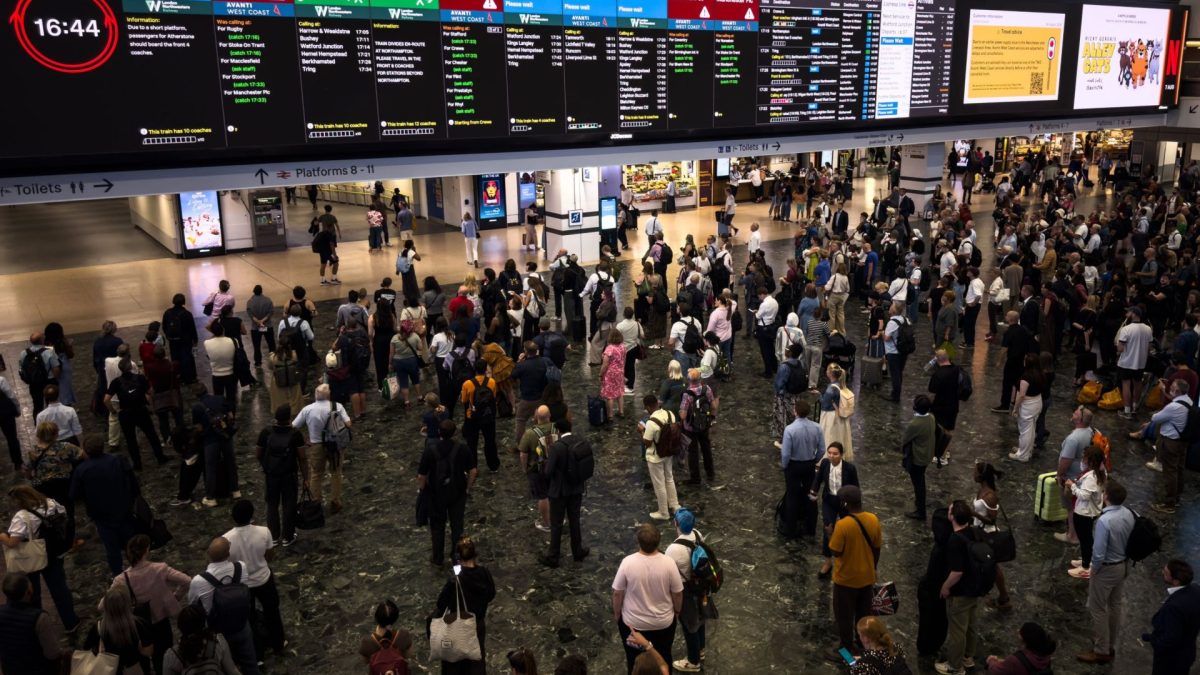
Britain’s rail network is under fire once again as rising delay compensation claims reveal the extent of the disruption facing long-distance passengers. Claims for delayed trains have grown exponentially in recent months, with Avanti West Coast, expected to pay out a staggering £70m in compensation this financial year, The Guardian reported. Over the summer, the operator paid out £20m in compensation and £50m in 2025-26. The latest data from April to July revealed that the number of cancelled trains across the UK network has increased by a third. This comes as it was announced that some of the UK’s busiest train stations, Birmingham New Street and London Paddington, will close for multiple days over the busy Christmas period. There were 3.8 million successful compensation claims between 1 April and 25 July an increase of 55 per cent compared to the 2025 period, figures from the Office for Rail and Road found. The four weeks from the middle of June to the middle of July showed train operators received more compensation claims than in 2025 rising from 877,583 to over 1.2 million this year. Surge in claims Avanti, which runs long-distance journeys connecting London to the West Midlands, Wales and Scotland, had the highest number of delay repay claims in that period, with 287,230 from the end of June to 18 July. The company said it was responsible for 23 per cent of delays that were 15 minutes or more from May to August this year, citing reasons such as infrastructure issues and trespassing as some of the causes. Official figures also showed that fewer than half of Avanti trains ran on time in July. Previous figures showed that only 37.9 per cent of Avanti trains were “on time” in the 2025-26 financial year – the single worst performance of any operator, according to the Office of Rail and Road (ORR), which is responsible for regulating Britain’s railways. Despite its poor performance, experts have warned that the line is crowded and has infrastructure and capacity issues. An Avanti West Coast spokesperson said: “We apologise to customers affected by train delays. A range of factors can impact service performance, and we are working closely with our industry partners to improve punctuality and reliability across the network.” Great Western Railway (GWR), meanwhile, were hit with second highest number of delay repay claims between the end of June to 18 July, with 209,127 claims received. GWR and Avanti are some of the few long-distance operators who pay delays from just 15 minutes. Nationalisation The figures come amid ongoing frustration over ticket pricing. While rail fares were frozen for the first time in 30 years following privatisation, a freeze introduced in 2025 that remains in place until next March, passengers in Britain still face some of the highest costs in Europe. Analysis by the Transport and Environment campaign group found that British rail operators charge more than two times higher than the average cost across the EU for routes of similar lengths. The renationalisation of some of the UK’s rail operators is part of Labour’s plan to make trains cheaper to run and more reliable. Avanti is one of the rail operators that will be brought into public ownership and will be nationalised by March next year. Cross Country, East Midlands Railway and Great Western Railways will also be nationalised, and become Great British Railways. South Western Rail, C2C, Greater Anglia, West Midlands Trains, Govia Thameslink and Chiltern Railways have already been nationalised. But experts have warned nationalisation is not a silver bullet for fixing the rail network. “I don’t think nationalisation can fix and improve the issues that come from that lack of capacity,” William Barter, an independent rail consultant, told The i Paper. “It’s certainly not the magic bullet that solves everything.” Andy Mellors, managing director at Avanti West Coast, said he was “proud” of what the company has achieved over the last six years, including “running more services than ever before”. He added: “Over the coming months, we’ll work closely with the government to ensure a seamless transition into public ownership while remaining focused on delivering for our customers and communities.”
Avanti West Coast’s £70m delay repay boom shows how broken Britain’s trains are
Full Article
Original Source
Read the full article at Inews →KhanList aggregates and links to publicly available news content. We do not host full articles from third-party sources. Always verify important information with original sources.