
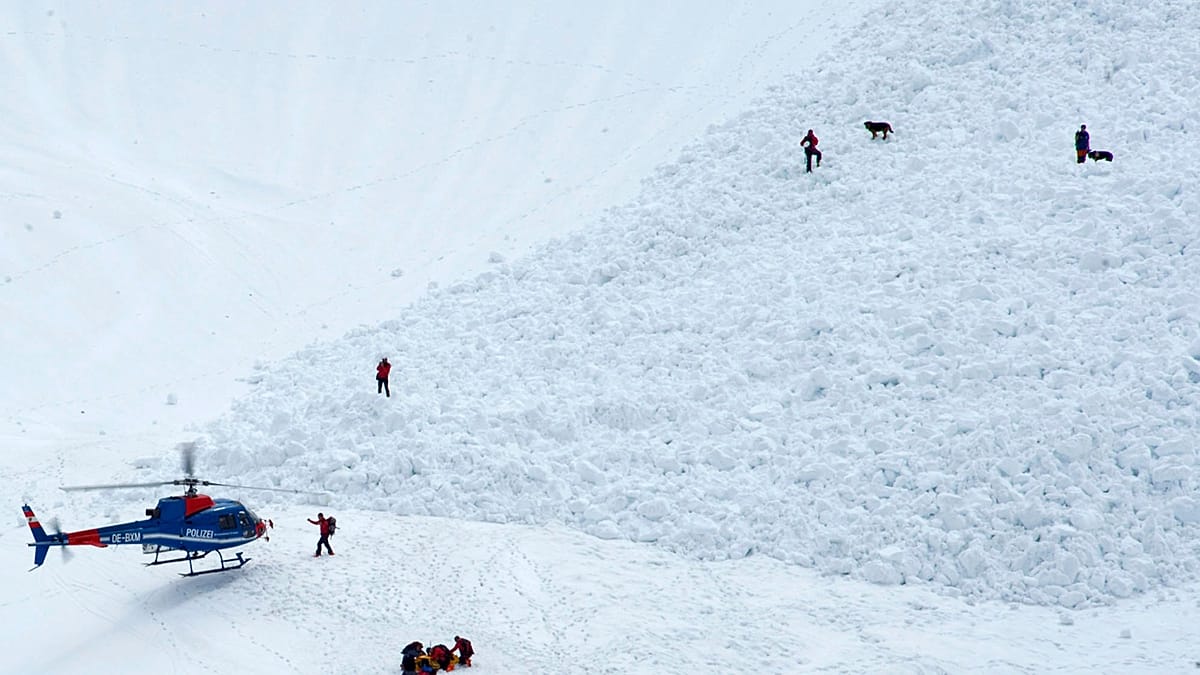
The first ski lifts on Germany’s Zugspitze (source in German) began operating on Friday, officially marking the start of the ski season – and with it, avalanche season. ADVERTISEMENT ADVERTISEMENT Temperatures on the Zugspitze are currently around -7°C, with a monitoring station at an altitude of approximately 2,070 metres recording a snow depth of 47cm. On the nearby Nebelhorn, the snow is already 67cm deep. Older layers of snow and wind can contribute to the formation of unstable layers within the snowpack and accumulations of windblown snow, both of which are among the most common causes of avalanches. "By the time you see an avalanche coming towards you, it is usually too late to react," Thomas Feistl, head of the Bavarian Avalanche Warning Service (source in German), told Euronews. He explained that people often trigger avalanches themselves, making prevention particularly important. Fatal avalanches are often triggered by people skiing, snowboarding or snowshoeing away from marked and secured pistes. The most common type in such cases is known as a slab avalanche. But how does it occur? Throughout the winter, successive layers of snow build up, some compact and others loose and unstable. The weight of a skier can cause a weak layer within the snowpack to collapse, triggering a fracture that rapidly spreads across the slope. Within seconds, a slab of snow breaks away and slides down the mountainside. Avalanche debris is extremely heavy, Feistl explained. Those completely buried beneath the snow are usually unable to move or free themselves. "The forces exerted on the body when someone is caught in an avalanche are enormous. In most cases, you are at the mercy of the avalanche and there is little you can do to save yourself." A skier does not need to displace large amounts of snow to trigger an avalanche. All it takes is for a weak layer within the snowpack to fracture at a vulnerable point. The fracture can spread over hundreds of metres, meaning that, under certain conditions, even someone moving below an unstable slope can trigger an avalanche. What else increases the risk of avalanches? Several factors can increase the risk of avalanches. Heavy snowfall is particularly hazardous, as fresh snow can form unstable layers within the snowpack. Strong winds further increase the danger by carrying snow across the mountainside and depositing it in certain areas, where it can form unstable accumulations known as wind slabs. Slopes with an incline of between 30 and 45 degrees are particularly prone to avalanches. Weak layers of older snow and rapid temperature changes can also undermine the stability of the snowpack, with the latter posing a particular concern over the coming days. At lower and medium altitudes in the Bavarian Alps, snow is currently lying on relatively warm ground, according to the Bavarian Avalanche Warning Service. The base of the snowpack is already moist and is expected to become increasingly so as temperatures rise over the coming days. This could trigger spontaneous glide-snow avalanches on smooth ground, regardless of which direction the slope faces. "How long you can survive beneath the snow depends on how much oxygen is available," Feistl explained. "If your airways become blocked by snow while the avalanche is still moving, you will suffocate within minutes. If you have a larger air pocket, you can survive beneath the snow for several hours." The chances of survival fall rapidly as time passes, making the first 15 minutes after burial particularly critical. A swift rescue response is therefore vital. "Digging yourself out is almost never possible," Feistl said. What makes avalanches particularly treacherous is that a slope can appear perfectly stable even when the underlying snowpack is unstable. Even years of experience in alpine terrain are therefore no guarantee of safety. When an avalanche strikes, "the first few minutes are crucial," Feistl said. "If the buried person and their companions are equipped with avalanche transceivers, probes and shovels, the search should begin immediately." However, those carrying out the search must also consider their own safety. Wherever possible, the emergency services should be alerted immediately to give rescue teams the best chance of reaching the scene in time. Where are avalanche accidents most common? Most avalanche accidents in Germany, Austria and Switzerland occur in the Alps, particularly in high-altitude regions with heavy snowfall and popular ski touring areas away from secured pistes. In Germany, the Allgäu Alps, the Wetterstein mountains and the Berchtesgaden Alps are among the areas most at risk. Austria and Switzerland record considerably more avalanche accidents than Germany, as a much larger proportion of their territory lies within the Alps. In Austria, accidents are particularly common in Tyrol, Vorarlberg and Salzburg, while in Switzerland, the worst-affected regions include the cantons of Valais and Graubünden, as well as the Bernese Oberland. Ultimately, Feistl stressed that prevention and responsible behaviour are key to avoiding avalanche accidents. "Being caught in an avalanche often has fatal consequences. Without standard safety equipment such as an avalanche transceiver, probe and shovel, the chances of being rescued in time are extremely slim."
Avalanche season begins on Germany’s Zugspitze as experts urge swift rescues
Full Article
Original Source
Read the full article at Euronews →KhanList aggregates and links to publicly available news content. We do not host full articles from third-party sources. Always verify important information with original sources.