
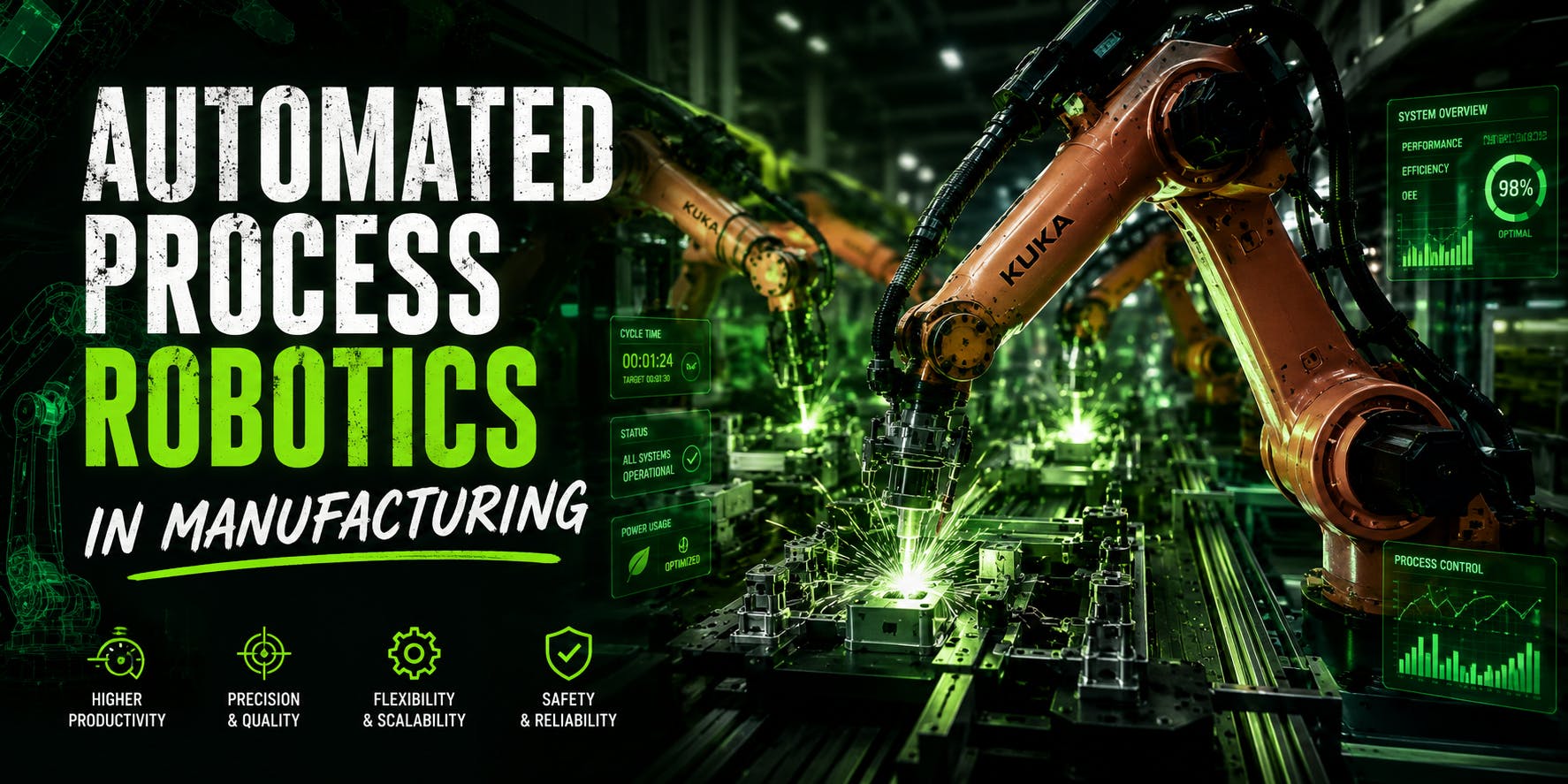
By 2035, industrialized countries that lead in robotics could see factory productivity increase significantly, while the value generated by manufacturing may grow substantially. Even today, automation is changing how factories operate—and recent global crises have made its importance impossible to ignore.Robots do not get sick, take unexpected leave, or need to stop production for a cigarette break. Automated systems can also be monitored and controlled remotely, allowing factories to continue operating when access to the workplace is restricted.** The COVID-19 pandemic accelerated interest in industrial robotics. Companies that had already invested in automation were often better equipped to maintain production, while businesses dependent entirely on manual labor faced shutdowns, staff shortages, and extended downtime. **Robotics in Europe \ I recently looked at how several European countries are using industrial automation and came across a report covering approximately 90 robotics companies in Slovakia. Many of these businesses are systems integrators or equipment distributors. The most common robot manufacturers include well-known names such as ABB, FANUC, and KUKA.** The automotive industry is the leading adopter of robotics in Slovakia, followed by electronics manufacturing. This is not surprising: both industries require high precision, repeatability, and consistent quality. Modern electronics, in particular, often involve components and tolerances that are difficult to handle reliably at scale without automated equipment.** Here are a few examples of industrial automation in practice: Robotics in manufacturing Companies with highly automated production lines are generally more resilient during periods of disruption. The pandemic gave many manufacturers an opportunity to reconsider both the benefits and the risks of introducing robots into their factories. What drives the robotization of manufacturing? Industrial automation is not driven by a single factor. Technology, labor costs, quality requirements, competitiveness, and changing customer expectations all play a role. Lower production costs Depending on the industry and application, robotization can reduce conversion costs and improve production efficiency. Automated systems can operate continuously, reduce waste, and maintain consistent output. In some cases, automation can produce major savings over the lifetime of a production line.Robots are particularly valuable for repetitive, physically demanding, or hazardous operations. Once programmed and properly maintained, they can perform the same task thousands of times with little variation.Higher productivity and competitiveness Robots help manufacturers increase output without necessarily expanding their facilities. They can work at a stable pace for long periods, and their performance is not affected by fatigue or repetitive strain. This gives companies several advantages: - More consistent production - Fewer defects - Shorter cycle times - Reduced material waste - Better workplace safety - Greater ability to compete internationally Automation can also support product personalization. Flexible robotic systems make it easier to produce smaller batches or customize products without completely redesigning the production line. More capable robots Industrial robots are no longer limited to simple, repetitive movements. Advances in mechanics, sensors, software, and artificial intelligence have greatly expanded their capabilities. Modern robotic systems can:- Handle heavy loads - Work with high speed and precision - Adapt to different product sizes - Change tools automatically - Recognize objects and surfaces - Detect defects - Collaborate safely with human workers - Switch between production tasks Collaborative robots, often called *cobots*, are designed to work alongside people rather than operate behind isolated safety barriers. They can assist with tasks such as assembly, packaging, inspection, and machine tending. Machine vision and artificial intelligence Computer vision allows robots to interpret images from cameras and make decisions based on what they see. In manufacturing, this is usually called machine vision: the application of imaging technology to solve practical industrial problems. Machine vision can be used for: - Product assembly - Defect detection - Quality inspection - Packaging verification - Labeling and tracking - Inventory management - Safety monitoring - Scrap identification - Predictive maintenance - Vision-guided robotic movement For example, a vision-guided robot can identify a randomly positioned part, determine its orientation, and pick it up without requiring every component to be placed in exactly the same position.This is especially important for companies producing small batches or frequently changing products. Flexible robots are no longer useful only in massive factories producing millions of identical items. Easier integration Robotics used to require large teams of highly specialized engineers. Although complex systems still require expertise, installation and programming have become much more accessible. Improved networking, simulation software, modular equipment, and intuitive programming interfaces have reduced the time required to deploy many robotic systems. Some robots can be taught by manually guiding them through a movement, using visual programming tools, or demonstrating the desired operation. The result is a shorter path from installation to production. Businesses can begin with one automated workstation and expand gradually instead of replacing an entire factory at once. Modernizing older production lines Many factories are now upgrading equipment that has been operating for 12 to 15 years or more. In highly automated countries, older robots are being replaced with faster, safer, and more flexible models. In less automated regions, companies are often using modernization projects as an opportunity to introduce robotics for the first time.This creates a continuous cycle of improvement. As equipment becomes more affordable and capable, automation becomes realistic for a wider range of manufacturers. **Financial and business considerations \ The cost of developing and manufacturing robots has fallen considerably over the past several decades. At the same time, the return on investment has improved because robots can increase output, reduce waste, and operate for many years. A modernized production line may pay for itself within a few years, depending on:- The cost of the equipment - The number of shifts - Labor costs - Production volume - Maintenance requirements - The value of reduced defects - The cost of downtime - The availability of financing or government support Local integrators can sometimes make automation more affordable by designing systems specifically for the needs of smaller manufacturers. Businesses do not always need to purchase the most expensive solution from an international supplier. A carefully selected, locally supported system may deliver better value. Here is an example of a robotic production system: Rising labor costs and workforce shortages Labor is another important factor. Wages have increased in many countries, while manufacturers are also facing shortages of skilled workers. At the same time, employees are more mobile than they were in the past. Companies can no longer assume that a worker will remain in the same position for decades. Recruiting and training new employees can be expensive, especially for jobs that are repetitive, physically demanding, or performed in difficult environments. Robots can help companies address these challenges by taking over routine tasks while allowing employees to focus on supervision, maintenance, programming, quality control, and problem-solving. However, automation does not eliminate the need for people. It changes the types of skills a factory requires. Successful companies still need technicians, engineers, operators, software specialists, and managers who understand how automated systems work. Human error, safety, and consistency The “human factor” can create unexpected costs through mistakes, injuries, illness, fatigue, and inconsistent performance. Robots can reduce some of these risks, particularly when they are assigned to dangerous or repetitive tasks. They can work in noisy, cold, hot, or otherwise uncomfortable environments, provided the equipment is designed for those conditions. They can also perform highly repetitive operations without losing concentration. That said, robots are not perfect. They can be incorrectly programmed, improperly maintained, or affected by sensor failures and unexpected changes in the production environment. Automation therefore requires proper engineering, safety systems, maintenance, and human oversight. Automation is becoming a necessity Industrial robotics is no longer reserved exclusively for the largest corporations. Smaller manufacturers can also benefit from starting with a focused project, such as: Automated packaging Robotic welding Machine tending Palletizing Quality inspection Pick-and-place operations Automated labeling The best approach is usually to identify one costly, repetitive, or difficult process and automate it first. Once the company understands the technology and measures the results, it can decide whether further investment makes sense.High-quality production is becoming a basic requirement rather than a luxury. Customers expect reliable products, fast delivery, and consistent performance. Robotics can help manufacturers meet those expectations while making their operations more resilient. Here are several more examples of industrial robots in action: The future of manufacturing will not be defined by people versus robots. The most successful factories will combine both: robots handling repetitive and hazardous work, and people providing judgment, creativity, technical expertise, and continuous improvement.
Automated Process Robotics In Manufacturing: From Competitive Advantage to Necessity
Full Article
Original Source
Read the full article at Hackernoon →KhanList aggregates and links to publicly available news content. We do not host full articles from third-party sources. Always verify important information with original sources.