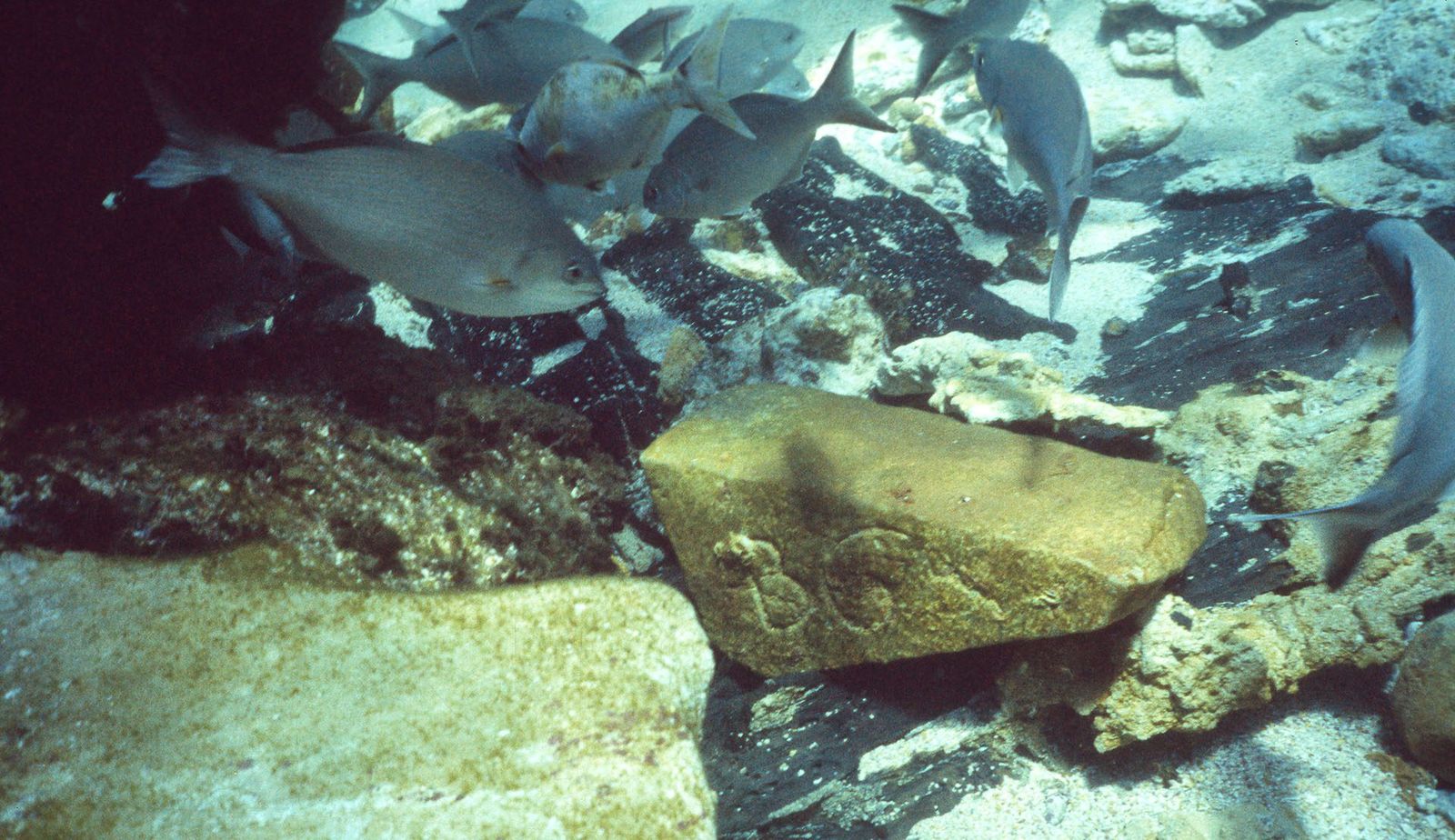
When the Dutch East India Company’s flagship “Batavia” sank in 1629, it went down with large, carved sandstone blocks in its hold. The stones are now shedding light on trade at the dawn of global capitalism The sandstone blocks were photographed at the wreck site in the 1970s. Western Australian Museum In 1629, the Batavia wrecked in the Houtman Abrolhos Islands off western Australia, setting off a horrifying chain of events that included mutiny, murder and slavery. But along with its 341 passengers and crew, the Dutch East India Company flagship was also transporting massive prefabricated sandstone blocks, bricks and other building materials when it sank—cargo that is now providing new insights into trade at the dawn of global capitalism. A new study, published July 29 in the Journal of Archaeological Science: Reports, finds that the sandstone aboard the Batavia was quarried from several areas in what is now Germany. After sourcing the stones from different places, the Dutch East India Company brought them together and shipped them halfway around the globe in what researchers describe as a “surprisingly sophisticated” 17th-century supply chain. The findings illustrate the “logistical complexity” of the Dutch East India Company’s operations, shedding new light on how the company sourced, consolidated and transported building materials across vast distances to “support colonial infrastructure,” lead author Anthony Clarke, an Earth and planetary scientist at Curtin University, says in a statement. Ancient shipwreck cargo reveals surprising global trade secrets of the 1600s The Batavia embarked on its maiden voyage on October 29, 1628, sailing as part of a larger fleet from the Netherlands to Batavia, the Dutch colonial capital in the East Indies (now Jakarta, Indonesia). When the three-masted ship struck a reef at full speed in the early hours of June 4, 1629, it went down with large, carved sandstone blocks in its hold. They were likely destined for the construction of a gateway or portico in Batavia, but never made it there. For years, scientists have been curious about the stones aboard the Batavia, some of which are now housed at the Western Australian Museum. More specifically, they’ve wondered where the stone came from, and whether it was sourced from one quarry or several. Historical records and visual inspections alone couldn’t solve the mystery, so researchers instead went looking for answers in tiny zircon crystals preserved inside the stones. These durable, microscopic mineral grains act as a geological fingerprint of sorts, shedding light on when and where rocks formed. Though the Batavia’s sandstone blocks look nearly identical, their zircon crystals told a more complete story, revealing they had come from at least two quarries in Germany—likely Bentheim and Obernkirchen, which are nearly 90 miles apart. The stones were transported to a Dutch East India Company hub—probably Amsterdam—where they were prepared and assembled into a single shipment bound for Batavia. “No surviving document records this precise journey,” Clarke and Chris Kirkland, a study co-author and geologist at Curtin University, write in the Conversation. “But geology exposes a sophisticated and coordinated supply chain linking quarry workers, stone cutters, river transporters, merchants and sailors across northwest Europe.”Discovered in 1963, the Batavia may be “the most notable shipwreck in Australian history,” as Kieran Hosty, a curator at the Australian National Maritime Museum, told National Geographic’s Tom Metcalfe in 2023. “It’s an incredible story of bloodshed.” After the vessel ran aground on Morning Reef, roughly 300 survivors made it to nearby islands, per National Geographic. Worried about the lack of fresh water, the vessel’s commander, Francisco Pelsaert, headed off in a longboat with 40 sailors and ship’s officers to get help. Meanwhile, a junior officer named Jeronimus Cornelisz—who had already been plotting a mutiny before the ship struck the reef—took advantage of Pelsaert’s absence and assumed control of the remaining group. For five months, Cornelisz and his accomplices terrorized the surviving men, women and children, murdering many, raping and enslaving others, and sending some away to nearby islands. It took Pelsaert and his crew about a month, but eventually they rowed the longboat all the way to Batavia, some 1,860 miles away. Seven weeks later, a rescue ship arrived and put a stop to the massacre. Cornelisz and six of his mutinous followers were hanged on Long Island in October 1629, while other mutineers were taken to Batavia to be executed. Two men were abandoned on the Australian mainland. Last year, however, new research proposed an alternative explanation for this gruesome sequence of events. Rather than “premeditated mutiny,” cultural psychologist Jaco Koehler wrote in an article published by the International Journal of Maritime History, “famine and water scarcity served as catalysts for mass murder” after the Batavia wrecked. In response to the famine hypothesis and research, Wendy van Duivenvoorde, professor of maritime archaeology at Flinders University, told the Guardian’s Tory Shepherd: “It’s interesting, it has a lot of interesting new things in it, but I’m not convinced.” The Batavia shipwreck and its related sites have been thoroughly investigated over the last six decades. But as new research continues to illustrate, “the famous ship is still revealing new stories,” Corioli Souter, an archaeologist and curator who leads the maritime heritage department of the Western Australian Museum and a co-author of the new study on zircon crystals, says in the statement. You Might Also Like Get the latest stories in your inbox every weekday. More about: Archaeology Australia Crime Geology History Murder Netherlands New Research Ships Shipwrecks Slavery Trade
Australia’s Most Notorious Shipwreck Tells a Story of Murder, Slavery, Mutiny—and, Now, ‘Surprisingly Sophisticated’ Trade in the 17th Century
Full Article
Original Source
Read the full article at Smithsonianmag →KhanList aggregates and links to publicly available news content. We do not host full articles from third-party sources. Always verify important information with original sources.