
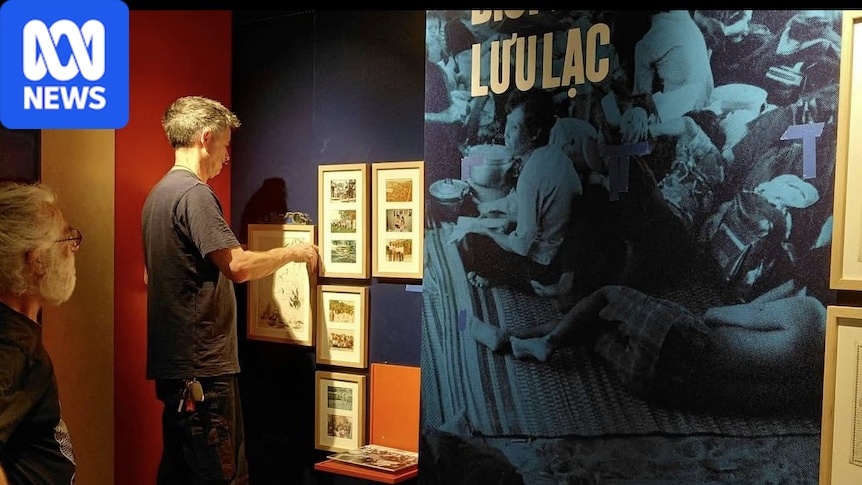
Before the days of bánh mì takeaways and discount flight holidays, to most Australians Vietnam was known only for the horrors of conflict and conscription.That was to change with the end of the Vietnam War.Thousands of Vietnamese refugees made the perilous journey to Australia in the mid-1970s, saying an abrupt goodbye to Saigon and an apprehensive hello to Melbourne's Sunshine and St Albans or Sydney's Cabramatta and Canley Vale.Tammy Nguyen's parents escaped Vietnam on a perilous six-day, seven-night boat journey. (Supplied)Five decades on, refugee beginnings and generational achievement were recognised with the opening of the nation's first museum dedicated to Vietnamese-Australian history.Constructed on a council car park in Sunshine, the unveiling of Vietnamese Museum Australia marked the culmination of a decade-long campaign to establish a permanent monument to the community's pioneering generation.The parents of the museum's chief executive, Tammy Nguyen, escaped Vietnam on a perilous six-day, seven-night boat journey."There are more than 350,000 people of Vietnamese-origin living in Australia and everyone has their own unique story to tell," Ms Nguyen said."This museum is a living monument to all those who courageously left their homeland behind — often as refugees on overcrowded and unseaworthy boats — seeking freedom and a better future."The project has received bipartisan support, with Victorian Premier Ben Carroll officially opening the centre on Saturday alongside MPs from across the political divide.Both the federal and Victorian governments contributed millions to the project, alongside grassroots community contributions.The Vietnamese-Australian community worked for more than a decade to establish the museum. (Supplied)Liberal MP Trung Luu, who represents the Western Metropolitan Region in the state's upper house, said the museum's opening was a significant day for the Vietnamese community."As someone who came to Australia as a refugee from Vietnam, today is deeply personal for me," he said."This museum honours the courage of every family who made that journey."Lan Anh Hoang says racial anxieties lingered due to the legacy of the White Australia policy. (Supplied)University of Melbourne development studies professor Lan Anh Hoang said public attitudes towards Vietnamese refugees in the 1970s and 1980s were mixed as the nation adjusted to life post-White Australia policy."In the immediate aftermath of the fall of Saigon, there was a great deal of sympathy and compassion, particularly because of Australia's own involvement in the war," she said."But as boat arrivals continued towards the end of the 1970s, concerns grew about uncontrolled migration, and the legacy of the White Australia policy meant that racial anxieties still lingered."Professor Hoang said Vietnamese migrants to Australia who relocate in 2026 find themselves in a more welcoming environment.But she added that they also tended to be more educated or skilled, with better English proficiency than the refugees who came in the 1970s."Many describe the kindness and generous support of churches and community organisations (in the 1970s)," she said."At the same time, Vietnamese families and their children faced more than their fair share of racism in the community and at school. "It was not easy to be a Vietnamese kid growing up in Australia at that time."Flashback: Members of the Vietnamese community pay their respects to Malcolm Fraser at the former prime minister's 2015 funeral. (ABC News: Clement Paligaru)University of Technology Sydney sociology professor Andrew Jakubowicz said the mid-1970s intake of Vietnamese-Australians under the Fraser Government was the first real test of the post-White Australia policy consensus.Malcolm Fraser became a champion of the Vietnamese-Australian diaspora and members of the community paid tribute to the ex-PM at his 2015 funeral."(Vietnamese-Australians) were admitted as the first big group of refugees from a group that had almost no prior presence," Professor Jakubowicz said."Initially, most were Catholic southerners and pro-Saigon. Their actual travel to Australia was traumatic — they were the first modern boat people."They arrived in the shadow of the end of White Australia into a country that was trepidatiously ready to accept Asians. "Before then, most Asians admitted after 1967 were English-speaking professionals."
Australia's first Vietnamese heritage museum opens in Melbourne
Full Article
Original Source
Read the full article at Abc →KhanList aggregates and links to publicly available news content. We do not host full articles from third-party sources. Always verify important information with original sources.