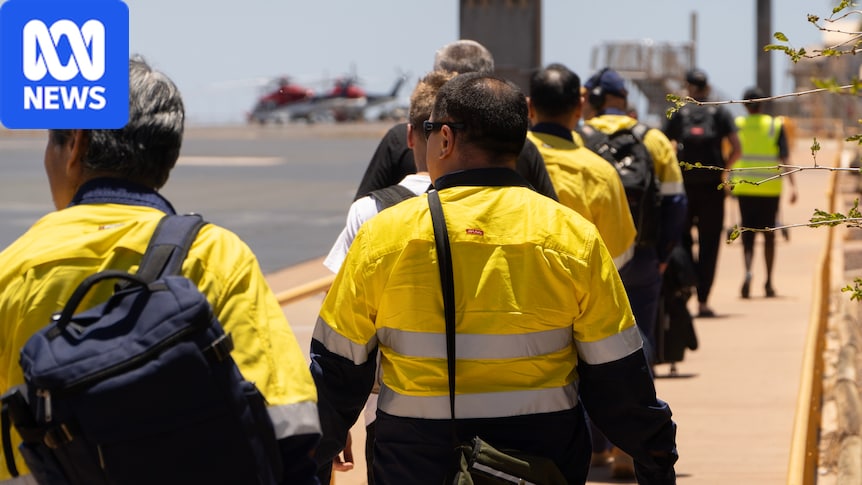
As households across Australia begin filling out their forms for the 2026 Census, mining communities fear the count will fail to capture the nation's growing fly-in fly-out (FIFO) workforce.The historic mining city of Kalgoorlie-Boulder, about 600 kilometres east of Perth, is experiencing one of the biggest booms in its history.An aerial view of Kalgoorlie's Super Pit gold mine. (ABC Goldfields: Ivo Da Silva)The rise in FIFO work practices has been so dramatic that Kalgoorlie-Boulder Airport is now among the busiest in regional WA, with more than half a million passenger movements.Mayor Glenn Wilson has made regular use of the airport travelling to Canberra to lobby for changes to the Census while casting doubt on the accuracy of previous data. "What we've continually done through lobbying of the ABS (Australian Bureau of Statistics) is to make sure our ghost populations are included," he said. "We have got a baseline population, and then with the mining activities, those populations increase and put added strain on our infrastructure and our services." He chairs the Australian Mining Cities Alliance which counts the City of Broken Hill, City of Karratha, Mount Isa City Council, Isaac Regional Council and the Shire of East Pilbara among its members.Glenn Wilson is concerned "ghost populations" are not being included in the data. (ABC Goldfields: Jarrod Lucas)FIFO boom at airportWhen the first national census was held in 1911, the population of Kalgoorlie and Boulder, then separate towns, was estimated at a combined 19,605. That grew to 29,306 as of the 2021 Census, with 20 per cent of the population employed in gold mining. According to the latest ABS data, Kalgoorlie-Boulder's population was 31,268 at June 30 last year. An aerial view of the Kalgoorlie CBD. (ABC Goldfields: Jarrod Lucas)Mr Wilson estimates there could be as many as 10,000 FIFO workers in Kalgoorlie-Boulder due to the current boom. "We know since the last census there's been more dwellings built in Kalgoorlie-Boulder, there are less rentals available, less houses for sale, so if this data comes back and tells us our population is going south, there is an issue with how the census is done," he said. "Why is it important? Because funding opportunities at a state and federal level rely on up-to-date population figures."An increase in population gives us more opportunity to get more funding. It's as simple as that, because many of the grant mechanisms take your population into account."Passengers line up for security screening at Kalgoorlie-Boulder Airport. (Supplied: Cass Be)Kalgoorlie-Boulder Airport was built for 100,000 passenger movements a year back in the early 1990s. City of Kalgoorlie-Boulder figures show there were 562,710 passenger movements in the 12 months to June 30, eclipsing the previous year's record of 458,876 passengers."Based on the airport figures, I am very optimistic we're going to see a population increase," Mr Wilson said.FIFO workers on the tarmac at Karratha Airport. (ABC News: Cody Fenner)Similar concerns in PilbaraThe FIFO workforce has been a long-term feature of the iron ore heartland of WA's Pilbara, where the 2021 census put the population at 82,000.But Regional Development Australia's Pilbara chief executive Daiva Gillam said infrastructure was struggling to meet the needs of the local and FIFO population."I'm going to give you a real world example," she said."The Shire of East Pilbara in Newman are spending over $50 million of their own money to upgrade the wastewater treatment plant because it can't cope."For every person in Newman that lives there, there are up to three FIFOs all flushing the toilet in the East Pilbara."The infrastructure is not built to cope, but those workers aren't usually counted in the Pilbara as being residents."Newman sits in WA's east Pilbara region. (ABC Pilbara: Charlie McLean)Robert Powell is on a two and one roster, working two weeks in Port Hedland as a grounds person at a camp and spending the week off in Perth.Despite spending more time up north, he will list his Perth home as his primary residence."Home is home, work is work, and it needs to be reflected that way in the census," he said."It's, to me, no different to saying I live in Armadale and work in Welshpool. It's where I live, it's where I want the services provided."He suggested adding more questions to the census would help properly account for the FIFO workforce.Workers leave a FIFO flight at Karratha Airport. (ABC News: Cody Fenner)How are FIFO workers counted?Census spokesperson Emily Walter said FIFO workers were similar to seasonal farm workers who can be a challenging demographic to collect data on. She said the ABS had employed a dedicated team to coordinate with mine sites to enable workers to complete the census in the most accurate way. "The census creates a snapshot at a point in time, like taking a photograph," she said. "FIFO workers are often in a location for several days or weeks at a time, and the concept of a usual residence is one that we use to capture where someone is for more than six months of the year. "If they are spending more than six months of the year at the location where they work, then they need to use that as their usual residence. "That 'usual residence' concept is something that is really important for how we understand the data, and an internationally comparable definition." A matter of 'belonging'Organisational psychiatrist Cheryl Yam said the question ran deeper than data for affected FIFO workers."The question isn't simply 'where do I sleep most nights?' It's more where do I belong?" she said.Cities like Kalgoorlie previously relied on a chiefly residential workforce, but the FIFO population is growing. (ABC News: Erin Parke)"The camp really isn't necessarily home, but it's also more than just a workplace; because it's where they spend much of their day-to-day life."Dr Yam said workers often felt the remote camp was where they stayed and home being where they lived.Officials understand the sentiment, but say the workforce and infrastructure pressures across regional Australia meant every worker needed to be accurately counted.In keeping with that growth theme, Ms Gillam said it was vital for regional areas that every worker was counted. "Nobody wants to say that they live where they work," she said. "But for the purpose of the census only, if you're here for six months, yeah, this is where you live." The census data is scheduled to be released in June 2027.
Australia's 'FIFO ghosts' a growing problem on census night
Full Article
Original Source
Read the full article at Abc →KhanList aggregates and links to publicly available news content. We do not host full articles from third-party sources. Always verify important information with original sources.