
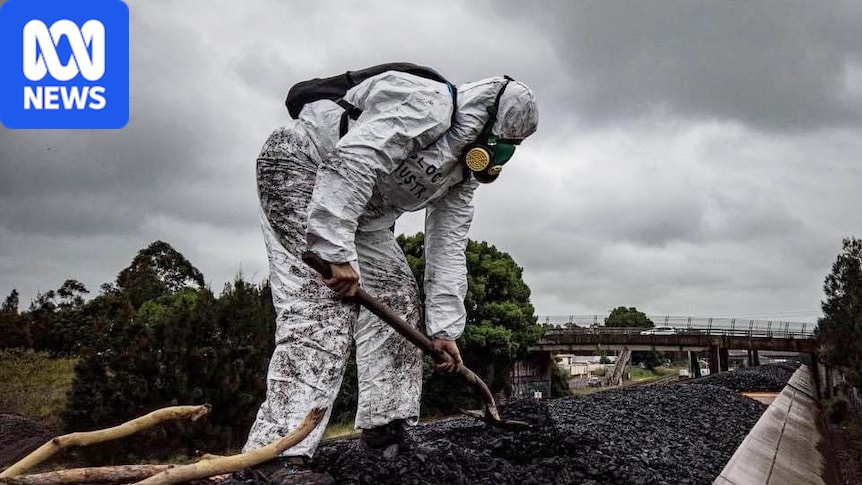
Seven days after a glacier collapse caused devastating floods in Nepal, the United Nations gave a troubling update on global warming.Surface temperatures were on track to exceed the 1.5-degree Celsius increase that scientists had long warned against crossing by 2030.Countries with the greatest responsibility for climate change "should act the fastest," the report's authors wrote, to ensure "those who have contributed least" are not "left to bear its greatest burdens".It was awkward timing for the Australian government.An open-cut coal mine expansion in Queensland's Bowen Basin had just been approved, allowing 55 million more tonnes of coal for export until 2055.The same week, Resources Minister Madeleine King laughed as she turned on the tap that would feed gas fracked from the Beetaloo Basin into the power grid. Madeleine King and NT Chief Minister Lia Finocchiaro "turning the tap on" for gas fracked in Beetaloo Basin. (ABC News: Dane Hirst)Prime Minister Anthony Albanese was in Palau doing his best to spruik Australia's environmental credentials in the Pacific, a region vulnerable to climate change."What do you say to Pacific leaders who see the resources minister opening a new gas project at Beetaloo?" AAP journalist Ben McKay asked the prime minister during a press conference on the island."Today a decision's been made on the BHP Saraji coal mine expansion. They look at you, and they say you are the problem," the journalist said."No, they don't do that," Mr Albanese said. "Australia is highly regarded when it comes to climate change."Anthony Albanese speaks at the 2026 Pacific Island Forum in September. (ABC News: Mark Moore)A hard sell in TürkiyeThis week, that claim will be tested at the highest level, when the most important global climate conference takes place in Türkiye.As Climate Change and Energy Minister Chris Bowen leads the negotiations, Australia will work hard to present itself as the poster child for climate action.The country has a target of reducing emissions 62 to 70 per cent below 2005 levels by 2035, and its latest greenhouse gas inventory has its domestic footprint down by 25 per cent on 2005 levels.Renewables now supply almost half the national energy market and the government hopes that will reach 82 per cent by 2030, through a range of incentives.But setting aside any limitations to the domestic policy framework, there is a glaring problem sitting beyond it that is only getting bigger.Emissions from Australian coal and gas exports have almost doubled since 2005.Calculations from the latest government data show estimated emissions from those exports, when burnt overseas, reached almost 1,200 million tonnes for the 2025-26 financial year, up from 681 million tonnes in 2005.The Climate Council said it had tracked 16 new coal mines or expansions that had been approved in Australia since May 2022, and 11 new gas approvals.Further expansions, including the Hunter Valley Operations coal mine in NSW and the Saraji East coal mine in Queensland, could be approved at the federal level before Christmas.None of this has gone unnoticed by those paying attention, such as Lyric Thomas-Pera, a Sydney-based activist with the Pacific Climate Warriors group.In late October, members of the group attended BHP's AGM to ask a series of uncomfortable questions.Ms Thomas-Pera, who has family members affected by climate change in Fiji, asked board members if they were concerned about BHP's reputational risk in pursuing coal mine expansions while marketing itself as a "future-facing company".Lyric Thomas-Pera (centre) and fellow activists at the BHP annual general meeting. (Supplied: 350.org)Chairman Ross McEwen thanked the 23-year-old for the question and said reputational risks were "absolutely part of the risk assessment … for any of our projects".He also pointed to BHP's "very clear plan" to reduce its carbon footprint by 30 per cent by 2030, "which guides the board too on all of its actions".But this carbon footprint, like Australia's national greenhouse gas inventory, also excludes any downstream emissions produced overseas, including the coal exports from Saraji.BHP's Saraji mine will be able to keep operating until 2055 after it received federal approval in September. (Supplied: Nearmaps)Under the Paris Agreement accounting rules and Australian legislation, these downstream or "Scope 3" emissions are not included in domestic reporting.When the coal that the BHP Mitsubishi Alliance digs up in Queensland combusts offshore, it's someone else's accounting problem.But the logic behind this appears to be unravelling.High court draws lineIn October, the High Court found NSW planning authorities were required to consider the emissions caused by burning fossil fuels overseas when approving projects.The decision was centred on a planning statute and its application in a Hunter Valley mine expansion.It said the idea of "scopes" was merely an "accounting concept", and ultimately "the impact of greenhouse gas emissions is the same, regardless of how they are categorised".The Mount Pleasant coalmine is currently permitted to produce between 10.5 and 12.5 million tonnes of thermal coal per year, primarily for international export. (Supplied: Nearmaps)The High Court found NSW law required authorities to consider "all greenhouse gas emissions [including Scope 3 emissions], and … to consider imposing conditions to minimise, to the greatest extent practicable, those emissions".The decision aligns with cases in the UK and Norway, which found that the environmental impact of a project must consider the full extent of the emissions connected to it.Ralph Regenvanu (left), Special Envoy for Climate Change and Environment for the Republic of Vanuatu, and Arnold Kiel Loughman, Attorney-General for the Republic of Vanuatu, attend the International Court of Justice. (Reuters: Piroschka van de Wouw)London barrister Harj Narulla said Australia needed to be open about its share of responsibility, in tackling climate change.Mr Narulla represented the Solomon Islands in a 2025 International Court of Justice (ICJ) case that found accountability for climate-related harm should rest with fossil-fuel-producing nations at the point of extraction.Harj Narulla acted as counsel for the Solomon Islands in the landmark climate change proceedings before the International Court of Justice. (Supplied: Doughty Street Chambers)"Importantly, the court affirmed the 1.5C target, and also they said that fossil fuel production, consumption subsidies and licensing may be unlawful under international law," he said.Mr Narulla said a resolution at the UN General Assembly in May had strengthened the ICJ advisory opinion."[The ICJ] said that because of its outsized contribution to greenhouse gas emissions, fossil fuel production, consumption, subsidies and licensing may be an internationally wrongful act."Because it basically pushes us over the threshold of 1.5 degrees based on current trajectories."Mr Narulla said Australia's ongoing fossil fuel expansions go "well beyond" keeping the world on track for a 1.5-degree pathway, which puts the country "squarely in the frame for being challenged in terms of our compliance with international law".The world 'needs' fossil fuelsClimate Change and Energy Minister Chris Bowen did not respond directly to the ABC's questions about how Australia's expansion of fossil fuel projects was compatible with its international legal obligations.In a statement, his spokesperson said Australia would try to "build consensus on electrification" at COP31 and work on unlocking climate finance and investment to support the clean energy transition.The summit is focusing on 35 per cent electrification by 2035, aiming to capitalise on the economic pain brought about by soaring fossil fuel costs caused by the war in Iran.Chris Bowen at a gathering in Denmark in May, where climate leaders from 40 countries discussed the COP31 agenda. (Reuters: Ritzau Scanpix/Liselotte Sabroe)Asked about Australia's fossil fuel record on a Guardian podcast this week, Mr Bowen said the "academic conversation" in the public debate around the issue differed from what happened in international negotiations."I've never had a minister say to me, 'Well, we wish you'd stop selling us so much fossil fuels,'" he said."They're in the middle of their transition … trying to get off fossil fuels, but they know they can't do that immediately."They're building renewables, they're building batteries, they're building capacity, but they know it's not going to work overnight, and they need, in the meantime, to use fossil fuels, and they've got to get them from somewhere."Public pressure continuesIn the past week, more than 500 Australian academics signed an open letter to the prime minister, requesting the government "end approvals for new or expanded coal, oil, and gas projects" and create a legally binding transition away from fossil fuels.Mr Albanese has not responded to the letter, but Mr Bowen said in a statement projects were assessed case by case under national environmental law.Lyric Thomas-Pera wants the Australian government to make actions follow words. (ABC News: Berge Breiland)Lyric Thomas-Pera said the Australian government had spoken a lot about the country being "part of the Pacific family"."I feel like this is the time for the Australian government to really show us what being a part of that family is," she said."When you're in a family, you don't let another one down. You don't let them fall behind; you uplift them, you support them, and I believe that that is what the Australian government needs to do for the Pacific."
Australia's export emissions under scrutiny ahead of climate talks
Full Article
Original Source
Read the full article at Abc →KhanList aggregates and links to publicly available news content. We do not host full articles from third-party sources. Always verify important information with original sources.