
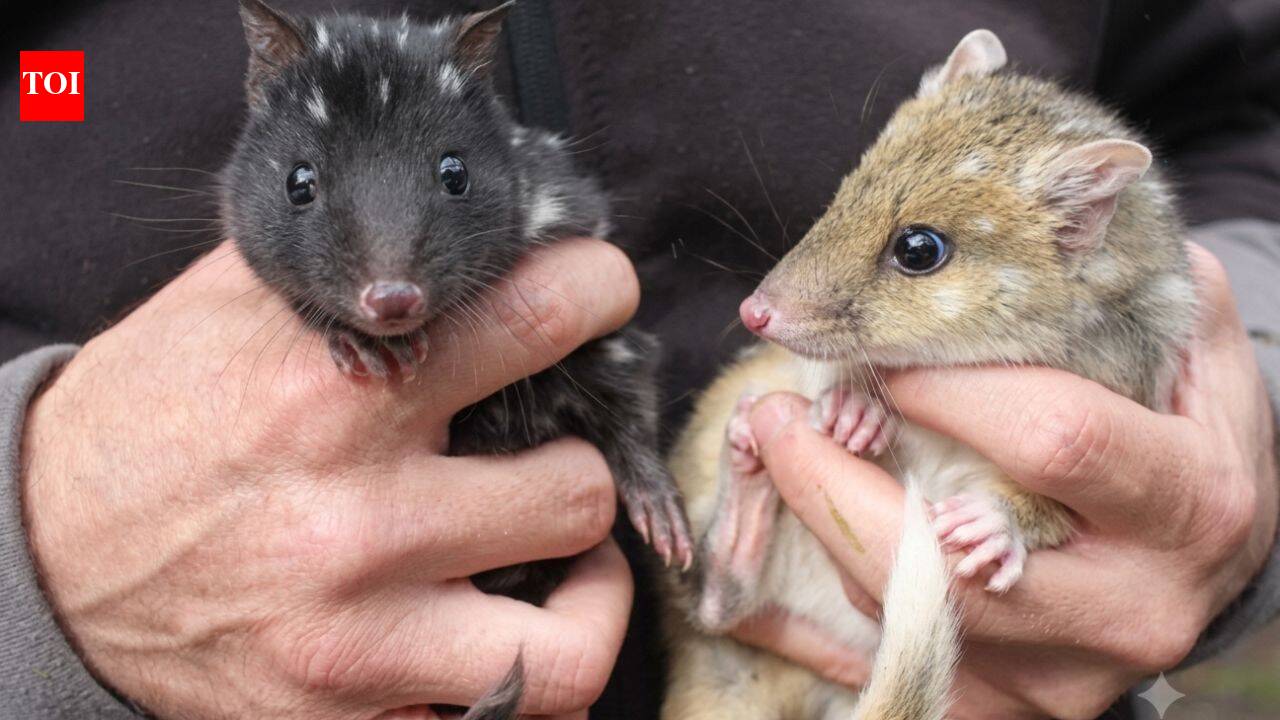
A study released 20 captive-bred eastern quolls at Tasmania’s 6,500-hectare Silver Plains conservation property. (Photo: Booderee NP)The eastern quoll, a small nocturnal marsupial once common across eastern Australia, is showing signs of recovery after years of decline. Captive-bred eastern quolls released in Tasmania have successfully reproduced, with one female carrying six joeys in her pouch.Eastern quolls are considered extinct in the wild on mainland Australia. According to Mongabay, the species disappeared from the mainland by the 1960s after facing several threats, including habitat loss, disease, road accidents and predation by cats, dogs and invasive foxes.Wild eastern quoll populations still survive in Tasmania, where foxes are absent. However, researchers have also recorded a decline in the Tasmanian population. Conservationists are now using captive breeding and rewilding programmes to help strengthen these remaining populations and bring the species back to areas where it has disappeared.The eastern quoll (Dasyurus viverrinus) is a small carnivorous marsupial with a pointed, ferret-like face and a bushy tail. It has two main colour forms- light fawn and blackish-brown, both with white spots across the body. The animal is mainly active at night.How quolls disapperedEastern quolls were once widespread along Australia's eastern coastal fringe. Historical accounts described them as being in 'plague abundance'. Farmers also valued them because they hunted rodents, while some people kept them as pets.The species was sometimes called a 'native cat' in the 1800s because of its size and hunting behaviour, which were similar to those of domestic cats brought to Australia by European settlers.That widespread presence did not last. By the 1960s, the last known eastern quoll population on mainland Australia had disappeared. Several factors contributed to the decline, including disease, loss of habitat, collisions with vehicles and attacks by cats, dogs and invasive foxes.There was a possible sign that some eastern quolls may have survived longer than official records suggested. In 2016, a taxidermied eastern quoll surfaced after reportedly being collected as roadkill in Barrington Tops, northwest of Sydney, in 1989. The specimen had been handed to the National Parks and Wildlife Service almost three decades later.Today, Tasmania remains an important refuge for the species. The island has no invasive fox population, although conservationists are concerned about the impact of cats.Cats remain a threat David Hamilton, a conservation ecologist at the Tasmanian Land Conservancy and an adjunct researcher at the University of Tasmania, is part of a group studying the threats facing eastern quolls.Research published in 2023 found a major decline in eastern quoll numbers across Tasmania. The study used historical wildlife survey data and more recent sightings. It found that populations had declined sharply around 2000 and again in 2009.“Some of the research that has come out over the last decade or so shows this concerning downward trajectory in eastern quolls in Tasmania,” Hamilton said.“There was a steep decline around the start of this century, and that’s continued unabated in some areas, whereas in some others they’ve recovered relatively well,” he told Mongabay. “While the initial declines were strongly linked to climate, we don’t really know why some populations have failed to recover.”Researchers and conservationists from universities, zoos, sanctuaries, non-governmental organisations and captive-breeding facilities are working together to understand the problem.Rob Brewster, rewilding manager for the Invasive Species Council, believes cats are a major contributor to eastern quoll deaths in Tasmania.“We know that some of our quolls that we’ve released in Tasmania as part of that Tasmanian Land Conservancy-University of Tasmania partnership have been killed by cats,” Brewster said. “We can directly implicate cats in the decline of eastern quoll populations in Tasmania.”Captive-breds reproduceConservationists are using 'rewilding' to strengthen eastern quoll populations. The approach has involved several trials. A 2025 study recorded the release of 20 captive-bred adult eastern quolls including 10 males and 10 females at Silver Plains, a 6,500-hectare conservation property owned by the Tasmanian Land Conservancy.Researchers expected the released animals to reproduce. However, genetic testing of juveniles captured in December 2021 and January 2022 showed that none of the released adults from the 2020 group had contributed to the population.“We think that was partly down to the fact that there was a release of adults who hadn’t had any reproductive experience in the wild,” Hamilton said.The researchers then changed their approach. Later releases included both adult and juvenile eastern quolls and took place in areas where populations were struggling to recover.One such site was The Quoin, a 5,000-hectare private conservation property. After an initially slow start, captive-bred quolls released there in 2025 successfully reproduced.One released female now has six joeys in her pouch. The joeys begin developing their white spots at about five weeks of age.After being released into The Quoin, a female eastern quoll has in her pouch six joeys (Tasmanian Land Conservancy photo)Challenges on mainlandThe successful breeding in Tasmania is encouraging, but returning eastern quolls to mainland Australia remains more difficult.In a 2018 pilot programme, organisations led by Parks Australia released 20 eastern quolls into the unfenced Booderee National Park. Within the first three months, 14 were lost, mainly because of fox predation.Liz Gerber, conservation and community engagement manager and eastern quoll project lead at Sydney Zoo, said the animals' natural response to danger can make them vulnerable to introduced predators. “They have a flight or freeze response,” Gerber said. “They often choose freezing.”That behaviour may have helped eastern quolls avoid native predators such as birds of prey, but it is less effective against foxes, dogs and cats.Sydney Zoo began a breeding programme in 2024 to raise eastern quolls for release into fox-free, fenced conservation properties on the mainland. So far, nine eastern quolls have been released, including four joeys released in January 2026 at Bannockburn Rewilding Sanctuary, about 150 kilometres south of Sydney. The long-term goal is to make more fox-free fenced land available for eastern quolls.The species plays a role in the ecosystem by eating insects such as cockroaches and spiders, as well as small mammals including mice and rats. Gerber said eastern quolls also act as scavengers.“They are a really important scavenger in our environment. We have lost that key role in our bushland, the little recycler, the little scavenger that stops the spread of disease; it’s one of those species that we’ve had missing for so long,” she said. “The question is, if we brought something like that back, would we see a change in our environment?” she asked.
Australia's endangered eastern quolls breed again after 60 years off mainland
Full Article
Original Source
Read the full article at Timesofindia →KhanList aggregates and links to publicly available news content. We do not host full articles from third-party sources. Always verify important information with original sources.