
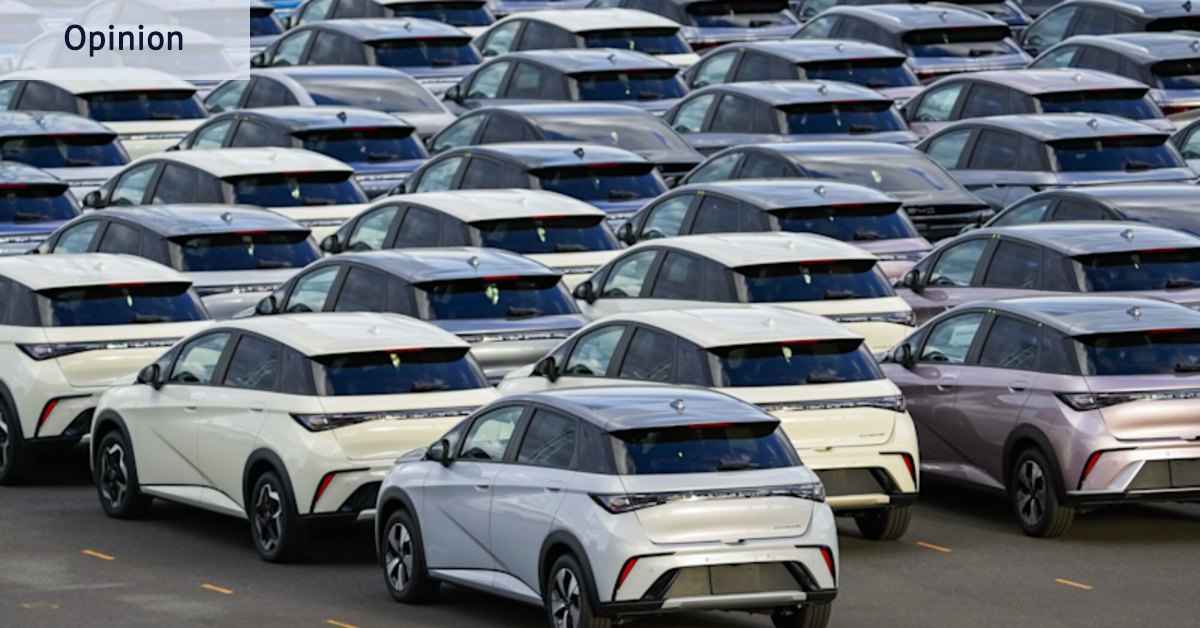
OpinionEconomics WriterUpdated September 4, 2026 — 11:16am,first published September 4, 2026 — 5:00amUpdated September 4, 2026 — 11:16am,first published September 4, 2026 — 5:00amYou can’t blame Australians for seeing fuel prices over the past few months and deciding to ditch their petrol-powered cars.As Reserve Bank governor Michele Bullock pointed out at a recent press conference, petrol prices are one of the most visible — and therefore memorable — prices, with most of us passing a petrol station somewhere on our daily commutes.Electric and hybrid vehicle sales having been revving up the Australian economy as people look for ways to save.BloombergWhile petrol prices have fallen from their peak of about $2.50 a litre in our major cities earlier this year, they’re still hovering at about $2 a litre after the government’s fuel excise discount ended in August. That’s about 20 cents more expensive per litre than the average petrol price across our major cities in 2025.Fuel prices are significant — not just because they make up about 3 per cent of an Australian household’s spending — but because they affect how much it costs for businesses, especially in the transport, farming and aviation sectors, to provide their goods and services.As we know, inflation, or price growth, is still a big challenge for the Reserve Bank (and many of us paying higher prices for everyday items). In the 12 months to July, prices across the economy grew 3.5 per cent — lower than the 3.8 per cent they were growing at in the year to June, but still well above the bank’s target range of 2 to 3 per cent.It’s a rational response for people to look for ways to save money. We know, for example, from the recent earnings season where Australian businesses reported their profits, that customers remain hungry for a bargain.We also know from the most recent “national accounts” — which gives us a snapshot of the economy — that Australians revved up their spending on vehicles across March to June this year. But it wasn’t just splashing cash on any old automotive.“There were record sales of electric and hybrid vehicles as more households looked to lower ongoing operating vehicle costs,” the Australian Bureau of Statistics told us.Greater consciousness about environmental sustainability, growing proof of — and improvements in — the reliability of electric vehicles and their increasing affordability (helped by the government’s subsidy for EV purchases) have gradually been winning over Australian drivers looking to buy a new car.But this year, that trend has ramped up with nearly one in every two vehicles sold across April, May and June in Australia being either electric or hybrid. Data from the Australian Automobile Association shows fully electric vehicles now make up a fifth of new car sales compared to one-eighth six months ago.Basically, as our hip pockets have been squeezed by rising costs — especially the relatively high cost of fuel — Australians have been spending more…so that they can spend less (on things like fuel) in the future.The Reserve Bank could raise interest rates again last year after economic growth and inflation data came in higher than expected.Brent LewinBut like all other spending, our enthusiasm for EVs has an effect on the broader economy.That’s because household spending makes up roughly half of our total economy. That means any change in our overall level of spending tends to have a pretty big effect on the direction of our economy.From March to June, household spending grew 0.4 per cent and contributed to half — or 0.02 percentage points — of the overall growth figure of the economy.While economic growth hasn’t shot the lights out for a while, it has been trundling along at a bit more than 2 per cent annually as of the June quarter. And the most recent 0.4 per cent quarterly figure, while lower than three out of the four quarters before it, did come in slightly stronger than the 0.3 per cent that most economists were expecting.Our love of electric and hybrid vehicles also affects growth in other ways.For example, there was a build-up in “inventories” — goods that businesses have stocked up — when it came to electric and hybrid cars as sellers prepared themselves for continued strong demand for these vehicles.When inventories increase, that technically adds to our economic growth.Of course, since mining is such a huge part of the Australian economy, that build-up in vehicle inventories wasn’t enough to offset a drawdown in inventories in the mining sector. Coal miners in particular, who faced strong demand for exports (partly due to a bounce back from weather disruptions earlier in the year), drew down on coal that they had stocked up to help meet the higher-than-usual demand.This meant inventories, which fell overall, ended up wiping 0.1 percentage points from economic growth.Meanwhile, the effect was reversed when it came to net trade (exports minus imports): another component of economic growth.Coal exports have also helped to fire up Australian economic growth in the three months to June.Oscar ColmanWhile the rise in electric vehicle imports took away from economic growth, the increase in coal exports (and their prices) helped to tip the balance so that net trade contributed 0.1 percentage points to economic growth. This was the first time since the December quarter of 2023 that net trade added, rather than detracted, from growth.There was also a step-up in government spending, including on initiatives such as free public transport, which contributed 0.1 percentage points to growth.Business investment spending, which was a major driver of growth in the March quarter, took a step back from the limelight. While it remained at a relatively high level thanks to construction linked to data centres, there was little change, meaning it didn’t contribute to growth ... at least not immediately.The uptake of electric and hybrid vehicles is a clear example of Australians trying to save money. After all, they will be able to reduce or completely wipe out their exposure to fuel prices, instead relying more heavily on electricity.While electricity prices can also fluctuate, uptake of solar and renewable energy generation has put many Australian households in a better position when it comes to energy costs. In 2025, Australia led the world in per-person household solar, with more than four million homes — or one in three — equipped with solar panels.That means, especially over the longer term, electric and hybrid vehicles should be deflationary: that is, they should help to put downward pressure on energy prices as demand for petrol drops and electricity demands are met using lower-cost solar power.Crucially, it will also help to act as a buffer against global economic shocks we can’t control (such as the most recent surge in oil prices which came about as a result of the Iran war).But in the short term, the slightly higher-than-expected economic growth and higher-than-expected inflation figures might put the Reserve Bank on edge.Of course, as the bank often says, one set of numbers isn’t something to be too spooked by – and we have seen unemployment start to rise: a sign of capacity in the economy coming under less pressure. It’s also worth remembering that a lot of this data, especially the economic growth figures, come in with a lag: where we are now might be quite different to where we were a month – or several months – ago.But if demand, especially household spending, keeps coming in stronger than expected, and our productivity (how much we can make or provide for a given amount of resources) doesn’t improve, we might end up, at least in the short term, with higher prices and interest rates.Our enthusiasm for electric and hybrid vehicle purchases is driving economic growth forward, but to see the costs pay off – individually and for the broader economy – we may have to look further down the road.The Business Briefing newsletter delivers major stories, exclusive coverage and expert opinion. Sign up to get it every weekday morning.Millie Muroi is the economics writer at The Sydney Morning Herald and The Age covering workplace and economics. She was formerly an economics correspondent based in Canberra’s Press Gallery and the banking writer based in Sydney.Connect via X or email.From our partners
Australians are flocking to electric vehicles. There’s a hidden cost
Full Article
Original Source
Read the full article at Smh →KhanList aggregates and links to publicly available news content. We do not host full articles from third-party sources. Always verify important information with original sources.