
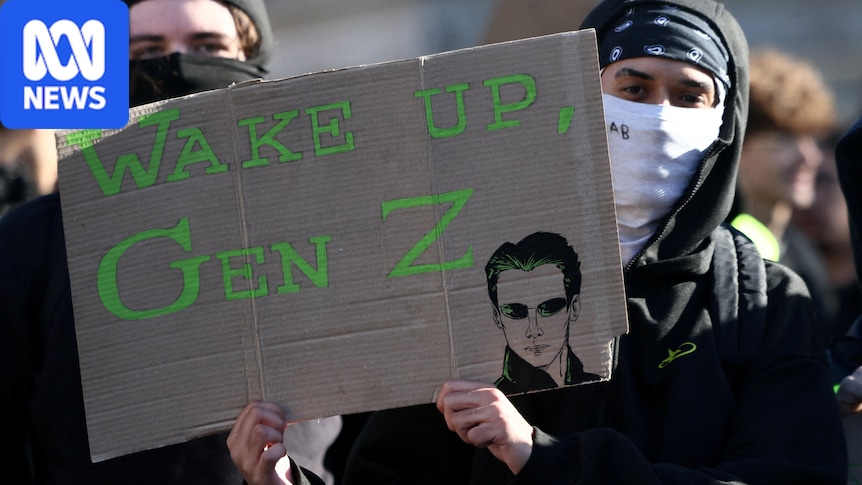
Many are too young to vote, but students around the world are changing the political landscape.In France, protests over underfunded public schools spiralled into weeks of violent unrest, igniting a wider wave of youth-led demonstrations across Europe.In Serbia, students cycled around the continent and ran ultramarathons to draw attention to a campaign that ended the 14-year rule of the government.And in Brazil, millions of young people mobilised online, helping thwart the far-right's return to power in a fiercely contested election.Now, Australian students are taking their frustrations to the streets, amid what researchers describe as a "resurgence" of activism among gen Z — those currently aged 14 to 29.Youth-led movements in Serbia, France and Brazil have emerged as a potent political force. (ABC News; Reuters)On Thursday afternoon, students across several Australian cities are expected to walk out of classrooms to protest Pauline Hanson's One Nation party and its policies.For 18-year-old Victorian student Odessa Bishop-McMurray, the action is about pushing back against what she sees as the "normalisation" of far-right politics in Australia.Odessa Bishop-McMurray is one of the organisers of the student walkouts. (Supplied)"Pauline Hanson is coming for the rights of immigrants, women and trans people … high schoolers have a responsibility to take this task upon ourselves," she says."We want to see racist, fascist politics completely de-legitimised in society."Odessa is a member of the High School Anti-Capitalists, one of the groups organising the walkouts.She says housing unaffordability, insecure work, climate change, the cost of living and the conflict in Gaza are also among the issues driving students to mobilise."As a young person, it is not difficult to see that the future we're facing is incredibly dire."Meanwhile, politicians are putting fossil fuel companies and profits over the live-ability of the planet."The November action follows similar student walkouts in August, which Odessa estimates attracted 15,000 participants around Australia.Victorian high school students walked out of school in August to protest One Nation. (ABC News)Organisers are hoping to build on the momentum of student movements overseas, with footage of protests in France and Serbia circulating on social media feeds.They expect today's action will draw an even larger crowd than in August, although the final turnout remains to be seen.For 16-year-old David Ye, another student involved in organising the walkouts, student-led campaigns overseas have been a source of inspiration.David Ye speaks at a rally against Pauline Hanson's One Nation. (Supplied)"Every time the French protests come on the news, it sends shock waves of hope throughout our group that we can grow and we can win," he says.David says students are also drawing connections between demands for better learning conditions and wider inequalities, such as racism and sexism."It's great that students are recognising the interconnectedness between all of these issues and taking up those fights themselves," he says."Young people are totally capable of thinking critically, participating in politics, and fighting for the future because, after all, it is our future."The One Nation party office has been contacted for comment.A 'global political awakening'Across countries with very different political systems, young protesters are voicing some remarkably similar frustrations.In Paris, student protester Hippolyte Barbry sees a generation increasingly disillusioned with the political status quo."We do see similar issues at play, notably the defence of democracy and the sovereignty of the people in the face of either authoritarianism or the insularity of a ruling elite," he says."There is a growing sense of frustration with the current system … sometimes I even wonder whether this might spread to even more countries."Harvard-affiliated researchers Erica Chenoweth and Matthew Cebul have noticed a similar pattern in youth-led movements around the world. "Gen Z may be experiencing a global political awakening," they wrote in a recent essay.They identify economic precarity, high youth unemployment, and the exclusion of younger generations from political power as commonalities behind the recent wave of gen Z-led protests.But they argue corruption and greed are often the deeper grievances."Young people are furious with political elites, who shamelessly reap the spoils of opulent privilege while their countries suffer," they write.French student protests over underfunded public schools helped ignite a wider wave of youth-led demonstrations across Europe. (Reuters: Stephane Mahe)The scale of youth-led activism is reflected in data from the Carnegie Endowment for International Peace, which recorded 17 significant anti-government protests led by young people in 2024 and another 12 in 2025.In Australia, recent research from the Institute of Family Studies found that 41 per cent of young people surveyed had expressed views about government actions in the previous five years. Among this group, 31 per cent said they had taken part in a protest or demonstration.Yet only 11 per cent of Australian youth believe they have a meaningful say in government decisions.Eve Mayes, a sociologist of youth and education at Deakin University, says the current "resurgence" builds on a longer history of youth activism, including the global school strikes for climate in 2018 and 2019.But she says one feature of more recent activism is the way young people are connecting struggles that might once have been treated separately."They're expressing themselves in collective ways and online, through digital networks of influence to connect up issues."After learning about Australia's planned walkouts, Hippolyte says he sees parallels with the movement in France."Clearly, young people in Australia categorically refuse to have a party in power that would promote discrimination," he says."And for that alone, well done to them."Growing 'scepticism' of big techDr Mayes says social media can foster what earlier researchers described as "underground networks of outrage and hope", allowing people with shared concerns to find one another and build connections.But she says young activists are also becoming more alert to the power of technology companies to shape what they see and how they understand the world.There is, she says, "a bit more of a scepticism and a critical attention to the role of big tech".Some organising may even be moving away from digital platforms and towards "more low-tech modes of organising", including street protests.But that does not mean young people are united by a single political outlook.Young people are connecting struggles that might once have been treated separately. (Reuters: Christian Mang)Dr Mayes cautions against treating gen Z as a homogeneous group, pointing to the different social circumstances and online environments shaping their views."There might be some young people who are navigating algorithms that channel them towards ethno-nationalist political explanations," she says.While some young people see inequality and insecurity as reasons to challenge existing power structures, she says others may be drawn to explanations that blame migrants or other marginalised groups.That divide is something David says he sees among his own peers."Even among students, it is quite uneven," he says."The rise of the manosphere, for instance, which is heavily dominated by aspects of far-right politics, has definitely permeated the minds of many of my peers."For David, that influence is alarming, but it reinforces why he believes young people need to organise and challenge those ideas.For Hippolyte, the process of asserting their collective rights is important in itself. "Through this movement, young people are learning to organise themselves and that is essential."And for Odessa, the ultimate goal is more ambitious."We want a new world. We want the future to be better for us, and we're going to take that into our own hands."
Australian students joining global wave of youth activism
Full Article
Original Source
Read the full article at Abc →KhanList aggregates and links to publicly available news content. We do not host full articles from third-party sources. Always verify important information with original sources.