
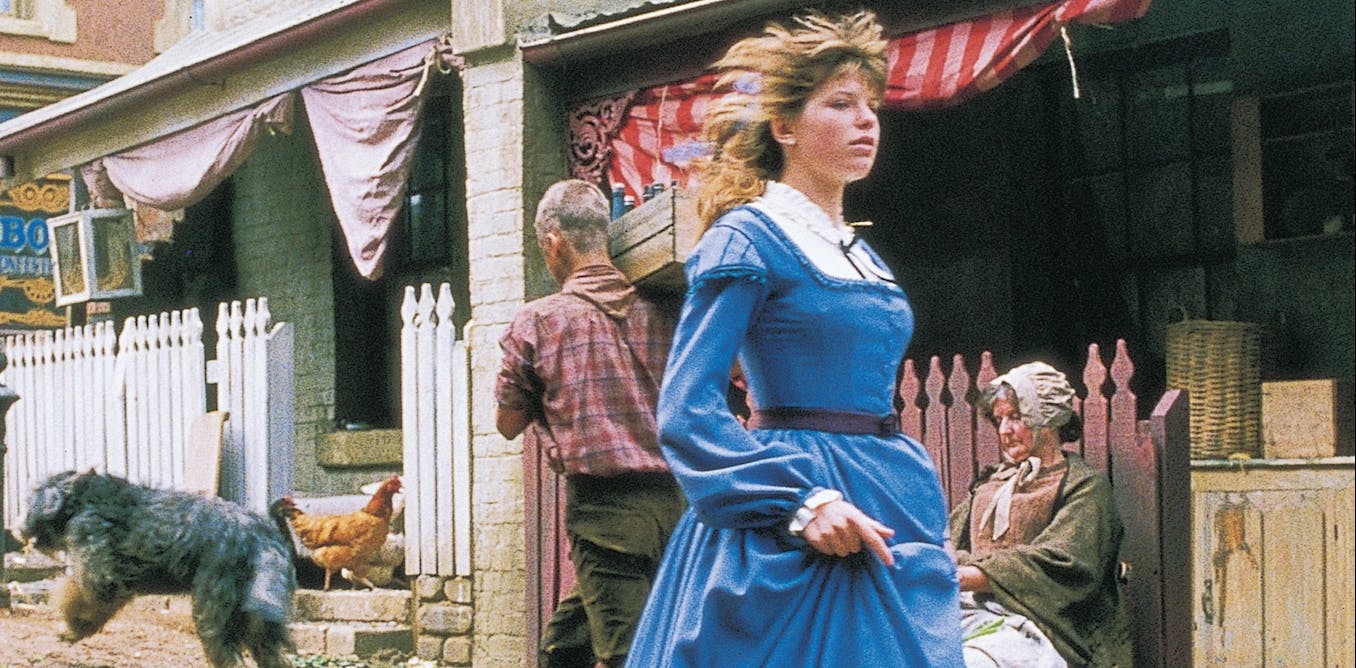
My copy of Ruth Park’s Playing Beatie Bow was given to me by my mother in 1982, when I was 14 – the same age as the novel’s protagonist, Abigail Kirk. A sticker inside shows that my mother bought it at the Feminist Bookshop in Balmain, a shop I remember visiting with her more than once. The shop is long gone, and the Sydney where my mother bought the book has constantly been altered. “In the first place, Abigail Kirk was not Abigail at all” is the novel’s striking opening sentence. Immediately, Park gives us a girl who feels out of place. It turns out she is not at home in her name or her family. Soon, her home city of Sydney will become strange to her too. Almost half a century after its first publication in 1980, Playing Beatie Bow (also a 1986 film) has never gone away. It remains in print, with a new hardback edition appearing next month in Penguin’s Modern Australian Classics series. It is an Australian children’s classic whose great subject is time. The books we read as children can shape us forever – as readers and people. In this series, we asked experts to reflect on some of Australia’s most beloved children’s classics, spanning the 19th century to the new millennium. A time-slip novel Playing Beatie Bow is a time-slip novel: it takes a girl living in Sydney in 1980 and makes the city’s past a physical reality to her. Time operates here at several scales. Abigail is 14, poised between childhood and adulthood; the Sydney she inhabits, including The Rocks, is being remade. At the novel’s opening, Abigail is already caught between past and future. Her father, Weyland Kirk, has left the family for another woman. Angry at his departure, Abigail rejects Lynette, the name by which he knew her, and renames herself Abigail – a name associated with witches, fictional and historical. She and her mother live in a high-rise designed by her father’s architectural firm, a “glistening spike of steel and glass” rising among the “tiny meek cottages and old bond stores” of The Rocks. When Abigail learns that her parents plan to reunite, she is appalled. How could a woman as capable and independent as her mother allow herself to be treated like a “worn-out glove”? Abigail is “outraged” that she could be “so … so – female”. It is at this moment that she is transported into another moment in the life of her city. Abigail and and her mother live in a ‘glistening spike of steel and glass’ among the ‘tiny meek cottages and old bond stores’ of The Rocks. City of Sydney The way into the past has itself travelled through time. Abigail watches children playing an old game called Beatie Bow, circling a girl chosen by a counting-out rhyme: Oh, Mudda, what’s that, what can it be? The wind in the chimney, that’s all, that’s all. The past also survives as an object. Abigail finds a discarded yoke from an old garment, its embroidered flowers faded almost beyond recognition, and sews it onto a bottle-green dress. Wearing it, she follows the strange child who has been watching the game – and finds herself in The Rocks in 1873. There she meets Beatie and the Bows and Talliskers, immigrants from the Orkney Islands, who take her in. The living Rocks she encounters is recognisable, but utterly strange, a working community where sickness and death remain close at hand. Sydney history made strange Park had already immersed herself in Sydney’s history, most notably in her magisterial The Companion Guide to Sydney (1973). Another past comes into view in its opening chapter. Among the female convicts aboard the Lady Penrhyn was a “thirteen year old”; the women were “milliners, lace-weavers, stay-makers, glove-makers, barrow women and servants”. From the ship’s rails, they saw Sydney’s “low hills”, “tawny blonde with summer”. Park also describes “a thirty-foot depth of bleached white shells left behind after thousands of years of Aboriginal picnics on this bountiful shore” – a shell midden, though she does not call it one. The sentence briefly opens a much deeper measure of Sydney time. Wikipedia In Playing Beatie Bow, Park makes the city’s history strange again, seen through the eyes of a girl who has pursued another girl into the past. Almost immediately, readers saw that Playing Beatie Bow looked both ways in time. The novel won the Children’s Book Council of Australia’s Book of the Year Award in 1981, followed by the US Boston Globe–Horn Book Award for Fiction in 1982. The Australian judges praised Park’s recreation of “the sights, sounds and smells” of The Rocks in 1873, but historical reconstruction was not an end in itself. They singled out her use of the past “to foreshadow and illuminate the present and future” – a striking description of a novel in which time is never simply a matter of then and now. ‘You can’t write down to kids’ Park also trusted the imaginative capacities of young readers. She was writing at a moment when “young adult” was becoming a new publishing category, whose possibilities intrigued her. In journals, letters and interviews, she repeatedly stated that children’s writers should write for children, not to impress other children’s writers. “You can’t write down to kids,” she said after winning the award. “Kids have an intuitive feeling about motivation. They can always detect insincerity.” That principle is at the heart of Playing Beatie Bow. Park asks Abigail – and her readers – to imagine themselves elsewhere. In 1873, Abigail falls in love with Beatie’s older brother Judah Bow, only to discover that he is promised to Dovey Tallisker, his cousin and a member of the Bow household. Abigail, who had condemned her father for desiring another woman and her mother for taking him back, now finds herself in the place of the one who wants what she cannot have. Ruth Park watched the gentrification of the working-class Sydney neighbourhoods she wrote about. State Library NSW Time travel has displaced her in more ways than one. The Sydney to which she will return is itself changing. Park had been writing about that city since The Harp in the South (1948), her famous novel of working-class Surry Hills, and had watched its inner neighbourhoods change around her. By the late 1970s, The Rocks was undergoing redevelopment and gentrification, as buildings were demolished, preserved or restored and the colonial precinct was remade as heritage. Park makes that transformation visible from the opening pages, with Abigail’s “glistening spike of steel and glass” among the old cottages and bond stores. In the decade leading to the bicentenary of 1988, when Australians were reflecting on how the past should be remembered, Playing Beatie Bow offered its own answer. History of ordinary lives As in The Companion Guide, with its oysters, mussels and Aboriginal picnics, Park looks for the past in what lies close to hand. History resides not only in restored buildings and official commemorations, but in games, stories and ordinary things. At one point, Abigail understands why her mother’s secondhand shop contains no working-class Victorian clothes: they had been “worn out by unceasing labour a hundred years before.” The past survives unevenly. Some lives leave fewer things behind. Such attention to what survives — and what is easily overlooked – is one reason the novel still speaks to readers. Park brings the working-class and immigrant Rocks vividly into view: the Bows and Talliskers, Chinese workers, sailors and “high-steppers” or prostitutes. Her history is crowded with ordinary lives, vivid precisely where the record grows faint. Sometimes, as with those 30 feet of shells marking thousands of years before European settlement, what remains measures time differently. What remains as people, families and cities change? The novel asks how objects can carry one time into another. Which brings me back to the book my mother bought at that bookshop in Balmain. In 1982, it was an almost new book about a girl my own age travelling into Sydney’s past. Forty-four years later, the book carries its own past.
Australian children’s classics: Playing Beatie Bow is a time-slip novel that makes Sydney strange
Full Article
Original Source
Read the full article at Theconversation →KhanList aggregates and links to publicly available news content. We do not host full articles from third-party sources. Always verify important information with original sources.