
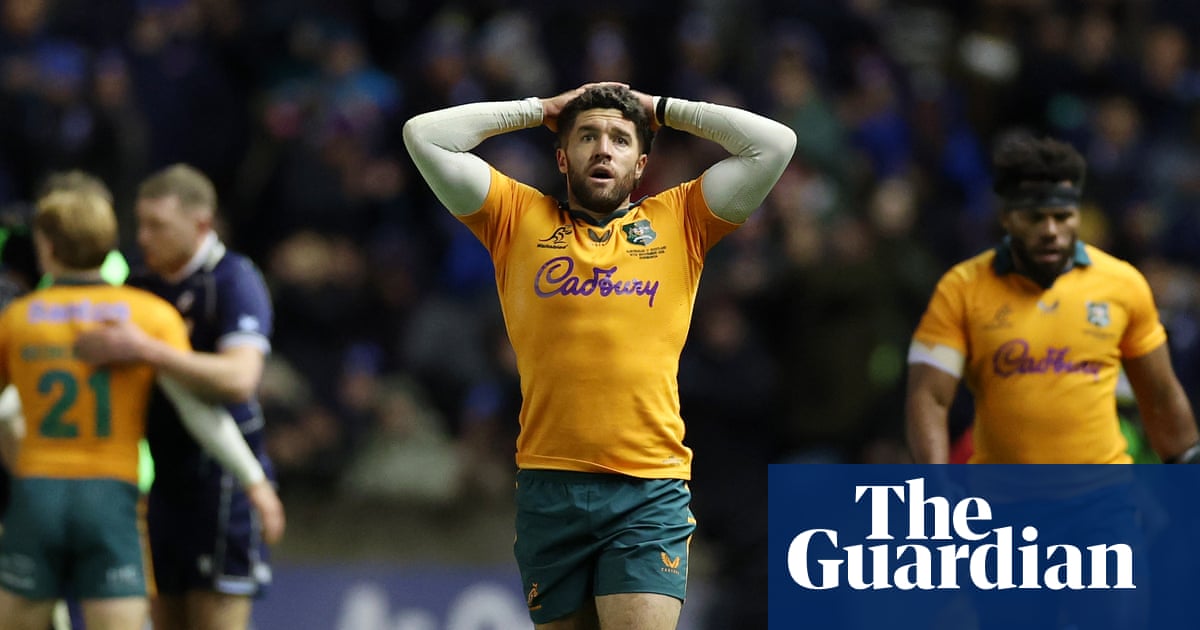
On the same day that Australia’s rugby league men’s side swept aside New Zealand to win a fourth consecutive World Cup, the Wallabies trudged through the Scottish rain looking incapable of doing anything remotely similar.In Brisbane, the Kangaroos punched holes, found space and scored six tries. At Murrayfield, their union counterparts struggled to move forward up the pitch, let alone entertain. Different codes, different demands, different levels of competition. But the contrast between a team certain of its direction and one apparently aimless was impossible to ignore.Scotland’s 15-12 victory was considerably more convincing than the score suggested. Max Jorgensen’s converted try at the death provided scant consolation as Australia rarely looked like winning. Gregor Townsend’s side were hardly irresistible. They made errors, kicked away possession and offered only fleeting glimpses of the imagination associated with Finn Russell. But they consistently won the collisions that mattered. The Wallabies, meanwhile, could not lay the foundations for anything more ambitious.One sequence around the 66th minute provided a grim portrait of their attack. Australia had a lineout on Scotland’s 22. After nine phases they had gone roughly five metres backwards. After 11, they were still losing ground. Eventually Joseph-Aukuso Suaalii and Len Ikitau combined to put Jorgensen into space down the right, but the Scottish defence recovered and Rory Darge, captain on the night and the best player on the park, ended the ordeal with a turnover.Eighteen phases. All that possession, all those collisions, and not a single meaningful dent in the defensive line. The most damning aspect is that Les Kiss had identified the importance of the gainline after the defeat by England last week. “We gave them too much at the gainline for sure,” he said. That was a criticism of Australia’s defence, but the other side of the equation proved equally troubling at Murrayfield where the Wallabies lost all the collisions that dictate how a match is played.It is tempting to blame another fly-half. Carter Gordon, restored to the No 10 shirt after injury, was competent rather than commanding. He found a fine touch with one kick in the first half and looked reasonably assured organising his side. But there was little that felt transformative, and an attempted cross-field kick before the interval floated into touch as the attack around him narrowed to the point that they might as well have formed a maul. Equally, he was often directing runners who were being met before they could build momentum. Changing the conductor makes little difference when the orchestra cannot find the beat.The most bewildering casualty of this approach is Suaalii. Remember his first appearance for Australia at Twickenham in 2024? He played with freedom and audacity in a debut for the ages. Two years ago he looked capable of justifying all the noise surrounding his expensive move from rugby league. Now, stationed in the outside channels, he can go long stretches without touching the ball in a position to do any damage. At one point it was worth double-checking that he was still on the field.Tate McDermott takes a heavy hit from Scotland’s Jamie Dobie. Photograph: Andy Buchanan/AFP/Getty ImagesIn another timeline he might have been playing on Sunday in the Rugby League World Cup final instead. When explaining his code switch, Suaalii spoke of the opportunity to travel the world, play in a Lions series and contest a home Rugby World Cup. He has achieved some of those dreams and is on track for the rest, and no one should pretend that one wet evening in Edinburgh renders his decision a poor one. But a penny for his thoughts as he watched Australia’s attack stall once again. And perhaps a penny, too, for Mark Nawaqanitawase, the former Wallaby who has just won a National Rugby League Premiership with Sydney Roosters and is now heading back to union in Japan. He has not even committed to wearing the Wallabies jersey at the World Cup next year. One wonders if he will, after this latest damp squib.skip past newsletter promotionafter newsletter promotionNone of this is to suggest that the 13-man code is inherently superior. The more immediate point is about how Kiss better uses the talent in his ranks. Ikitau was peripheral, while Jorgensen and Tom Wright were starved of quality possession. Harry Potter’s excellent finish for a first-half try showed what is possible when Australia shift the ball with conviction. Such moments were the exception.There were players who deserved better. Fraser McReight was, once again, ferocious at the breakdown, his turnover after a crunching tackle on Ben White among the afternoon’s best interventions. Josh Canham offered a similarly defiant performance, including a mind-reading lineout steal deep in Australian territory. Yet both increasingly resemble men working overtime to keep a malfunctioning machine running. They salvage possession, generate opportunities only to watch them dissolve into another succession of static carries.Scotland deserve credit, particularly Darge, for making the breakdown a hostile place. But their defensive task was simplified by Australia’s inability to force retreating tacklers or create quick ball. Without those advantages, gifted backs are left receiving passes with defenders already in their faces. Slow possession invites tacklers to rush up which means attackers take contact without momentum. Like a cascade of falling dominoes, the next carry and the one after begins further behind the gainline. Eighteen phases might give the impression of impressive ball retention, but without penetration it is merely another way to slowly go nowhere.
Australia slowly going nowhere after trudge through Murrayfield rain | Daniel Gallan
Full Article
Original Source
Read the full article at Theguardian →KhanList aggregates and links to publicly available news content. We do not host full articles from third-party sources. Always verify important information with original sources.