
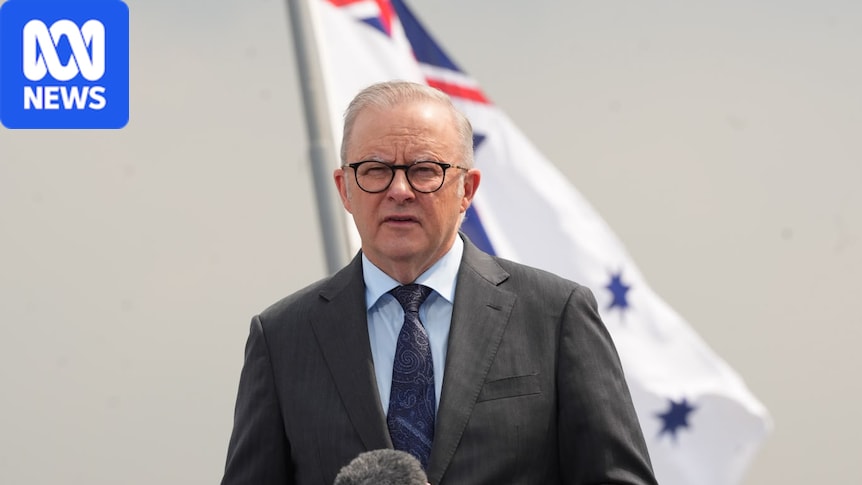
Australia has joined a US-led agreement to protect the sensitive technology and supply chains needed to develop advanced artificial intelligence, amid growing competition with China.But the expansion of the Trump administration's AI alliance has raised questions about how effectively the US can build an alternative to Beijing's technological influence, particularly in South-East Asia where China has already made significant inroads.The new US deal was signed by ten countries including Australia, Japan, India and the United Kingdom and aims to reduce their reliance on nations that could disrupt access to critical minerals, energy, data centres and the transport networks needed to power the AI industry.Under the agreement, known as the San Francisco Declaration, countries would work together to identify vulnerable supply chains, protect sensitive technology from theft or foreign interference and coordinate efforts to strengthen their domestic industries.The cheating scandal involving former NVIDIA CEO Jensen Huang, has put pressure on US President Donald Trump to address growing competition with China. (Reuters: Evan Vucci)It is part of the Trump administration's broader Pax Silica initiative, which Australia joined last year, that seeks to build a network of trusted partners as the US competes with China for technological dominance.Speaking at the Association of Southeast Asian Nations (ASEAN) summit in Manila on Monday, Prime Minister Anthony Albanese said countries needed to work together to ensure humans remained in control of artificial intelligence."We must shape AI rather than let it shape us," he told regional leaders.A spokeswoman for Mr Albanese later said Australia's involvement in the new AI declaration was about "ensuring the technologies and supply chains we rely on are secure".Mr Albanese is expected to meet with US President Donald Trump as part of the Quad leaders' dialogue due to take place on Tuesday evening, which will also include Indian Prime Minister Narendra Modi and Japan's PM Sanae Takaichi.Nvidia saga heightens focus on AI supply chainsChina currently controls more than 90 per cent of the global refining of several critical minerals, including rare earths, graphite and gallium, which are used in everything from computer chips to electric vehicles.The US dominates the market for advanced computer chips, with American companies such as Nvidia designing the powerful processors needed to train and run the most sophisticated AI models.The new agreement comes amid turmoil at Nvidia, whose former chief executive Jensen Huang resigned last week following revelations of an affair with a woman suspected by US intelligence of spying for China.Mr Huang had advocated for allowing US companies to sell advanced AI chips to China, arguing that keeping Beijing reliant on American companies was better than encouraging it to develop its own alternatives.Trump's AI initiative yet to achieve its aimsThe ambitious expansion of the scope of Pax Silica to include infrastructure like powers and energy systems has raised questions about how the agreement would work in practice.Olivia Shen, who is the director of the Strategic Technologies Program at the United States Studies Centre at the University of Sydney told the ABC it remained unclear what Pax Silica had achieved since its launch about a year ago."They're talking about things like ports, terminals, communication networks and energy, which is a really big expansion in scope when the original hasn't been met yet," she said.Ms Shen said the US was also facing strong competition from Beijing, which has been courting South-East Asian nations with its own AI diplomacy efforts.While Singapore and the Philippines have joined Pax Silica, several other ASEAN nations, including Indonesia, Malaysia, Vietnam and Cambodia, have backed rival Chinese initiative, the World AI Congress Organisation (WAICO).Ms Shen said this reflected the region's reluctance to choose sides in the technological rivalry, noting Beijing had a significant advantage in offering cheaper, openly available AI models that may be more attractive to developing economies.She said both the US and China were jostling for "escalation dominance" in the AI race though "neither side have an obvious advantage to some degree"."China could very easily weaponise control over rare earths and processing, while the US could strengthen export controls on chips," she said.For Australia, Ms Shen said closer involvement in the US initiative could improve access to frontier AI models from America."It continues to bind us more closely to the US," she said."For national security use cases of AI, we were never going to bind ourselves to China … but as we consider Australia's stake in AI tools overall, China continues to make attractive open weight models that the private sector is interested in."
Australia backs Trump's AI alliance as US takes on China
Full Article
Original Source
Read the full article at Abc →KhanList aggregates and links to publicly available news content. We do not host full articles from third-party sources. Always verify important information with original sources.