
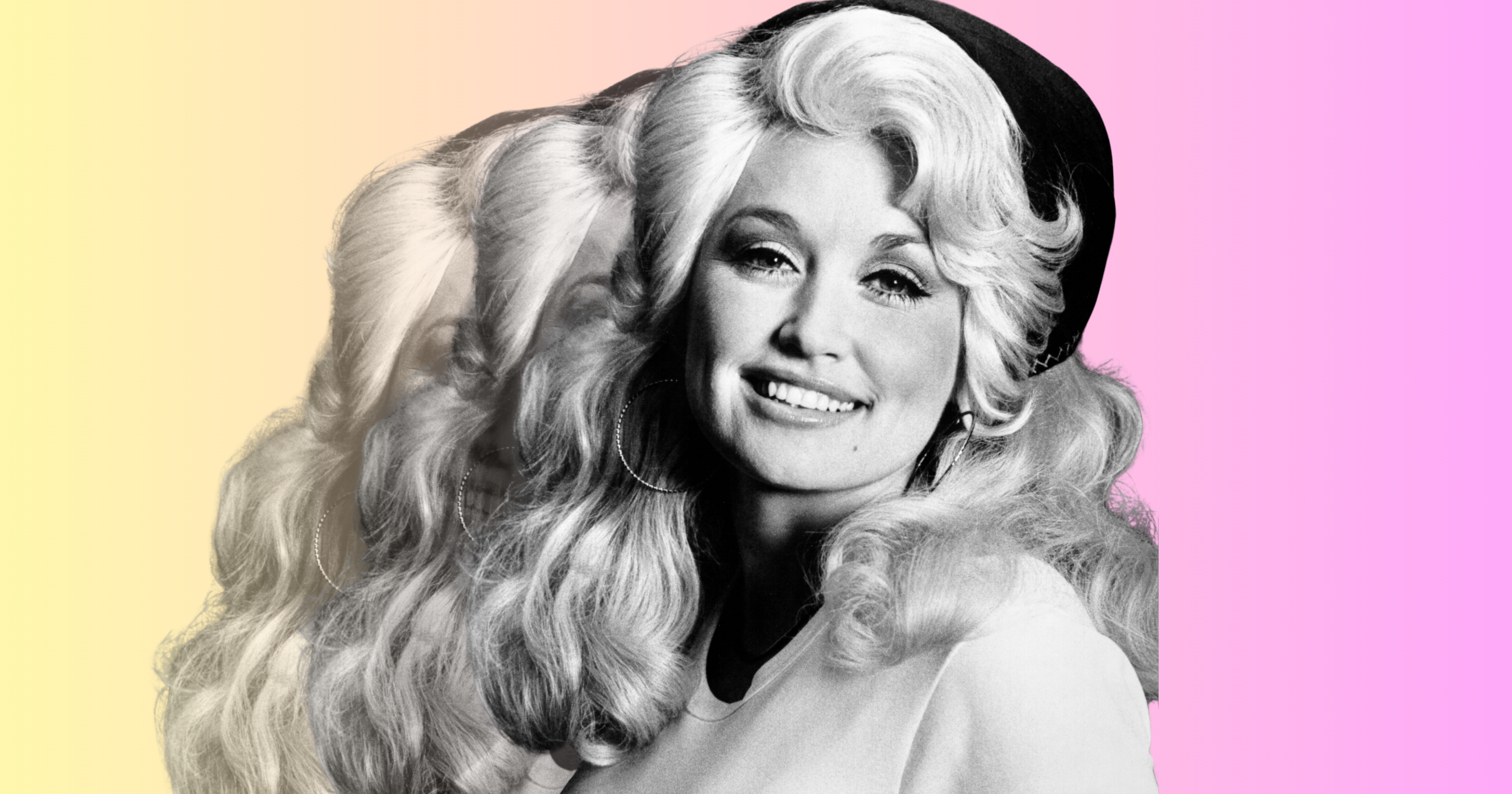
Photo Courtesy of Getty ImagesIn the depths of sorrow, we turn to music. I know what each of my heartbreaks have sounded like. I know every song that has picked me up off the bathroom floor and every artist whose voice has been the unknowing soundtrack to my grief — due to loss, love, and everything in between. Those sonic moments of comfort — the ones that reach through the speakers and whisper that your loneliness isn’t singular — are so personal, shared between you, your headphones, and your tears. Dolly Parton has been with me for some heavy shit stuff (censored out of respect to Dolly, who hated cursing). Fittingly, since she couldn’t have kids of her own, Parton has helped me through my own journey with infertility. After my first pregnancy loss, I’d go on long walks by myself to cry, scream at the trees or God or whoever was listening, and grieve. I listened to a lot of Dolly (and Whitney and Aretha and all the divas whose voices have transcended their time on earth). What I remember most about those walks was that I listened to the WNYC podcast series Dolly Parton’s America.In it, host Jad Abumrad walks listeners through Parton’s impact, from her poor Appalachian upbringing to her country roots and Dolly iconography to how borderless her influence became — how the themes of her folk music stretched from Appalachia to West Africa, from “Nashville to Nairobi”, the show charts Parton’s global appeal. Like many have pointed out since her death this week, Parton was the last thing we all agreed on. She was universally beloved when the concept of being “universally beloved” doesn’t really exist anymore. She was an elder who adapted to the times when so many of her generation reject change. She was a celebrity who spoke her mind and loudly stood up for the less fortunate when stars of that ilk are becoming increasingly rare. She was a rich white lady who could have been a billionaire and chose to be a philanthropist instead. She led with empathy. Now, being empathetic is denigrated as a weakness. She embraced her femininity while being fiercely feminist, proving the two aren’t mutually exclusive. She said she wasn’t political but her actions showed us her politics clearly. Parton wasn’t perfect and she held multiple contradictions at once, but there was one thing she was, unequivocally: good. That goodness stretched from Parton’s Imagination Library, which provided hundreds of millions of books to children, to her support for LGBTQ+ and Black communities, to how she carried herself, to her philosophies on life and the cards it dealt her. Oftentimes, we value women by our reproductive systems. Society will say that motherhood is where we show our worth, that a woman’s most virtuous achievement in life is giving birth. None of that is true, of course, but even in death, when Parton is being remembered for her vulnerable songwriting, unmatched artistry, impeccable comedic timing, and her many charitable contributions, we’re also talking about the fact that she had no biological children. It’s a conversation we wouldn’t be having if she were a man (case in point: we’re not talking about the late Tim Curry, who also passed this week, in the same way), which makes it unfair to a point, but I also think that Parton’s views on motherhood are important to excavate. She spoke about motherhood the same way she did life: with irreverent honesty, wit, wisdom, and humility. “I think it probably was [God's] plan for me not to have kids so everybody’s kids could be mine. And they are now.dolly parton”There isn’t much in the Dolly Parton’s America podcast about Parton’s struggle to conceive — she and her husband Carl tried for years — and her ultimate decision to be at peace with never having children, so there are quotes of her talking about her views on motherhood that I hadn’t seen until now that our timelines are full of Dolly Parton tributes, like this one she said to Andy Warhol for Interview Magazine:“I couldn’t have children, I tried to for years. I’ve never been pregnant in my life. When I was a girl and fooling around, I was scared to death I’d get pregnant, and then when I got married and wanted to have children, I couldn’t have any. But I don’t miss it. I did for awhile, but I realize that I am everybody’s mother. I’ve raised five of my younger brothers and sisters, and now their kids call me Aunt Grannie. I’m like the grandma and the aunt.”Last week, for the third time, a positive pregnancy test made me believe I’d finally become a mother. Once again, it didn’t work out the way I wanted. Despite growing up going to church, I don’t pray much anymore. What could possibly be the divine reasoning for the harrowing highs and lows of infertility? My husband and I are still trying, but over the past few days, I’ve been reckoning with the idea that it may not happen for us, that maybe I will never carry a pregnancy to term and raise a child who inherits a big forehead like all of us Newmans on my mom’s side of the family have. Parton has picked me up off the bathroom floor a lot this week. I’ve been inconsolable. Turns out, the third time wasn’t a charm. That fact has been a devastating reconciliation of expectations versus reality.So much of the social media surrounding fertility journeys show the happy ending. There’s the hard fought battle for a baby, but it always ends with a baby. For Parton, it didn’t. And somewhere along the way, she and her husband decided that was for the best. She decided that providing books to hundreds of thousands of children was enough. She decided that helping raise her younger brothers and sisters was enough. She decided that being Aunt Dolly (most famously, to her goddaughter Miley Cyrus) was enough. A godmother, an auntie, a philanthropist, a caregiver. It was all enough. In the past week, many writers have taken on the impossible task of eulogizing a last-of-her-kind icon who cannot be put into words. How do you describe the defeat, hurt and humor laced in the melodies of “Jolene”? How do you explain the spiritual experience of listening to “Light of a Clear Blue Morning” for the first time? How do you illustrate that Parton was the closest thing we had to an actual saint on earth while also being a complex cultural figure who loved to tell a dirty joke? How do you sum up that she birthed every country female singer songwriter currently reigning the charts? When Ashley Fetters Maloy from The Washington Post tried to tribute Parton, her piece “Why it matters that Dolly Parton wasn’t a mother” was met with backlash. People took offense to the publication’s post on X that read, “Parton’s lack of children demonstrated that the world could in fact love a woman who wasn’t a mother.. She was proof that a person could be an advocate for children while choosing against parenting.”I actually understand and agree with Fetters Maloy’s sentiment about how the world sees women. See: when JD Vance disparaged “childless cat ladies” or how the internet reacts when a woman dares to get pregnant past the age of 40 or, god forbid, decides not to have children at all and expresses zero regret for that choice (Oprah and Tracee Ellis Ross may be applauded now but they have faced an onslaught of judgment). And with the tradwife movement on the rise, choosing to be childfree is radical. The whole piece is worth a read, not just the poorly-worded social post. Maybe it is a nice narrative to push though, that Parton was a progressive badass who chose to be childfree decades before it was cool, and in true Dolly fashion, there are cheeky quotes to back up that framing (“We don’t want children of our own… we don’t want the total responsibility” Parton told the BBC in 1978), but the reality is more complicated. Parton suffered from endometriosis resulting in a partial hysterectomy. She was unable to have children of her own, then chose not to become a parent by other means, and devoted her life to helping kids anyway, and raising them in her own way. I think it does Parton’s story a disservice to leave out the fact that infertility isn’t a choice, and that she spent years dealing with the devastating disappointment of a dream unrealized. “God has a plan for everything,” Parton said on the Today show in October 2017. “I think it probably was his plan for me not to have kids so everybody’s kids could be mine. And they are now.”These quotes have been hitting me in the gut. I had an appointment at a new fertility clinic on Wednesday. It was scheduled months ago. I didn’t know when I booked it that I would be dealing with another unsuccessful pregnancy, or that Dolly Parton would be dead. When I walked in, “9 to 5” was playing on the speakers in the brightly lit office. As my doctor rattled off my medical history from her notes (including a fibroid removal surgery last year I am still mentally and physically recovering from), I listened to the faded sounds of Parton’s iconic anti-capitalist hit: “They let you dream just to watch 'em shatter/ You're just a step on the bossman's ladder/ But you've got dreams he'll never take away.” Infertility will have you questioning every choice you’ve ever made, especially ones that involved putting your career above starting a family, wondering why you spent years pouring cups of ambition, striving for titles that don’t mean much to you anymore. Some of that is just the web of bullshit grief spins in your brain, scrambling your sense of self, but, in that moment, I found it fitting that Parton’s pro-union pop masterpiece was playing in the background. Like Parton, I am an auntie and it’s the title I am most proud of. I have four perfect nieces and nephews (the youngest just turned six), and I’m grateful to be a surrogate auntie to my friends’ kids. I know that I have so much space in my heart for the children in my life, and if the maternal love I have to give goes to my community instead of a biological kid of my own, I think I can be OK with that — just like Parton was.When I shared the above Parton and Andy Warhol quote on social media, the post (which has over 800,000 views and 83,000 likes) was flooded with comments affirming Parton’s status as a mother to the world and some testimonies from people whose aunts helped raise them. “I had a great aunt like this and she was and is one of the most important people in my life,” one commenter wrote. “The most motherly person in my family is an aunt of mine who has no children,” posted another. I have friends who have chosen to never have kids and they are some of the most caring, nurturing, and loving people I know. My own godmother, my mom’s best friend of almost 50 years, raised me just as much as my parents and big brothers did. She’s a striking, loud, Caribbean lady from St. Vincent who would never be caught without dark lipstick. She showed up to my cousin’s funeral with purple lips, head-to-toe polka dots and a wide brimmed fascinator. She taught me to dress boldly (I still raid her closet for bright prints and statement jewelry), to live fearlessly (she once stopped a mugger by whacking him with her purse), and how to be a loyal friend (my mom wouldn’t have survived my parents’ divorce without her). My godmother has kids of her own, but I’ve always felt like hers. I know intimately that you don’t have to give birth to someone to become their favorite person. And yet, I needed the reminder this week. I needed to remember that for all the years I was uncertain about having children, I knew that being an Auntie — by blood or through friendship — was the honor of a lifetime. Thinking of the women in my life who are nurturing kids who will grow up and write comments like the ones above made me replace sobs with happy tears. In death, Parton has provided me with something I didn’t think was possible a few days ago: hope. Not the hope that precedes the certainty of getting what I want, but hope that one day I’ll be able to accept whatever happens. Dolly Parton didn’t have her own kids, but that doesn’t really matter. She was a mother. In every sense of the word, she was maternal. Since the announcement of Parton’s death on Tuesday, stories of her generosity have filled our timelines. To millions of kids, she was the lady who sent them books. To her niece Rebecca Ann Seaver, she was her “most trusted confidant” and “best friend.” To Cyrus, she was “an angel.” Parton knew what it meant to value community, and to be a part of the village that raises a child. The most impressive thing about Parton wasn’t just that her music connected her to the world, it’s that her life was a testament to the value of kindness and community, to treating every child as your own, and to seeing humanity in everyone and knowing that empathy is our greatest strength.Dolly Parton and I have the same birthday, over 40 years apart. A big-haired, big tittied, spunky blonde from Appalachia and an anxious, small chested Black girl from the suburbs of Ontario, Canada don’t have much in common on paper, but the fellow Capricorn was one of those fixtures in pop culture who felt like family. That may be a little parasocial, and I’m sure I’ve been projecting the trauma of my infertility onto her this past week, but sometimes, that's what art and celebrity does. What we consume can be a mirror that reflects more about ourselves than the artist. Projection or not, I know that Dolly Parton’s legacy — more than the Grammys, the chart topping hits, and Oscar-nominated roles — will be that she was a good person doing good in the world. I may never be able to be a mom, but I can be good. I can try my best to use my privileges to benefit others. I can provide the children in my life and beyond with all the love, protection, and respect I can muster, just like Aunt Dolly.
Aunt Dolly Was Enough
Full Article
Original Source
Read the full article at Refinery29 →KhanList aggregates and links to publicly available news content. We do not host full articles from third-party sources. Always verify important information with original sources.