
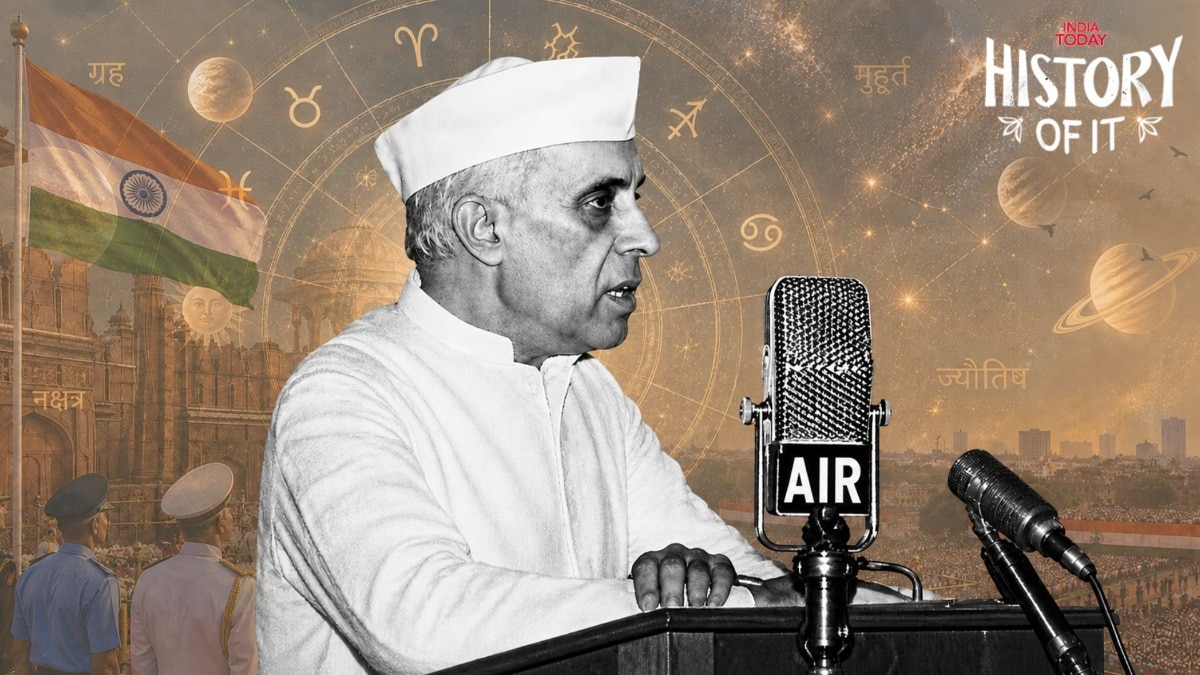
Lord Mountbatten, the last British Viceroy to India, fixed August 15 for the transfer of power to Indians, but seers objected to the date as inauspicious. Jawaharlal Nehru, the to-be first Indian Prime Minister, found a middle path. And that's why India got freedom at midnight."What have they done! What have they done!" Swami Madananand, an astrologer in Calcutta (now Kolkata), cried out in disbelief. Madananand had moments earlier heard the press conference of the last Viceroy of British India, Lord Mountbatten, on All India Radio (AIR). It was June 4, 1947, and Mountbatten had just announced that the British would be handing over power to Indians on August 15, 1947.The country had waited for this moment for generations. The British would finally be leaving, and the date had been advanced from June 1948 to August 1947. Freedom had a definite date now. August 15, 1947 said Mountbatten in his announcement. But Swami Madananand was not celebrating. For him, the date was written not merely on a calendar but in the stars, and what he saw after rushing towards his celestial charts was ominous.The stars did not appear to favour August 15.As the news travelled about India's Independence Day, astrologers in Calcutta, Banaras (now Varanasi) and parts of southern India began examining the date with their charts of astrology. August 15 was a Friday that year. Charts were drawn, planetary positions studied and the proposed moment of India's birth scrutinised. The conclusion that all the astrologers came to was unsettling for the believers. The date on which India would be free was "inauspicious". The politicians had chosen the day, but the astrologers were now worrying about the hour. The date of Independence could not be altered. But perhaps the hour in which India will be independent could be changed.We would like to state here that India Today Digital neither believes in astrology nor promotes it. What we are attempting is to revisit the events leading up to India's Independence Day. On Saturday (August 15, 2026), India will be celebrating its 80th Independence Day. It has been a long journey, but let us return to the days leading up to August 15, 1947.With astrologers agreeing that the date wasn't auspicious for the birth of a nation, a way had to be found that the nerves of everyone could be calmed. Because it would be a day that all had to greet with hope.Then came the words of Jawaharlal Nehru, Independent India's first Prime Minister, who would forever attach midnight to India's freedom. "At the stroke of the midnight hour, when the world sleeps, India will awake to life and freedom," he would say in his iconic speech.So, why did India get its freedom at midnight? The answer lies in an unusual chain of events involving Mountbatten's choice of August 15, astrologers who objected to it, and the search for a moment considered favourable for India's birth.What exactly happened in those days is a story buried inside the larger story of Independence.(Video Courtesy: Prasar Bharati Archives/YouTube)MOUNTBATTEN AND INDIAN LEADERS ANNOUNCED PARTITIONBy the summer of 1947, Britain had already accepted that its rule over India was coming to an end. The question before London was no longer whether to leave, but whether it could withdraw before the country descended into chaos.In Freedom at Midnight, French author Dominique Lapierre and American journalist Larry Collins capture the mood of those final months. After decades of nationalist struggle, they write, Britain had been pushed towards a choice to "let Britain leave India in good time rather than be driven out by the forces of history and armed rebellion." The decision to transfer power had been taken, but the India Mountbatten inherited was a country coming apart.The Congress and the Muslim League were caught in a political deadlock. Congress wanted a united India. Muhammad Ali Jinnah believed the time for compromise had passed. According to the Freedom at Midnight book, Jinnah wanted a "speedy surgical operation, which was the Partition"."On June 3, 1947, Mountbatten, Jawaharlal Nehru, Muhammad Ali Jinnah and Baldev Singh addressed the country over All India Radio. The Mountbatten Plan announced that British India would be divided into two dominions, India and Pakistan, and that power would be transferred months ahead of the original June 1948 deadline," wrote Lapierre and Collins wrote in their book.Mountbatten's thoughts were not finished on June 3. The next morning, he suddenly called a press conference. What came next stunned everyone, even those who had been following the negotiations closely. The British were not going to wait until June 1948 to hand over power. Mountbatten announced a definite date, August 15, 1947.Indians had been told that the British would leave. Now they knew exactly when. There were barely 10 weeks left. This was a moment that every Indian had been waiting for years. But outside the conference rooms of Delhi, some were getting queasy about the date. Astrologers turned their attention to the date that Mountbatten had chosen. And they found that it was anything but auspicious. A friend of India: India's first Governor-General British India's last Viceroy Lord Mountbatten declaring Independence of India in the presence of Jawaharlal Nehru, Rajendra Prasad and other leaders in New Delhi on 15 August 1947. (Image: Getty) REVOLT FROM ASTROLOGERS, THEIR APPEAL TO MOUNTBATTENIn Freedom at Midnight, Lapierre and Collins describe Mountbatten's decision as a serious breach of an established Indian tradition. "He [Mountbatten] had committed the unpardonable fault of announcing his choice without first having consulted representatives of the most powerful occult body in India, the jyotishis, the astrologers," the authors wrote.For generations, astrology had been consulted before important beginnings in India. In the book, Lapierre and Collins reveal that, "the astrologers had laid down which days of a given week would be auspicious, and which would not." There was a particularly troubling detail about Mountbatten's chosen date. Sunday was inevitably an inauspicious day, so, too, was Friday. And August 15, 1947, happened to be a Friday.The announcement had barely gone out when astrologers across the country began examining what the date meant for India's future."As soon as the radio announced Mountbatten's date, astrologers all over India began to consult their charts. In Benares and parts of southern India, their reaction was severe. The date was considered so unfavourable that India, they believed, would be better advised to tolerate the British one day longer rather than risk eternal damnation," the authors noted in Freedom at Midnight.Swami Madananand in Calcutta rushed to his celestial charts. Spread before him were calculations involving the movements of the sun and Moon, planets, zodiac signs and the positions of the 27 stars influencing the destiny of the earth. He set his calculations for August 15 and began examining what the heavens held for the country about to be born."As he did so, he sat up aghast. His calculations foretold disaster," Lapierre and Collins wrote.The problem, according to the book, was not simply that August 15 was a Friday. India was to come into existence under Makara, or Capricorn, with Saturn and Rahu exerting their influence, while Jupiter and Venus occupied what the authors describe as "the most accursed sites of the heavens".For Madananand, this was no abstract calculation. A new nation was about to be born, and he believed its first moment could shape its destiny."What have they done! What have they done!" Madanand shouted. His angst alarm turned into an appeal. He immediately wrote to Mountbatten, pleading, "For the love of God do not give India her independence on 15 August." This has been documented in Freedom at Midnight.The warning that followed was even more striking. "If floods, drought, famine and massacres follow, it will be because free India was born on a day cursed by the stars," Madananand wrote.On one end, Madananand was demanding a change of date to Mountbatten. On the other end, several other astrologers had reportedly approached Jawaharlal Nehru and other Hindu leaders to try and change the date. But the astrologers couldn't have stopped what had begun. The political machinery was already moving too fast for the date itself to be abandoned. Tryst with freedom: Celebration of the first Independence Day of India, in Bombay (now Mumbai ) on 15 August 1947. (Image: Getty) WHAT MADE AUGUST 15 INAUSPICIOUS ACCORDING TO ASTROLOGY?The situation's interesting aspects were recorded through the astrological reasoning by Kotamraju Narayana Rao or KN Rao in his book, The Nehru Dynasty: Astro-Political Portraits of Nehru, Indira, Sanjay and Rajiv.Rao explains that the astrologers demanding a solution was not necessarily to reject the date altogether, but to find a favourable muhurta (auspicious moment) within the period available.The central concept was Abhijit Muhurta, the midpoint between day and night. According to Rao's book, "In Vedic astrology, when an otherwise suitable moment is unavailable, work can be commenced during Abhijit Muhurta."There was another favourable factor in the calculation, the Pushya Nakshatra, associated with Saturn. "Pushya, which is a maha-nakshatra, is considered favourable for founding a kingdom," according to Rao's book.The horoscope that Rao presents for independent India therefore rests on a curious combination of a country that would be born under a Taurus ascendant, with Saturn's mahadasha followed by Mercury's, both considered favourable in the framework he describes.The crucial issue, then, was not simply August 15 versus another date. It was the precise moment at which August 15 would begin. And that opened the door for a compromise. Astrologers charted independent India’s horoscope using Vedic astrology, mapping its Lagna, Navamsha and planetary positions. (AI Illustration) HOW NEHRU FOUND THE MIDDLE PATH: THE FREEDOM AT MIDNIGHTAccording to Lapierre and Collins' Freedom at Midnight, Mountbatten chose August 15 almost spontaneously."The date I chose came out of the blue," he recalled, explaining, "I knew it had to be soon" and that he was "determined to show I was master of the whole event."He narrowed it to August or September and finally settled on August 15, giving a personal reason. "Why? Because it was the second anniversary of Japan's surrender."With the date personally chosen and publicly announced by Mountbatten, changing it was hardly an option for Indian leaders. The compromise, therefore, was to retain August 15 but find an auspicious hour within it.KN Rao cites journalist Durga Das's book, India from Curzon to Nehru and After, for the account of how Jawaharlal Nehru responded to the issue. Nehru, according to Das, "hit upon an interesting compromise"."Nehru then hit upon an interesting compromise. He called the Constituent Assembly in the afternoon of 14th August and continued its sitting till midnight when, according to Western practice, 15th August took birth and zero hour was within the auspicious period envisaged by the Hindu calendar," Rao wrote, citing Durga Das.That decision transformed the transition of power into something extraordinary.India would technically enter August 15 at midnight. But the midnight hour also provided the auspicious window that the astrologers had sought. According to the Hindu calendar, the new day of August 15 hadn't yet begun."A congeries of astrologers finally advised India's politicians that, though 15 August was a wholly inauspicious day on which to begin their nation's modern history, 14 August represented a considerably more favourable conjuncture of the stars," the authors noted in Freedom at Midnight.The authors further revealed that "A relieved Viceroy [Mountbatten] accepted the compromise the Indian politicians proposed to propitiate the celestial bodies and agreed that India and Pakistan would become independent dominions on the stroke of midnight, 14 August 1947."And so the long fight for Independence acquired an extraordinary final detail. On the night of August 14, the Constituent Assembly remained awake as the old day disappeared. At midnight, August 15 was born, and with it, an independent India.Jawaharlal Nehru then delivered words that would become inseparable from the country's birth, "At the stroke of the midnight hour, when the world sleeps, India will awake to life and freedom." So, it was with agreement from all that an independent India was born "at the stroke of midnight".- EndsPublished By: Avinash KateelPublished On: Aug 14, 2026 07:00 IST
August 15 inauspicious, said astrologers. Nehru's solution, freedom at midnight
Full Article
Original Source
Read the full article at Indiatoday →KhanList aggregates and links to publicly available news content. We do not host full articles from third-party sources. Always verify important information with original sources.