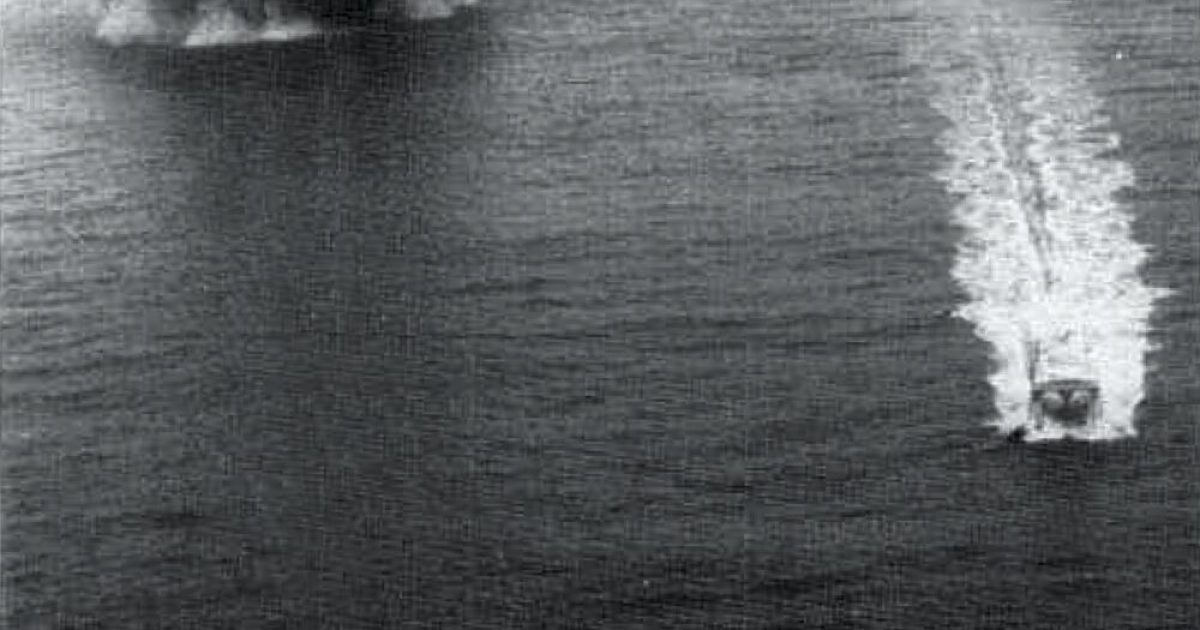
Today in the history of astronomy, a solar storm does a lot more than just put on an auroral show. | Published: August 4, 2026 Dozens of Vietnam-era sea mines, like the one shown here exploding off the coast of Haiphong in 1973, detonated on Aug. 4, 1972, after a solar storm caused a magnetic field spike. Credit: United State Navy/Wikimedia In early August 1972, a series of flares and other solar-storm phenomena generated extreme space weather events in what is considered a Carrington-class event. By the 4th, a coronal mass ejection had reached Earth, arriving in just 14.6 hours – a record. Electrical, telephone, and other communication-grid problems hit North America while bright aurorae danced overhead, appearing much farther south than normally visible. But perhaps the most unique effect was the detonation of dozens of the U.S. Navy’s sea mines off the coast of North Vietnam: The mines were designed to detonate when a ship’s metal hull disrupted the magnetic field around them, and exploded after sudden magnetic spikes from the solar storm. The event prompted the Navy to accelerate the development of replacement mines that would be sensitive to not just magnetic field fluctuations, but seismic waves as well. Elisa Neckar is senior production editor of Astronomy magazine, and the editor of the Today in the History of Astronomy feature on Astronomy.com.
Aug. 4, 1972: Extreme space weather detonates mines
Full Article
Original Source
Read the full article at Astronomy →KhanList aggregates and links to publicly available news content. We do not host full articles from third-party sources. Always verify important information with original sources.