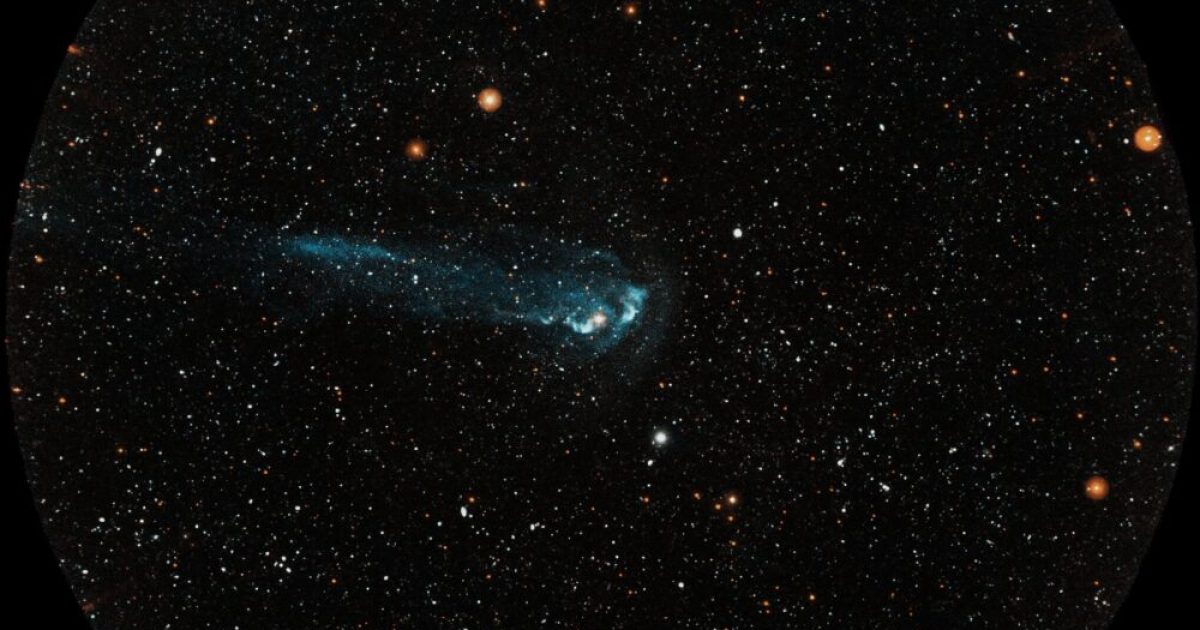
Today in the history of astronomy, the first record of a periodic variable star is made. | Published: August 3, 2026 Variable star Mira was first recorded in 1596. Today, it's well-known for its long, cometlike tail, shown here using data from NASA's Galaxy Evolution Explorer (GALEX) space telescope. Credit: Bipradeep Saha/NASA David Fabricius was born in modern-day Germany in 1564. He became a Lutheran pastor, but maintained a strong interest science throughout his life, also working as a cartographer and even corresponding with Tycho Brahe and Johannes Kepler. It’s his discovery of Aug. 3, 1596, that he’s best known for, though: When he saw an unusually bright star in Cetus the Whale, he initially thought it was a new comet. He recorded its position regularly, and saw it dimming by the end of the month. By October it was completely gone, but 12 years later, it reappeared. This makes Fabricius’ observations the first record of a variable star. Writing to Kepler about the star in 1609, Fabricius called it res mira, Latin for “wonderful thing”; Johannes Hevelius formalized the name Mira for the object in 1662. Elisa Neckar is senior production editor of Astronomy magazine, and the editor of the Today in the History of Astronomy feature on Astronomy.com.
Aug 3, 1596: David Fabricius discovers Mira
Full Article
Original Source
Read the full article at Astronomy →KhanList aggregates and links to publicly available news content. We do not host full articles from third-party sources. Always verify important information with original sources.