
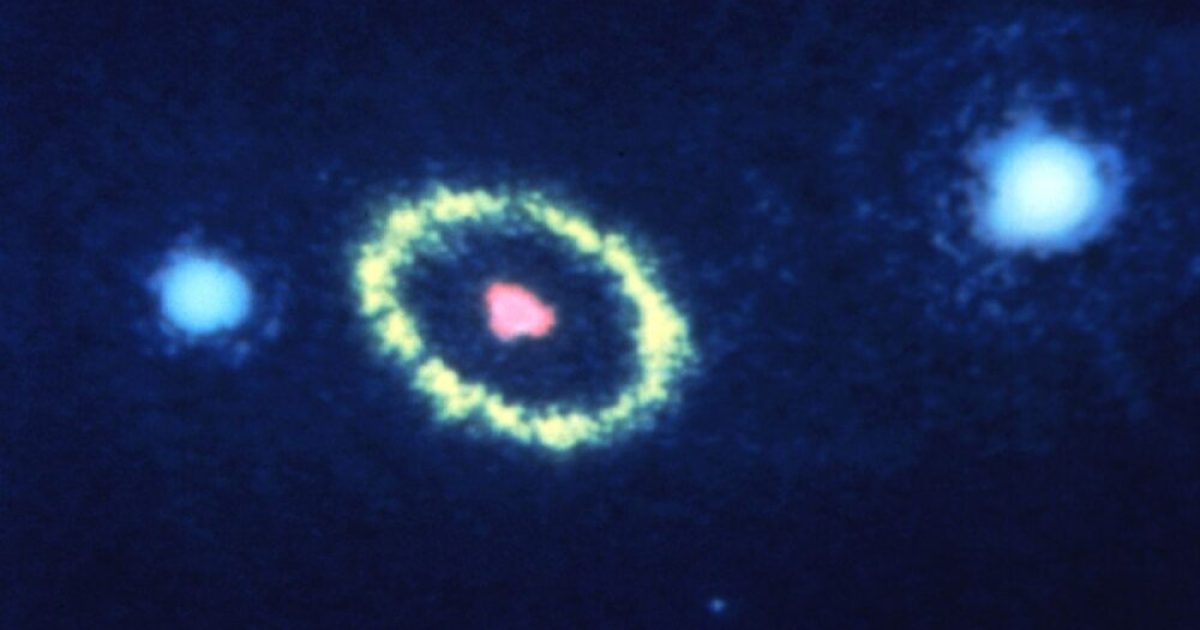
Today in the history of astronomy, NASA announces new details about our neighborhood supernova. | Published: August 29, 2026 Hubble's 1990 image of Supernova 1987A revealed a glowing ring of hydrogen around the remains of what was once a star. Credit: NASA, ESA, and STScI The first light from the explosion that was the death of a massive star in the nearby Large Magellanic Cloud reached Earth on Feb. 23, 1987. Supernova 1987A’s proximity gave astronomers unprecedented access into the final stages of stellar life, and in 1990, the Hubble Space Telescope began taking high-res images of the former star. Then, on Aug. 29 of that year, NASA announced that Aug. 23-24 observations had resolved a ring of material around the supernova remnants in unparalleled detail: Hubble revealed the glowing remains of the explosion were surrounded by an elliptical halo about 1.3 light-years across. The star had ejected hydrogen about 10,000 years before its death, and the luminescent ring was the remains of that stellar envelope. Hubble and other observatories, including Chandra and the Atacama Large Milimeter/submilimeter Array (ALMA), have continued to image SN 1987A since, providing astronomers with insights into stellar evolution and death – and further questions and unknowns to investigate. Elisa Neckar is senior production editor of Astronomy magazine, and the editor of the Today in the History of Astronomy feature on Astronomy.com.
Aug. 29, 1990: Hubble sees Supernova 1987A clearly
Full Article
Original Source
Read the full article at Astronomy →KhanList aggregates and links to publicly available news content. We do not host full articles from third-party sources. Always verify important information with original sources.