
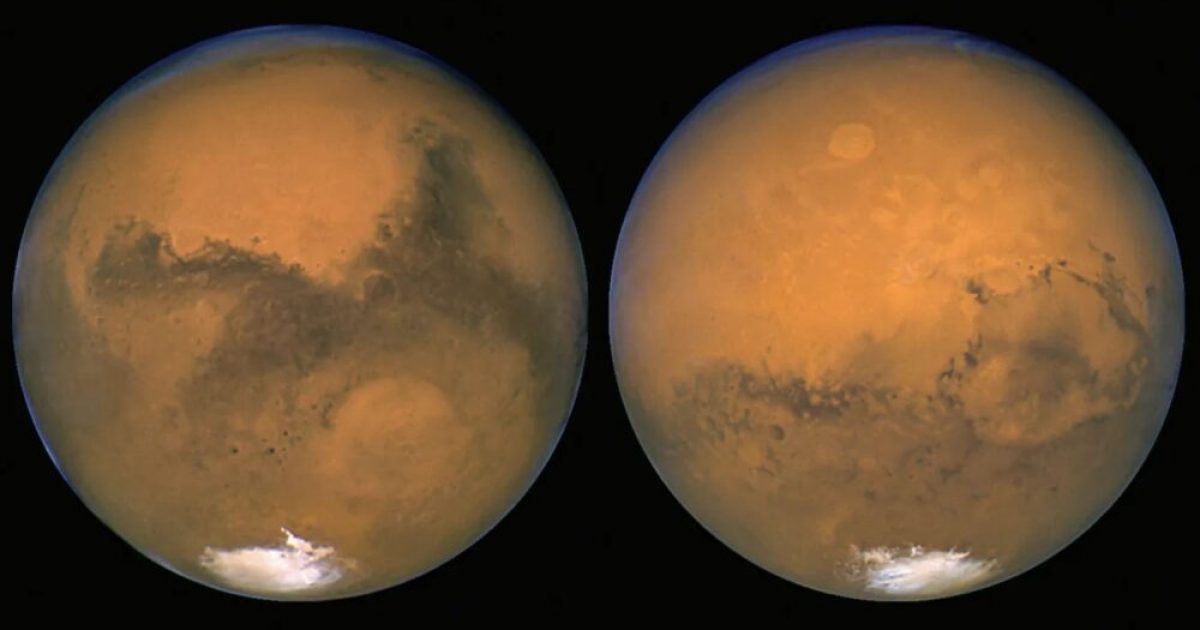
Today in the history of astronomy, Mars comes within a record-breaking distance of Earth. | Published: August 27, 2026 The Hubble Space Telescope snapped these two images of Mars about 11 hours apart, on Aug. 26 and 27, 2003, as it made its closest approach to Earth in 60,000 years. Credit: NASA, J. Bell (Cornell University), and M. Wolff (Space Science Institute) When the Sun, Earth, and Mars all align so that from an earthly perspective, Mars is opposite the Sun, Mars is said to be at opposition. Mars oppositions happen about every other year, and at opposition – or rather, within a few days of it – Mars is also at its closest approach to Earth for that orbit. Thanks to the shape of the orbits involved, some of these close approaches are closer than others. And the closest of all are when Mars is at perihelion, or its nearest point to the Sun, at the same time Earth is at aphelion, or its farthest point from the Sun. When those circumstances happen at the same time as an opposition, you get an event like Aug. 27, 2003, when Mars was the closest it’s been to us for about 60,000 years. The last time Mars was that close was Sept. 24, 57617 B.C.E.; the 2003 record won’t be surpassed until 2287 C.E. Elisa Neckar is senior production editor of Astronomy magazine, and the editor of the Today in the History of Astronomy feature on Astronomy.com.
Aug. 27, 2003: Mars zooms in
Full Article
Original Source
Read the full article at Astronomy →KhanList aggregates and links to publicly available news content. We do not host full articles from third-party sources. Always verify important information with original sources.