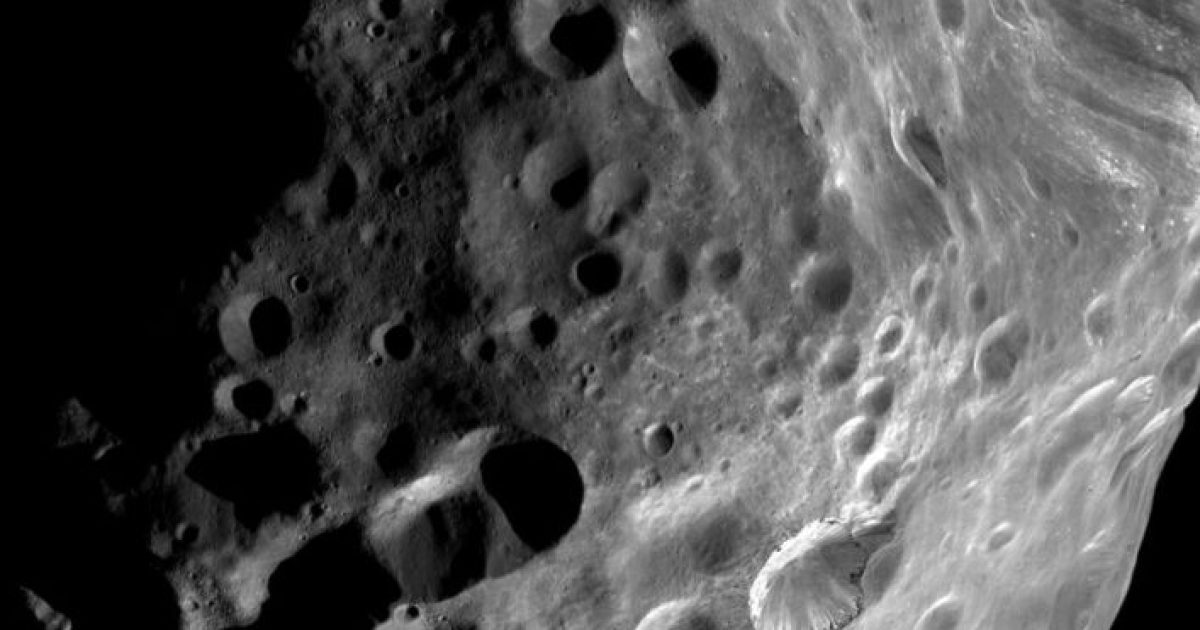
Today in the history of astronomy, a photo is shot. The moon Phoebe will be discovered in it months later. | Published: August 16, 2026 This mosaic of six images from the Cassini flyby of Phoebe showcases the irregular topography and plentiful craters. Credit: NASA/JPL In March of 1899, William Pickering discovered Phoebe, a moon of Saturn, on photographic plates taken on Aug. 16, 1898, by DeLisle Stewart. It was the first moon to be discovered photographically, rather than observationally, and over a hundred years later, it would be the first target of the Cassini spacecraft. Phoebe orbits at a considerable distance from Saturn (about 8 million miles [nearly 13 million kilometers]), far enough that when it was discovered it was believed to be Saturn’s outermost moon. (Today we know there are several smaller moons further out.) Phoebe also has a highly irregular orbit, suggesting it’s a captured object, and observations during the 2004 Cassini flyby bore that out. Elisa Neckar is senior production editor of Astronomy magazine, and the editor of the Today in the History of Astronomy feature on Astronomy.com.
Aug. 16, 1898: Phoebe makes an appearance
Full Article
Original Source
Read the full article at Astronomy →KhanList aggregates and links to publicly available news content. We do not host full articles from third-party sources. Always verify important information with original sources.