
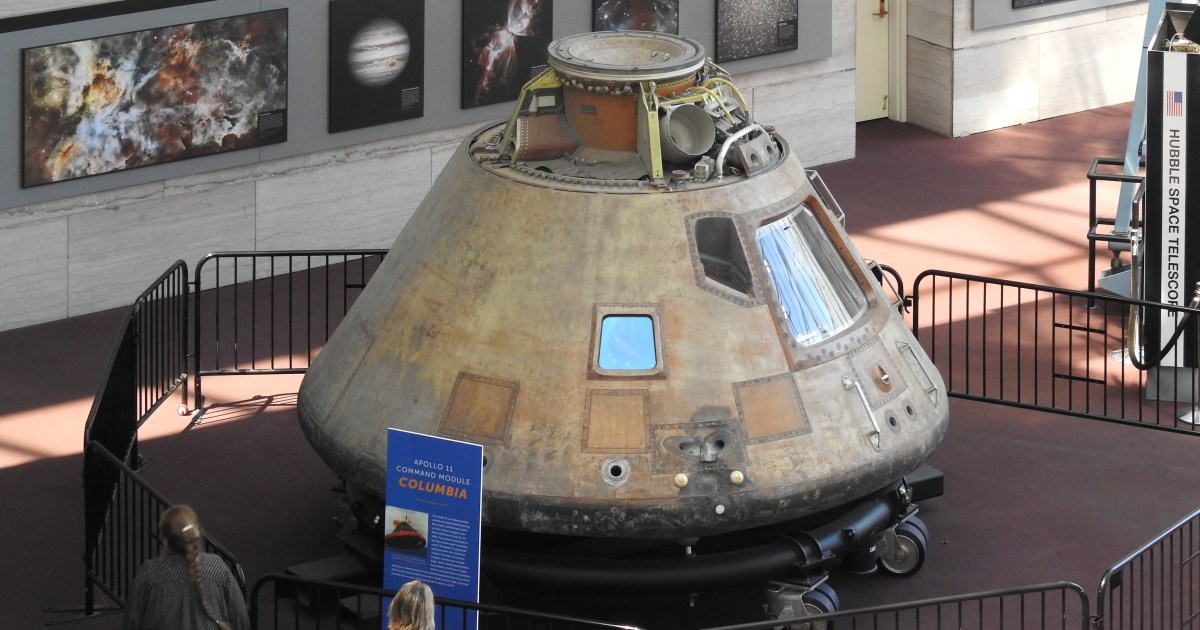
Today in the history of astronomy, the forerunner of the National Air and Space Museum is created. | Published: August 12, 2026 Among other items in the Smithsonian National Air and Space Museum is the Apollo 11 Command Module Columbia. Credit: xiquinhosilva/CC BY 2.0 via Wikimedia Commons The Smithsonian Institution began collecting aeronautical artifacts in 1876, when it acquired 20 Chinese Imperial kites. By the end of World War I, a Section of Aeronatics had been established within the Division of Engineering, and Smithsonian Secretary Charles Walcott had mandated that the institution collect aircraft of historical significance. In particular, Charles Lindbergh’s Spirit of St. Louis was a crucial acquisition for the collection. Senator Jennings Randolph introduced a bill to establish a National Air Museum in February 1946, a proposal strongly supported by General of the Army Hap Arnold. The post-WWII timing was no coincidence: Randolph and Arnold hoped to ensure that one of every type of aircraft used during the war would be preserved, and to capitalize on support and sentiment from a public that was very aware of American airpower. On Aug. 12, 1946, President Truman signed the bill into law, establishing the museum. In 1966, President Johnson signed into law a name-change to the National Air and Space Museum, making education about and commemoration of spaceflight part of its mission. Today, it has about 17,000 artifacts relevant to the exploration of space in its collections. The museum’s home on the National Mall opened in 1976, and it quickly became one of the most visited museums in the world. Elisa Neckar is senior production editor of Astronomy magazine, and the editor of the Today in the History of Astronomy feature on Astronomy.com.
Aug. 12, 1946: President Truman establishes the National Air Museum
Full Article
Original Source
Read the full article at Astronomy →KhanList aggregates and links to publicly available news content. We do not host full articles from third-party sources. Always verify important information with original sources.