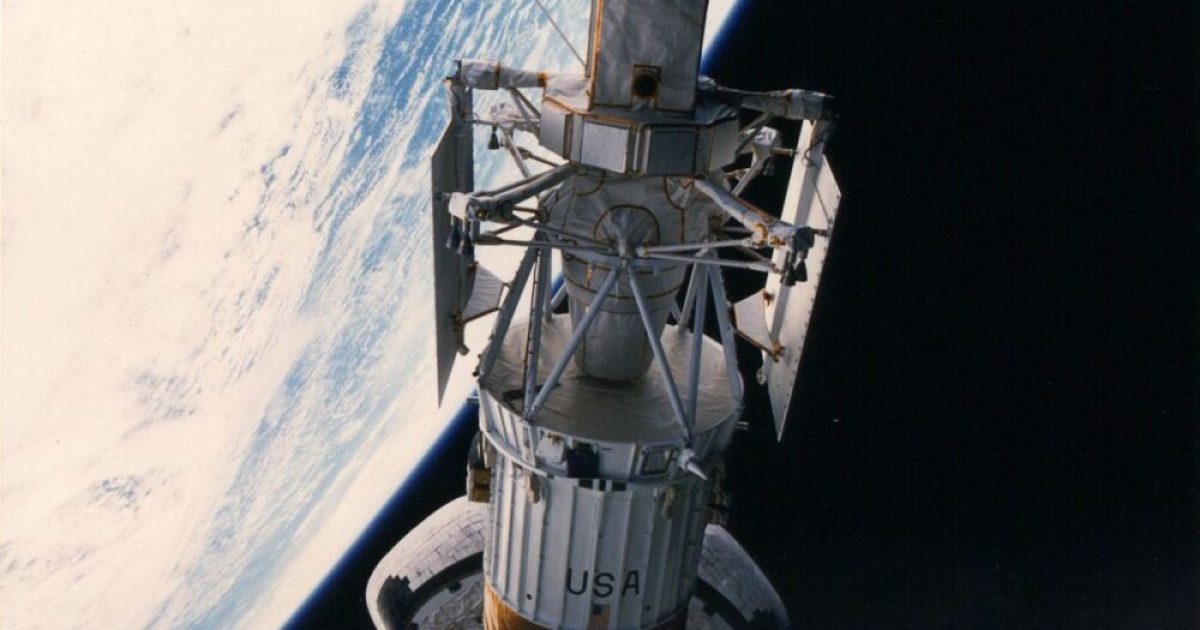
Today in the history of astronomy, Magellan begins its four-year mission to map Venus. | Published: August 10, 2026 To save money, Magellan was uniquely constuctued using spare parts from prior missions, including Voyager, Galileo, Ulysses, and Mariner 9. Credit: NASA On Aug. 10, 1990, the Magellan orbiter arrived at Venus and was inserted into orbit. Its goal was to map the surface of the planet, using radar to peer beneath the cloudy atmosphere. Launched aboard the Space Shuttle Atlantis in May 1989, Magellan was the first deep space probe launched from a shuttle. Budget constraints meant it also had a uniquely recycled construction, utilizing spare parts from many previous spacecraft. The mission was a resounding success, thoroughly mapping Venus in multiple ways and returning a record-breaking 1,200 gigabits of data on altimetry, radiometry, radar emission and reflection, slope, topography, and more. Elisa Neckar is senior production editor of Astronomy magazine, and the editor of the Today in the History of Astronomy feature on Astronomy.com.
Aug. 10, 1990: Magellan enters venusian orbit
Full Article
Original Source
Read the full article at Astronomy →KhanList aggregates and links to publicly available news content. We do not host full articles from third-party sources. Always verify important information with original sources.