
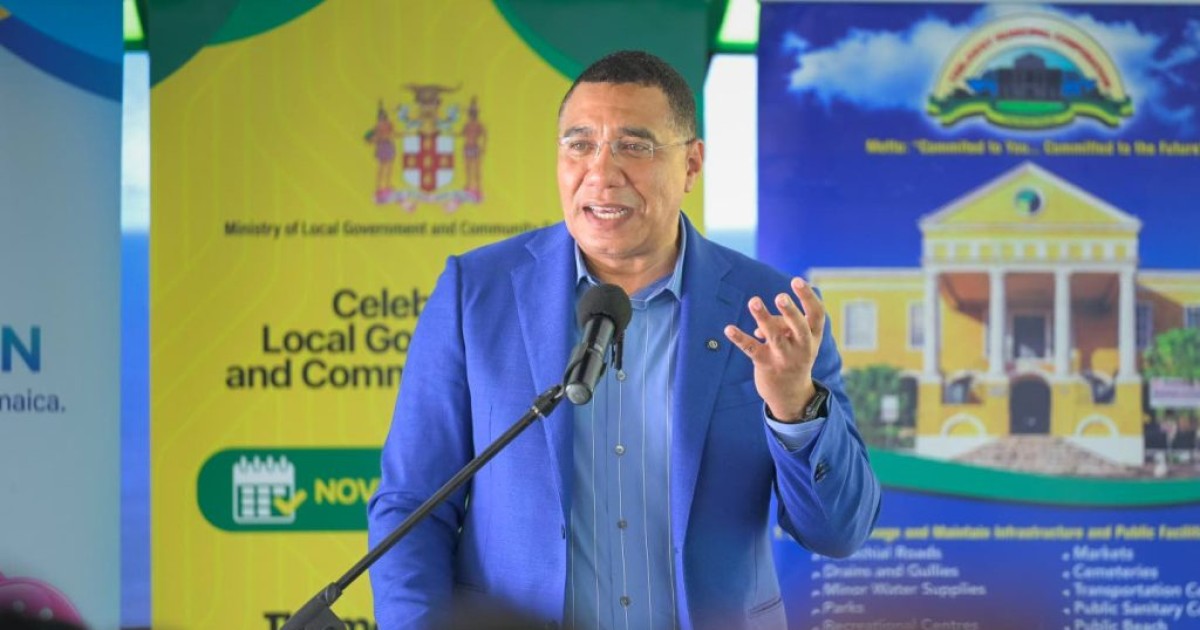
Prime Minister Dr Andrew Holness delivers the keynote address during the official opening of the Trelawny Adult Care Residential Facility in Falmouth on Thursday. (Photo: JIS) PRIME Minister Dr Andrew Holness has charged that some of the findings in the latest auditor general (AuG) report on the management of Hurricane Melissa donations by the Office of Disaster Preparedness and Emergency Management (ODPEM) should not have been included, as they raised concerns that could have been cleared up with readily available information. At the same time he reiterated plans for a revamp of ODPEM, transitioning it into a national resilience organisation. Speaking at the official opening of Trelawny Adult Care Residential Facility (formely infirmary) on Thursday, Holness said the Government had already started addressing structural and operational gaps within the agency, with the findings contained in the auditor general report further underscoring areas in need of continued strengthening. He pointed out that the Government had commissioned an independent review of ODPEM in 2024, with the findings received in 2025. Holness noted that the review highlighted several challenges, with recommendations for changes to the agency’s leadership, staff upgrades, system improvements, and a clearer mandate. “We will move swiftly to address the issues at ODPEM, including the staffing issues, and appoint permanent leadership, and restructure it. So, we are well advanced in what we need to do to restructure ODPEM, and those things will probably move with a little bit more speed now,” declared Holness as he argued that some of the matters raised in the October report were of serious concern, but that others could have been clarified before being presented as findings. “The report, in some instances — some of the points that have been itemised — are of great concern, as I have said, but some of them are easily explained, and probably should not have been a part of the report. For example, the report of 200 houses donated by the Government of China, only 30-plus can be accounted for. “That is absolutely something that should never have been in a report, because you can easily see where they are. There are reports even before, where Minister [Robert] Montague and [a] Member of Parliament [in] Westmoreland toured facilities where some of the houses were stored, and so it is there. The ODPEM has come out and they have clarified that they have [been] handed over to the Ministry of Economic Growth and [Infrastructure Development], that has the duty to build the platforms,” said Holness. The Auditor General’s Hurricane Melissa Relief Initiative Audit: Compliance Audit Report on Management and Distribution of In-Kind Donations, which was tabled in Parliament on Tuesday, listed 200 prefabricated houses, valued at approximately $139.1 million, among 1,332 fixed assets donated to the Government for response to the October 2025 Category 5 storm which devastated sections of the island. The audit found that ODPEM had not provided receipt forms for the houses and had not entered the internationally donated assets in its inventory records or fixed asset register. The auditors also reported that they had verified the existence of 31 prefabricated houses. The report did not conclude that the remaining houses had been stolen or were missing; rather, it identified gaps in the documentation and records needed to account for the donated assets. Despite his belief that some things should not have been in the report, Holness also defended the role of the auditor general. “The auditor general is an important part of our democracy that it is able to do this. There are other countries that don’t have this, but this is an important part. The society, however, has to develop the understanding of what the reports mean before drawing conclusions,” said Holness. The prime minister also addressed concerns about relief supplies that had spoilt, describing the matter as one of inventory management and agreed with the auditor general that there is a need to ensure that older goods are distributed before newer supplies. During a physical inspection of Warehouse 3 on June 18, the auditor general’s team found 359 boxes of crackers past their best-before dates, as well as insects on the packaging of some consumable items. The report noted that the other items inspected were within their usable dates. The audit further found that ODPEM had not maintained adequate store records to allow auditors to compare the physical stock with the quantities received and distributed. It also noted that rice remained in storage about three months after an infestation of weevils had been reported. Holness said the circumstances surrounding donated goods, including their expiry dates, should be considered before conclusions are drawn. “Normally your first in is your first out, and you have to have a process to look at the date of expiration that comes in on some of the items that you have, so you try to either dispose of them, or send them out. It is a complicated issue… I won’t go any further than to say that when you are dealing with donated items, the expiration dates are sometimes close to the use date. So you have to bear that in mind when you make your conclusions on that finding,” he argued. Holness also addressed ODPEM’s use of donated funds to pay Customs clearance fees for relief goods, acknowledging that the spending did not follow the instructions given for how the money should be used. The auditor general found that ODPEM spent approximately $45.1 million from its Donation Account on brokerage and related clearance fees, as well as warehouse rental and utility expenses. Of that amount, $32.97 million was used to clear goods intended for private organisations. The donated funds had been approved to support the Government-Directed Roof Repair and Semi-permanent Housing Solution Programme under the broader Shelter Recovery Programme. ODPEM acknowledged in its response to the audit that the brokerage fees fell outside the approved expenditure, but said the payments were considered necessary to prevent delays in releasing relief consignments. Holness said the decision was made at the executive level of ODPEM and was not a decision made by the Government’s executive leadership. “But I suspect they may be thinking that, if they didn’t pay, they wouldn’t get the goods, or if they didn’t pay, the goods would stay on the wharf, generating more fees that the Government would have to pay,” added Holness.
Audit fallout
Full Article
Original Source
Read the full article at Jamaicaobserver →KhanList aggregates and links to publicly available news content. We do not host full articles from third-party sources. Always verify important information with original sources.