
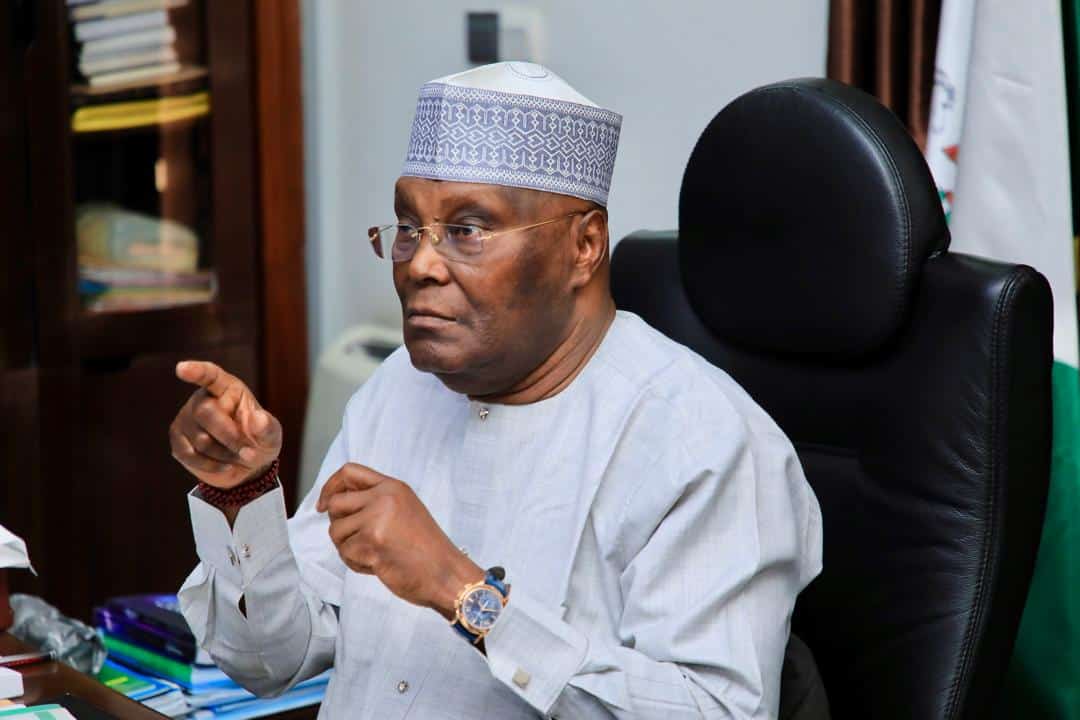
• Says Nigerians on minimum wage spend 80% of income on 40 litres of fuel •Questions use of N15.8tn subsidy removal proceeds •Demands transparency over N34tn import duty exemptions The presidential candidate of the African Democratic Congress (ADC), Atiku Abubakar, has again accused President Bola Tinubu of presiding over an economic system that has made life increasingly unaffordable for Nigerians. He challenged the federal government to explain why petrol remains cheaper in several oil-producing countries despite Nigeria’s status as one of Africa’s leading crude producers. In a statement issued yesterday by his Senior Special Assistant on Public Communication, Mr Phrank Shaibu, Atiku said the real issue confronting Nigerians was not a political disagreement between him and the president, but the crushing cost-of-living crisis facing millions of households. The former vice president was responding to a recent statement by Tinubu in which, according to him, the president criticised his economic position without mentioning his name, saying the president devoted substantial attention to attacking his proposals while claiming he would not “dignify” opposition leaders by naming them. Atiku maintained that in an oil-producing country, petrol should not become a luxury product and that the ultimate test of economic policy is whether ordinary Nigerians can afford transportation, food, education, healthcare and a decent life. He argued that there was a contradiction in the federal government’s position, noting that while his proposal to reduce energy costs had been criticised, Tinubu had also promised cheaper transportation, increased food production and relief for vulnerable Nigerians in the coming weeks. Atiku particularly questioned why Nigerians were paying about N1,400 per litre for petrol while citizens of several other oil-producing countries paid considerably less. He listed petrol prices of about N778 per litre in Saudi Arabia, N872 in Kuwait, N475 in Algeria and N441 in Angola, while noting that prices in the United Arab Emirates (UAE) remained below Nigeria’s despite significantly higher average incomes. “These countries did not conclude that oil production requires punishing citizens at the pump. In different ways, they have used their natural-resource advantage to moderate the energy burden on their people. Nigeria has turned that advantage upside down. Our people earn less, live under greater pressure and yet pay more for the fuel that drives transportation, farming, food distribution, manufacturing and virtually every aspect of daily life. “…Bola, Atiku is particularly ashamed on your behalf when he looks at Libya. A country battered by years of political instability still sells petrol at roughly N34 per litre and ranks around 115th globally in human development. Nigeria sells petrol at roughly N1,400 per litre and ranks around 164th,” the statement pointed out. It maintained that a Nigerian earning the N70,000 statutory minimum wage requires N56,000 merely to buy 40 litres of petrol at N1,400 per litre, representing 80 per cent of an entire month’s minimum wage. “Before that worker buys food, pays rent, electricity, school fees or medical bills, four-fifths of his monthly wage can disappear into just 40 litres of petrol,” the statement said. According to Atiku, expensive petrol was driving inflation across the economy because transportation and energy costs were embedded repeatedly in the prices of agricultural produce and manufactured goods. He said the Atiku Economic Recovery Plan (AERP) would instead seek to reduce costs at source through targeted support for Nigerian crude supplied to domestic refineries under a capped, transparently budgeted and independently audited framework. Under the proposal, he said, crude and refined products would be tracked, while the intervention would include a consumer pass-through obligation to ensure that benefits reached Nigerians at the pump. “The economics is straightforward. Reduce fuel costs and you reduce pressure on transportation. Reduce transportation costs and you reduce the cost of moving tomatoes, rice, yam, livestock and manufactured goods. “Reduce those costs and more of a worker’s income remains available for food, rent, education and healthcare. That is structural relief,” Atiku stated. He also dismissed suggestions that a targeted intervention to reduce fuel costs could threaten the Nigerian Education Loan Fund (NELFUND), workers’ salaries or the minimum wage, describing the argument as “fearmongering dressed up as economics,” and insisted that student loans could not be presented as proof that education had become affordable. “Celebrating NELFUND as proof that education has become affordable under your government is like setting school fees on fire and then boasting that you lent students a bucket of water. “A student loan is not a scholarship. It is a liability. The proper test of an education policy is whether ordinary families can educate their children without being pushed into debt merely to keep them in school,” he said. Atiku further said his proposed approach would focus on reducing the underlying costs confronting students and families, while reviewing existing student debt arrangements. The former vice president also challenged Tinubu’s administration to provide a comprehensive account of revenues and savings associated with the removal of petrol subsidy. According to the statement, the federal government had said subsidy removal mobilised about N15.8 trillion between June 2023 and December 2025, while Nigerians had endured higher transportation and food costs and a sharp decline in the purchasing power of wages. Atiku also renewed calls for a comprehensive reconciliation of nearly N30 trillion identified across Federation Account revenues, deductions, savings, transfers and related entries. In addition, Atiku demanded greater transparency over Import Duty Exemption Certificate approvals covering about N34 trillion worth of imports in 2025. “Nigerians deserve to know who benefited, the values attached to those exemptions, their legal basis and the measurable public benefit they delivered,” the statement said. Atiku suggested that the federal government’s latest promise of relief was coming after years of hardship and at a time when political activities ahead of the 2027 general election were beginning to gather momentum. “After more than three years of hardship, Nigerians are now being offered a temporary dose of political anaesthesia as 2027 approaches. God forbid that Nigerians should mistake election-season relief for economic recovery,” the statement added. The ADC presidential candidate maintained that his focus was on restoring affordability and improving the purchasing power of Nigerians, rather than engaging in personal exchanges with the president. He stressed that Nigerians deserved clear answers on what had been achieved with the trillions of naira reportedly mobilised from subsidy removal, the reconciliation of Federation Account figures and the beneficiaries of the import duty exemptions.
Atiku to Tinubu: Stop Punishing Nigerians, Explain Why Petrol is Cheaper in Libya, Angola, Algeria, Others
Full Article
Original Source
Read the full article at Thisdaylive →KhanList aggregates and links to publicly available news content. We do not host full articles from third-party sources. Always verify important information with original sources.