
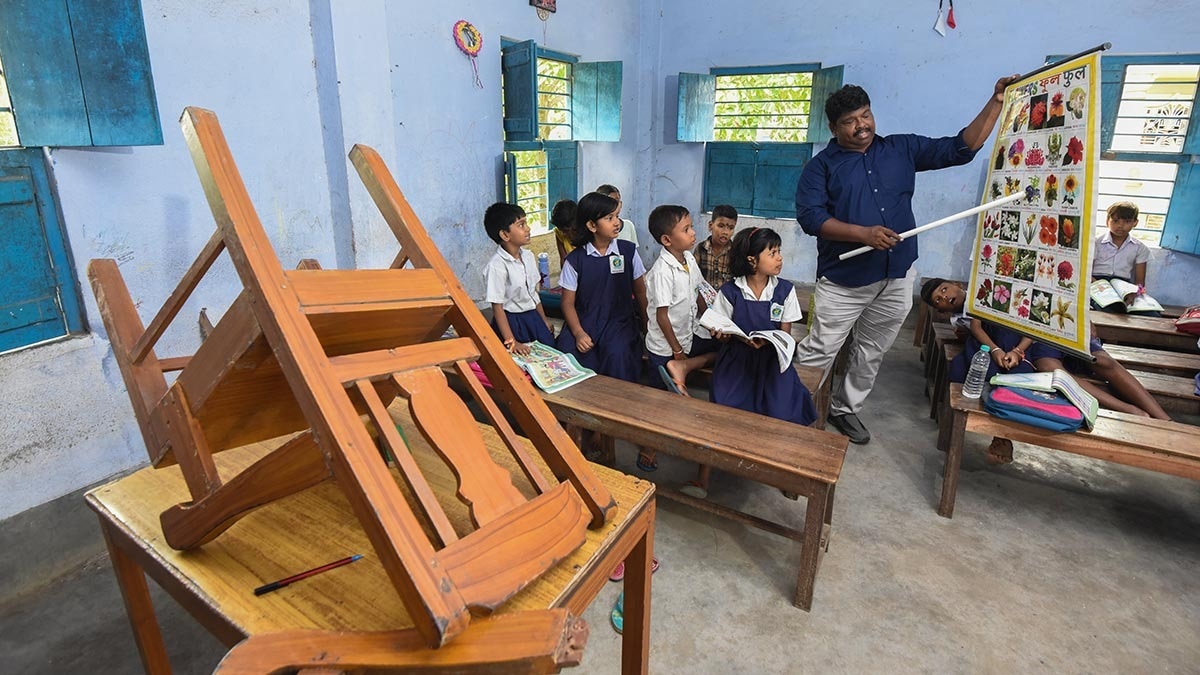
Uttar Pradesh's Atal Awasiya Vidyalaya scheme offers free CBSE residential education to children of construction workers and other vulnerable families. It aims to give children of migrant and marginalised households stable schooling through Class 12.The scheme is implemented by the Uttar Pradesh Building and Other Construction Workers Welfare Board (UPBOCW) under the Labour Department. (Photo: Debajyoti Chakraborty)Launched in Uttar Pradesh as a residential schooling programme for children of registered construction workers, the Atal Awasiya Vidyalaya (AAV) scheme provides free education and boarding facilities from Class 6 to Class 12. The schools are intended, among other things, to ensure that children’s education is not disrupted when their parents migrate for work.The scheme is implemented by the Uttar Pradesh Building and Other Construction Workers Welfare Board (UPBOCW) under the Labour Department.What is Atal Awasiya Vidyalaya?There are 18 Atal Awasiya Vidyalayas across Uttar Pradesh, with one school in each of the state's 18 divisions. The schools have been set up as residential campuses for students from Class 6 to Class 12 and follow a CBSE-affiliated curriculum.Sixteen of the schools were inaugurated by Prime Minister Narendra Modi in September 2023. The 18 schools were built at a reported cost of around Rs 1,115 crore, with each campus designed to accommodate up to 1,000 students. Admissions are offered for Class 6 and Class 9, with students continuing at the same school up to Class 12.Who is eligible?The scheme primarily covers children of construction workers registered with the UPBOCW. Eligibility also extends to certain children orphaned during the Covid-19 pandemic and other categories identified by the state government.Key conditions include:The child must be the child of a registered construction worker meeting the prescribed registration requirements.A maximum of two children from one family can apply.50% of seats are reserved for girls.Admissions are made through entrance examinations for Class 6 and Class 9.Eligibility requirements can vary by admission year and notification. For example, a 2025-26 admission notice in Gorakhpur required construction-worker registration to have been completed for a specified period and prescribed age limits for applicants.What do the schools provide?The schools provide residential facilities along with education. Students receive accommodation, meals, uniforms and textbooks, along with facilities for sports and extracurricular activities.The campuses include separate hostels for boys and girls, classrooms, laboratories, playgrounds, dining facilities, medical support and staff accommodation. Each school has been designed with a capacity of around 1,000 students.The residential model is aimed at providing continuity in schooling for children whose parents may move between locations for work.How to applyAdmissions are conducted through notifications issued for the relevant academic session. Applications and admission details are made available through the Labour Department, district-level offices and the Atal Awasiya Vidyalaya system.The application process can vary by year and division. Recent admission notices have required documents relating to the parent’s construction-worker registration as well as the child’s age and identity. Applicants should check the admission notification for the relevant academic year for the latest eligibility conditions, dates and document requirements.The programme currently operates through 18 residential schools across Uttar Pradesh, giving eligible children access to schooling and boarding facilities through Class 12.- EndsPublished By: Koustav DasPublished On: Sep 7, 2026 10:38 IST
Atal Awasiya Vidyalayas: UP's free residential schooling scheme explained
Full Article
Original Source
Read the full article at Indiatoday →KhanList aggregates and links to publicly available news content. We do not host full articles from third-party sources. Always verify important information with original sources.