
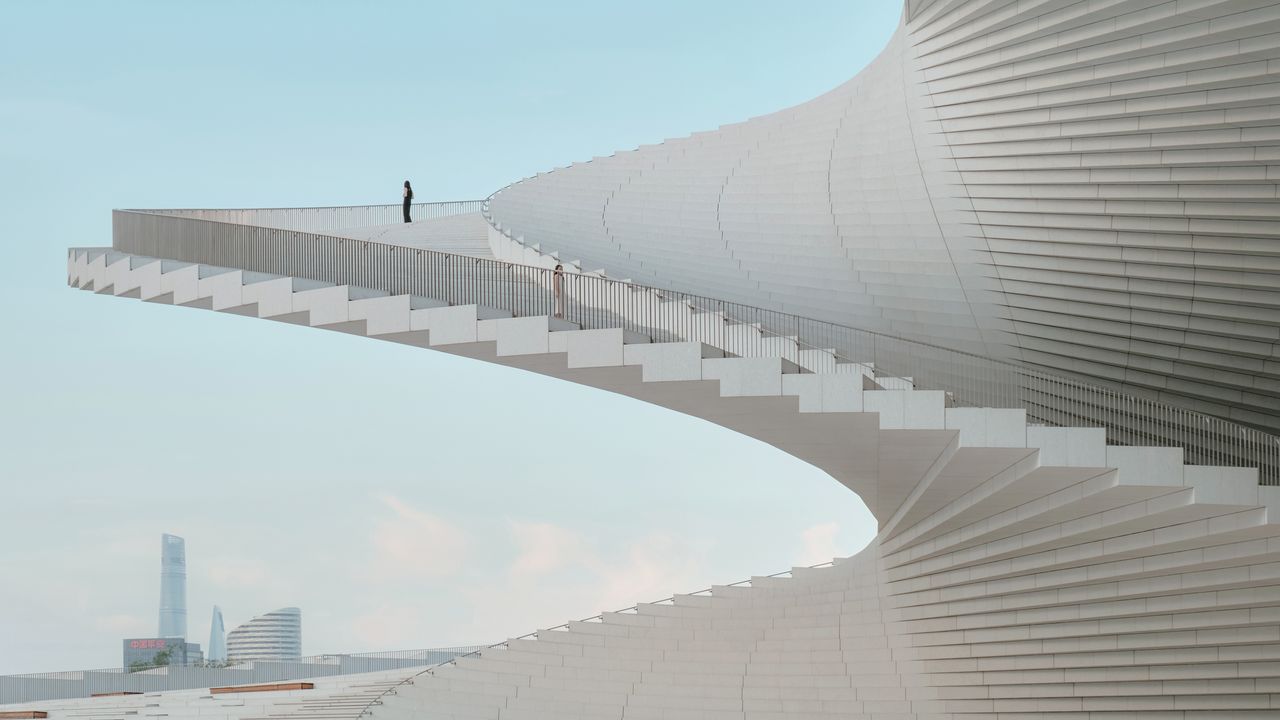
A decade in the making, the cultural center designed by Snøhetta has officially opened to the publicThe Shanghai Grand Opera House has redefined the typology of contemporary performing arts architecture, transforming it from a professional performance venue for ticketed audiences into an urban type open to all citizens.Along the banks of the Huangpu River in Shanghai, a sweeping spiral staircase winds along the side of a white building, flowing upward toward the roof like a puff of smoke hanging in the air. But journey below the gyratory geometry, and a new image appears: The steps and railing become the canvas and sticks of a hand fan unfurled in the wind. This is the recently unveiled Shanghai Grand Opera House, where the site’s sinuous pièce de résistance can be enjoyed well before the curtain rises.“Our initial thought wasn’t about what the building should look like, but rather: How can an important cultural institution be integrated into everyday public life in one of the world’s most vibrant cities?” says Kjetil Trædal Thorsen, founding partner of Snøhetta, the firm behind the project. “We wanted to explore how to transform it into a public landscape—a place where people can stop, experience, and enjoy themselves, whether they are watching a performance or not.”The Shanghai Grand Opera House is located on the banks of the Huangpu River, with a total construction area of approximately 1.6 million square feet. It officially opened to the public on October 17, 2026. The Grand Opera House’s overall architecture responds to the rhythm of the Huangpu River’s tides with a fluid and dynamic form. The continuously rising spiral roof integrates diverse functions such as dining spaces, exhibition spaces, education centers, and the theater into a cohesive whole. Overlooking the Shanghai Grand Opera House, this double-track grand staircase, where one can sit and stroll, has become the stage and theater for the entire city of Shanghai. A decade in the making, the completed project is one of the most significant in contemporary architecture. Spanning roughly 1.6 million square feet, the building encompasses three auditoriums that are equipped for diverse musical performances, including traditional opera, classical music, and even experimental productions. In addition to the venues, the building includes rehearsal, production, education, exhibition, and hospitality spaces, creating an all-encompassing cultural experience.The double helix staircase is the core and main body of the entire building, with independent two-way circulation routes that cleverly separate the flow of people. From below, it resembles a hand fan. Photo: Yumeng ZhuWhen conceiving the project, Snøhetta sought inspiration from the building’s site. Located in the Expo Back Beach area, the adjacent Huangpu River with its flowing stream, passing ships, and winding bends prompted the building’s most important design concept: movement. “While the Shanghai Grand Opera House certainly has distinctive visual characteristics, its form stems from considerations of circulation, participation, and public accessibility. The building’s geometry is closely linked to how people enter, ascend, explore, and experience the space,” Kjetil says.Take the striking steps. While they’re the most visually captivating aspect of the design, they’re also rooted in function, allowing patrons and passersby alike to ascend them and experience the structure in new ways. Once you reach the roof, the views of the Puxi skyline and the river further connect visitors to the environment.This idea continues throughout the rest of the complex, but as Kjetil explains, “the experience unfolds gradually.” Inside, large glass-curtain walls bring natural light into the sweeping lobby; as patrons move closer to the theaters, the design becomes more intimate, while the colors and textures become increasingly rich. “People move between open public landscapes and more intimate indoor environments; natural light changes with the alternation of day and night and the changing seasons,” he adds.The indoor plaza of the Shanghai Grand Opera House comprises three theaters with a total seating capacity of 4,200. Each of the three theaters also possesses a distinct spatial character. The Red Hall, with 2,000 seats, is the heart of the building. A deep burgundy color envelops the audience seating, and its compact five-tiered layout minimizes the distance between the audience and the stage. The meticulously designed balconies, boxes, and walls not only create a visual rhythm but also serve to reflect and propagate sound, turning the theater into its own expertly tuned instrument.The main theater, the Red Hall, has 2,000 seats and is the core performance space of the entire building. The seating is divided into five levels, including floor seating, orchestra seating, and the three-tier balcony seating. Shen Hall, with 1,200 seats, draws inspiration from the spatial form of classical opera houses and can accommodate various performance types, including Baroque opera, classical opera, local operas, and dramas. The Hall of Mirrors, with 1,000 seats, offers greater flexibility; the stage and seating can be adjusted to meet different production needs, creating more possibilities for experimental performances. The Hall of Mirrors also connects to the external landscape through a large glass-curtain wall, allowing light and the scenery beyond to become part of the performance.Shen Hall has 1,200 seats, providing a more immersive viewing environment for smaller productions. But great design isn’t just about what’s on the surface. At the Shanghai Grand Opera House, a network of interconnected tunnels and paths support behind-the-scenes movement necessary for a building program such as this. Audiences, actors, orchestras, stage crew, and backstage staff each have their own distinct movement paths, and multiple theaters must be able to operate simultaneously without interfering with one another. For example, the symphony orchestra’s rehearsal space and orchestra pit are located on corresponding underground floors, allowing for convenient horizontal transport of large instruments.The Hall of Mirrors uses the outdoor landscape as a backdrop for the stage. It features 1,000 seats and a flexible stage and seating layout. More like an open art laboratory, it allows for diverse performance possibilities. As noted, the Shanghai Grand Opera House is more than just a performance venue; it’s also meant to be a touchpoint for anyone in the city, audience member or not. “For us, ‘publicness’ is not just an ideological vision; it must be translated into a spatial reality,” Kjetil says. “People can connect with this space in many ways: watch performances, stroll on the rooftop, meet friends, visit exhibitions, admire the Huangpu River view, and even relive past memories here.”The Shanghai Grand Opera House uses prefabricated components and partial cast-in-place technology to create the striking curved stairs. In an era where architectural images spread rapidly through social media, this building, resembling a white folding fan, undoubtedly has the potential to become a popular landmark. But Kjetil is more concerned with whether people will want to return. “Photographs can spark curiosity, but truly meaningful architecture evokes emotional attachment,” he says. “If I return here in 50 years, I hope to see this building still deeply integrated into the daily life of Shanghai; in people’s eyes, it will no longer be just a ‘new landmark,’ but a familiar part of the city.”This story was originally published by AD China.Not a subscriber? Join AD for print and digital access now.Sign up for our daily newsletter to get the best of design in your inbox.Read MoreThe Best Airbnbs in Paris, Where Romance Meets High-End DesignFrom hidden architectural gems to stays with dazzling Eiffel Tower viewsWhere to Stay in Tokyo: 16 Design-Driven Hotels and Airbnbs in Japan’s CapitalFrom cool boutique accommodations to authentic rentals in the heart of the cityAxel Vervoordt Transforms a 1980s Chalet Into a Serene Mountain Retreat That Feels as Though It Has Always ExistedUsing centuries-old woodwork and ancient stone, the AD100 designer balances art and architecture to achieve peak zen in the Swiss AlpsThe 11 Most Beautiful Flower-Inspired Buildings Across the Globe—and One Is in the United StatesFrom temples in India to high-rises in Qatar, buildings that resemble blooms turn petals into functional formsThis Underground City in Türkiye Is One of the World’s Largest and Most AdvancedArchaeologists discovered that the subterranean network covers far more ground than previously knownThese Kitchens Changed Design History Forever—Inside the Race to Save the Last Ones StandingDevotees have spent years salvaging cabinets and hardware from the world's first modern kitchen. Now a new program is keeping some of the 1926 designs in their original homesInside Derinkuyu, Türkiye’s Massive Underground City Carved Out of Volcanic RockSpanning nearly 27,000 square feet, the subterranean metropolis once housed thousands of peopleThis Midcentury "Treehouse" Is Tailored for Its Tech-Founder Owner—Right Down to the Velvet Conversation Pit and Dry-Erase BoardAquilo Interiors and Butler Armsden Architects collaborated to preserve a historic Berkeley, California, home while infusing it with personalityThe Best Hotels in London Offer Plenty of English RefinementWhether you’re dropping in for high tea or booking a grand guest room upstairsStained glass gets a secular spin as designers and homeowners opt for colorful, handmade panes that deliver us from dull decor. Hallelujah!Artist Sunshine Thacker Built Her Upstate New York Dream House Brimming With Color, Memory, and EmotionIn a shaded clearing in the Hudson Valley, the ceramist realized her lifelong vision of homeBy Amir Capogrossi Badreddine
At the Shanghai Grand Opera House, the Gravity-Defying Staircase Was Designed to Look Like a Hand Fan
Full Article
Original Source
Read the full article at Architecturaldigest →KhanList aggregates and links to publicly available news content. We do not host full articles from third-party sources. Always verify important information with original sources.