
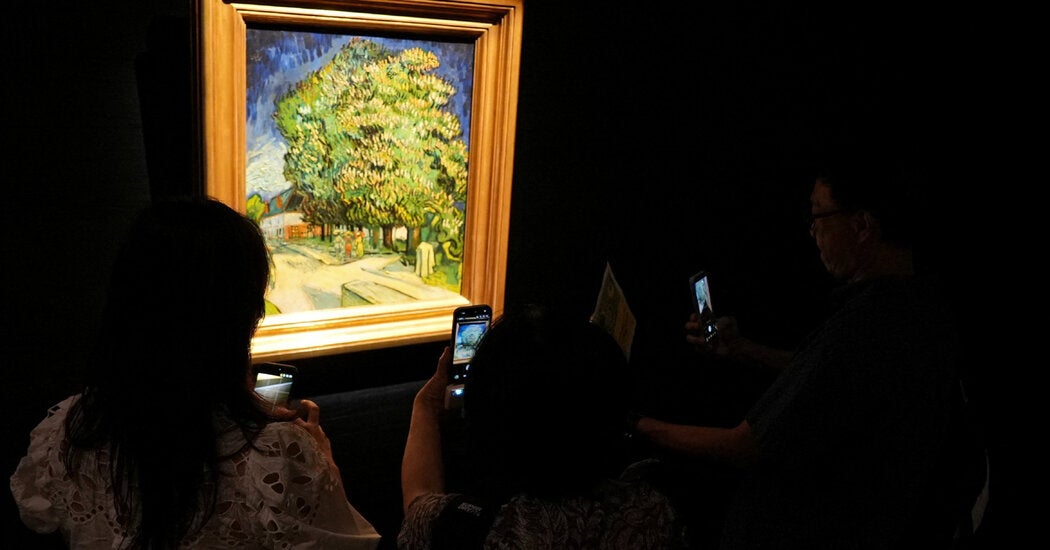
AdvertisementSKIP ADVERTISEMENTClaims on the painting by heirs of a Jewish owner were well known in the art world. The auction house will meet lawyers for the heirs on Monday.Visitors to Sotheby’s in Hong Kong in October looked at Vincent van Gogh’s “Châtaigniers en Fleurs (Blossoming Chestnut Trees),” ahead of its auction in New York.Credit...Joyce Zhou/ReutersNov. 15, 2026, 4:01 p.m. ETSome of the richest people in the world dined at Sotheby’s on Friday evening, on beef and mashed potatoes. Their host, the auction house’s chief executive, Charles Stewart, gave a rousing speech about the more than $1 billion worth of artworks that he was planning to sell this week.What he didn’t say to a room that included billionaires like Linda Macklowe, Hubert Neumann and Mitchell Morgan was that the week’s marquee lot, a dreamy 1890 van Gogh landscape worth around $180 million, was at that very moment in dispute.Earlier that day, Jewish heirs of the collector who previously owned the painting, “Châtaigniers en Fleurs (Blossoming Chestnut Trees),” had requested that Sotheby’s withdraw the lot, due to be auctioned on Wednesday, asserting that it was sold under duress in 1936 because of Nazi-era persecution.Legal representatives from Sotheby’s and the heirs are expected to meet in Manhattan on Monday to discuss a potential settlement.Industry experts said that questions about the van Gogh’s provenance were already being spoken about ahead of the sale, but a public dispute could scare away potential buyers, who would be anxious to know how Sotheby’s had let a painting with such a troubled history reach the salesroom.“It’s a nightmare for Sotheby’s. It’s a nightmare for the owners. It’s a nightmare for the buyers,” said Philip Hoffman, an art adviser who previously worked as an executive in the auction world.He said that even a potential settlement might not alleviate frustrated collectors, since more potential heirs could stake claims on the painting and complicate any agreement reached, even after the sale, leaving consensus on the van Gogh’s provenance uncertain: “We as art advisers stop our clients’ going into anything troublesome, when we could go find something else for $150 million with no trouble at all.”Luke Nikas, a lawyer representing Sotheby’s, said in an interview on Sunday that the company “takes provenance and restitution matters extremely seriously and has undertaken extensive research into the ownership history.For decades, Sotheby’s has employed lawyers and researchers to check the provenance of artworks — especially those that had been collected by Jewish families and that passed through Nazi territories. Relying on that expertise, the company has avoided getting involved in many sales of problematic works; however, Sotheby’s, like much of the auction industry, has still found itself in the middle of disputes with Jewish heirs accusing it of failing to perform due diligence.Earlier this month, a Paris court ordered Sotheby’s to nullify its sale and return a 1902 painting by Camille Pissarro to the heirs of a Jewish banker Salomon Flavian, whose art collection was seized by the Nazis in 1941.Issues with provenance at the auction house have extended beyond artworks like the van Gogh painting. Over the summer, the federal government confiscated a Martian meteorite from Sotheby’s after Justice Department officials raised questions about misleading customs paperwork, flawed provenance and an intermediary seller with a criminal background.Several experts pointed to the fact that Sotheby’s restitution department has lost expertise in recent years. For example, its leading expert, Lucien Simmons, left in 2024 after nearly three decades to become the Met Museum’s head of provenance.The guidelines on the restitution of works lost to the Nazis have also changed in recent years in countries like the United States and the Netherlands, making it easier for Jewish heirs to retrieve artworks owned by their ancestors and sold under duress. Earlier this year, Congress passed legislation to extend the Holocaust Expropriated Art Recovery Act, adding language that gives families extra time to file claims.“The law has evolved to accept the principle that if you were forced — even if you were out of Germany but still had no choice but to sell the asset — it is still considered a sale under duress and the result of Nazi persecution,” explained Sam Dubbin, a lawyer who has represented Jewish families in restitution disputes but is not associated with this case.In the case of the van Gogh painting, the Jewish heirs have asked Sotheby’s to halt its auction.Gunnar Schnabel, a lawyer for one group of heirs, said the painting was sold in 1936 under duress. It had belonged to the family of the Jewish-born German publisher, Samuel Fischer. His family had deposited the van Gogh picture with an Amsterdam gallery in the early 1930s.That painting re-emerged at auction this year as part of the Blaquier-Arrieta collection, a trove of artworks amassed by an Argentine family that made its fortune in the sugar industry. In 2012, the family patriarch, Carlos Pedro Blaquier, was charged with unlawful detention in connection with his suspected involvement in the “disappearance” of left-wing political activists, though he died before standing trial.There was fierce competition between Sotheby’s and Christie’s to secure the collection because the auction houses rely on estate sales, such as this one, to make profits as the market only begins to heal from a yearslong recession.While auction experts acknowledge the van Gogh painting might struggle to find a buyer with the specter of doubt hanging over it, some of them agree it could be a risk worth taking for such a rare painting.“A potential buyer would need to do due diligence on the universe of potential claimants,” Dubbin, the restitution lawyer, said.Zachary Small is a Times reporter writing about the art world’s relationship to money, politics and technology.Related ContentAdvertisementSKIP ADVERTISEMENT
At Sotheby’s, Risk-Taking Left a $180 Million van Gogh in the Lurch
Full Article
Original Source
Read the full article at Nytimes →KhanList aggregates and links to publicly available news content. We do not host full articles from third-party sources. Always verify important information with original sources.