
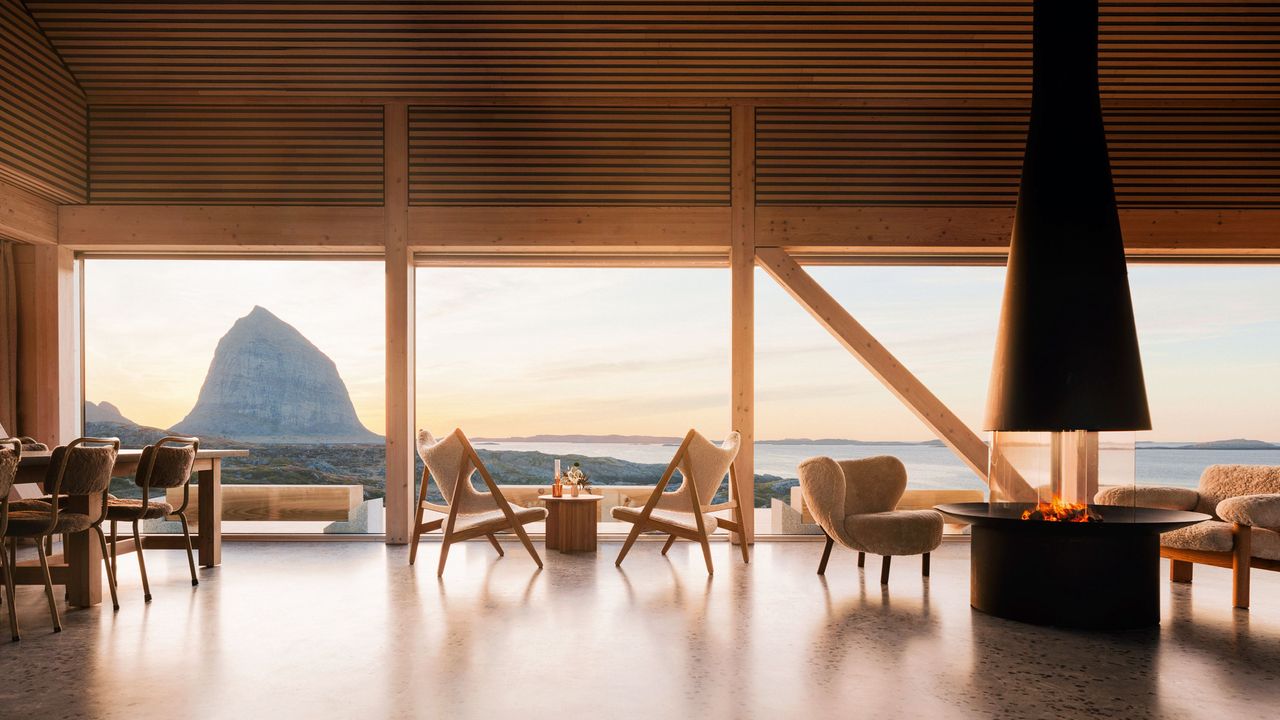
Traveling to Ytri Island Retreat—which bills itself as “Norway’s most remote island retreat,” and is a 112-mile journey by ferry from the northern coastal city of Bodø—is no small feat. It’s perched on Husøya, one of the 477 islands of the Træna archipelago enfolded by blueberry seas—no wonder that its name means “outer point.” But despite the sobering distance and tales of ferocious winter storms that have been known to blow whole buildings into the sea, I find not so much a rugged, isolated hideaway as a smart, well-oiled operation anchored in its community.A cozily furnished suite at Ytri Einar AslaksenThe concept of a luxury hotel was mooted by the locals a decade ago when, facing a hollowing-out of the regional fishing industry, the municipality and local development company Træna 365 gathered to brainstorm alternative futures for the archipelago. After six years of planning, investors Asle Helgheim and Ellen Hestenes—keen sailors with an existing Swedish spa hotel—came on board. Since Ytri Island Retreat opened in April, Træna’s population has increased by almost two percent—a sign that the project’s vision of social sustainability is already bedding in.A bathroom in Ytri with a sea view Einar AslaksenI arrive a few days out from the summer solstice, when the sun appears to move sideways across the sky and the landscape is one of repose. The spartan rocky tufts that unfold from the hotel to the sea are blanketed with moss and wildflowers, and rabbit-tailed strands of swamp wool quiver in the breeze as if they’re bursting to tell me something. Looking back from the shore at Ytri’s cluster of industrial buildings in garnet, mint, and silver—modeled after fishermen’s dwellings—I see its windows catching the golden swell of midnight sun and reflecting a gentle hammered-glass ocean uninterrupted by boats.Scallops seared alfresco at a campfire cookout Jonathan Vivaas KiseInside, the 38 rooms and suites are simple, even monastic: pitched, high, church-like ceilings in pale wood; Norwegian wool cushions and blankets in inky blues and smoky grays; wonky ceramic vases blooming with dried flowers; and a bioelectric fireplace in my suite’s lounge. Design firm Bonaparte Interiør has used local materials such as a terrazzo floor made of sand, stone, and shells from the island, and there are abstract prints by Norwegian artists on the walls and pine-scented Skøn toiletries in the bathroom. But really, the invitation here is to look out. Floor-to-ceiling windows in every room—and a lava-smooth bathtub in mine—all face the emblematic shark-toothed Trænstaven mountain that rears out of the ocean on Sanna island opposite.A look out onto Ytri's private harbor Kitt GrønningsæterHeeding the call, I set out on one of Ytri’s swish custom speedboats with Anders Budde, a water engineer who moved to Træna seven years ago. He’s now one of the hotel’s two activity guides and a free-diver who plucks the scallops and kelp served in the restaurant from the ocean bed. Sanna is one of the oldest inhabited islands in the north. At the Kirkhelleren—church cave—a colossal yawn in the mountainside visible from afar, fish hooks and tools dating back at least 9,000 years have been discovered, as well as mass burials, some containing the remains of people who died of the Black Death. The Trænafestivalen music festival in July culminates with a rave led from its “altar,” a psychic line back to the early travelers who pulled their kayaks ashore here.The hotel’s exterior, whose coloring was inspired by local fishermen's dwellings Einar AslaksenBudde tells me that, despite the ways in which the Lofoten archipelago—a sort-of neighbor, up to nine hours by boat—has been dented by overtourism, he doesn’t worry about the same happening here: “It’s so remote, and there’s a cap to the number who can arrive via sea—only a certain kind of person will make it here.” Private helicopter transfers from Bodø can be arranged, but I take his point: apart from the Hurtigruten cruise ships that offload down-jacketed day trippers here a few times a week, the islands’ inaccessibility is as much their saving grace as their challenge. Those who persevere can look forward to hikes, kayaking excursions, and freediving trips for the brave, and for the less so, drifting out on the water in flotation suits to see the kelp forests and Northern Lights up close, or lazing in Ytri’s ocean-facing sauna.The islands’ wildness finds its way into the food at the hotel’s restaurant, Alma. Breakfast unfolds like a miniature tasting menu: cured lamb and brown cheese, barley porridge, lentil hummus on seed crackers, coffee ground by a man on a neighboring island. From the four-course dinner, a delectable melting brown butter candle scooped up with bread is a tribute to the beacons used by sailors out at sea. But it’s the chef’s table—a 12-course odyssey reimagining a journey from Hawaii to Træna, two islands at opposite ends of the earth—that really stands out. On a shared table with nine strangers, I eat whale tartare to represent Hawaii; mussel chowder in a batter cup for San Francisco; and cod-tongue fish and chips in newspaper, a nod to London. Afterwards I take a dip in the bracing sea with my new friends before we weave our way under the blazing midnight sun to the village pub to watch Norway’s World Cup return. This is the great surprise of Ytri: while there are places travelers can go to escape themselves and others, this harbor for small stories is determinedly not one of them.This article was originally published in Condé Nast Traveller UK.
At Norway's Newest Island Retreat, Redefining the Relationship Between Community and Tourism
Full Article
Original Source
Read the full article at Cntraveler →KhanList aggregates and links to publicly available news content. We do not host full articles from third-party sources. Always verify important information with original sources.