
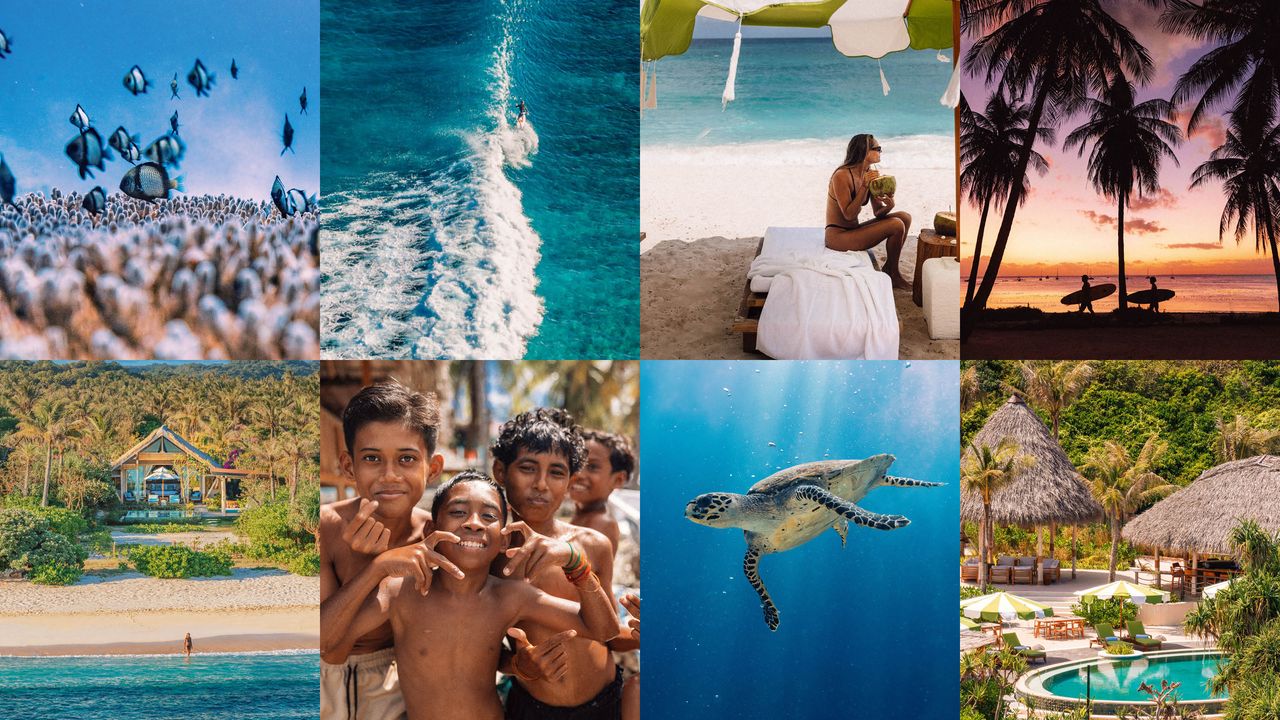
There are not many places left in the world like the tip of Rote. It’s a fragment of coastline on an island off West Timor, which itself is a far-flung extremity of the eastern Indonesian archipelago, closer to Darwin than Jakarta. Aussie surfers started coming here 40-odd years ago, arriving for Rote’s long, clean waves, magicked up by a rare blend of wind, swell, and bathymetry.There are other elements that give Rote its dream-come-true energy: tropical weather, white sand beaches, dense fringes of coconut palms, lingering sunsets, a steady trade wind in the dry season that keeps the mosquitoes down. Rote is, alluringly, always on island time. Crucially, it’s not easy to reach—good for surfers who don’t much like sharing a wave. The long journey to get here is why Rote has stayed Rote, one of the most wonderfully inconvenient places out there.Turtle in the sea off the island Jack JohnsShore in front of Nihi Rote Jack JohnsAmid all this remoteness, the first top-end resort has just opened, Nihi Rote and Hospitality Academy, sister property to Nihi Sumba, west of here. Both these hotels—a few hundred miles apart—front one of the most coveted waves in the world. When I visit, the hotel is still taking shape. At the eastern end of the bay is a clutch of thoughtfully designed, thatched, low-rise villas, each with a swimming pool; the interiors in mine use local materials such as lontar palm and ikat textiles. The gathering place is beach club Nammo, with its poolside restaurant and watersports instructors, smack in front of Bo’a break. Here I wait for the tide to turn before paddling out. When Nihi Rote launches fully in October, there will be 21 villas, three pools, a spa, a pump track, and a golf simulator. It is also planning to build and sell multimillion-dollar residences alongside the property.One night, I’m invited to Rote Hospitality Academy, where Timorese trainees have prepared an endearing evening of traditional song and dance; storytelling; and a feast of coconut rice with lemongrass, rendang beef stew, and grilled fish with sambal. Sitting around the fire pit, toes in the sand, the students share stories with me about the cuisine; traditional string instrument sasando, made of bamboo; and their struggles with learning to swim. For many, it is their first job, or their first job in hospitality, and it’s been a fast-track whirlwind. Before the hotel opened, they had already hosted a big-splash 50th birthday party for its owner, Michael Schwab, son of investment firm founder Charles Schwab. “We’ve never seen anything like this on Rote,” says one student.Traversing Nirwana Lagoon by paddleboard Jack JohnsChange is not always easy, especially in a place that, until recently, relied on seaweed farming and fishing. I feel a pang as I drive past Rote’s cinder-block and tin-roof huts, women on the porch pausing to wave as they plait each other’s hair, sepia-tinged frangipani blossoms strewn on the ground. Rote has long been open to outsiders—and that is increasingly rare in this world of ours. “Do you live here?” is a regular refrain from locals as I freewheel around town. It is always uttered with a smile—on the harbor, at a café, down on the beach. When I reply that I am passing through, they say: Come and live here, you are welcome, bring your family. Many have taken up such invitations, seduced by the island’s stress-free, go-slow rhythm. “We were also passing through,” a South African surfer tells me, echoing my line. “But that was two years ago.” He and his partner have had a baby, bought some land, and are now building a cottage.Blue waters lap at Bo’a Vida Jack JohnsDecorative shells at Sardine Beach Rote Jack JohnsI borrow a bike to explore the main coastal road, sealed but potholed and set back from the seafront, with sandy lanes trailing down to the beaches. Village merges into village, and the only demarcations are bollards painted “selamat datang" (meaning welcome) or a trio of life-sized crucifixes, prettily decorated despite being a symbol of execution. One is painted lavender, another strewn with flowers. The churches here are enormous and numerous, towering vaulted monuments, one resembling a gigantic Noah’s Ark. Catholic, a man tells me, then to be contradicted by his wife: no, Presbyterian. Another says Methodist. The pastor tells me Calvinist. Tropical Christianity, let’s agree on, and fervent. At Easter, I’m told, crowds enact the Stations of the Cross, parading through the streets in the garb of Roman soldiers.The rest of the year, there’s not much more than a scrap of traffic. One day I drive 40 minutes and count two motorbikes and one water bowser. I reach the end of a road that peters out into scrub, nothing beyond and nowhere for me to go. Although there are few vehicles, there are scads of roadside vendors selling gasoline in fancy glass bottles that look more like love potions. Lines of laundry flap. Animals are everywhere: languorous cows, silky-haired goats atop bathroom-tiled gravestones, and broods of chickens crossing the road, I could only assume, to get to the other side.Fish swim amongst the reef, just off Rote. Jack JohnsThis easy-going scene belies the region’s bloody colonial history. Timor was fought over by the Dutch and Portuguese—a battle rooted in the sandalwood and spice trade—resulting in its split into East and West. The British muscled in, but only for a few years, and the Japanese occupied the area during the Second World War. Remnants of history and cultural heritage are not obvious at first glance; some can be seen in the weaving of tessellated tenun ikat textiles and the ti’i langga, resembling a ten-gallon cowboy hat made of lontar palm, worn by men, with a phallic spike on the brim.A hat maker dons the wide-brimmed ti’i langga made of palm. Jack JohnsJuice, fruit bowls, and coffee are served for breakfast at Bo’a Vida. Jack JohnsThe best way to explore Rote, with its offshore islands, reefs, and consistent breaks, is by boat. At one rocky outcrop I find a vast cave of screeching fruit bats. I drop into the water with a mask and snorkel and fast-float in the choppy current to spy on triggerfish and parrotfish. I was told oceanic manta ray and whale sharks congregate here, so I focus my eyes towards the deep, which falls away fast; the next strike of land is Australia.I check out surf sites, ending up on the far side of Ndana Island, Indonesia’s most southerly point. Nobody is around. I spend most of my time crashing and splashing, but nothing can beat the occasional moment standing aloft, feeling the push of a wave, the water so clear I can see fish dashing about the coral. A couple of haggard, sun-smashed Aussie surfers arrive close to the end of the day, so I bow out of the wave, instead bobbing about straddling my board to watch the colors of the sky shift.Back on land I meet locals and newcomers with surf shacks, market stalls, and motorbike hire shops. Hotelier Mick Fogarty is just opening on Rote, after more than 30 years in Bali running the fabled Mick’s Place on Bingin Beach. When I ask him if he feels an ache about leaving Bali, he says “no” before I’ve finished the question. He and his Danish wife, Sascha Hansen, have three pretty self-catering bungalows, and, sensibly, used the best land to build a house for themselves. “We were going to build a restaurant but then thought, why don’t we build a home,” says Fogarty. That sums up the spirit of those who come to Rote. “Everyone moves here for the lifestyle,” he continues, “not to turn a profit, just to sustain a life.”The pool scene at Nammo Beach Club Jack JohnsA sleek chaise lounge at Sardine Beach Rote Jack JohnsAfter sunset, when everyone lopes back from the beach, there are a few couples hitching their gear onto motor scooters and a few families carrying babies, bags, and boards, toddlers in tow. Everyone’s sandy with wet, tangled hair. It’s a strong, fit, healthy scene. “No drugs, no nightclubs," as I keep hearing on repeat. One hotel owner points out, “many of the people here already had their 20 crazy years, so now we can all chill.” Another labels Rote a “retirement village for surfers, who come for peace and quiet."Off Nemberala Beach, T-Land break is one of Indonesia's longest left-hand waves. Jack JohnsCarla Lázaro Ferro from the Canary Islands calls it differently. She lived here, then moved to Berlin, where she found herself “crying for Rote." “Here you feel you can give back. Life is more meaningful, more chaotic, more free,” she tells me. On my last night, I sleep out on the deck of my villa at Ferro’s Bo’a Vida resort, overlooking the Bo’a wave and the Timor Sea. Here on the southern edge of Indonesia, the stars glow like light bulbs, even on the horizon. Only the dazzle of the rising moon dims them. I feel as far away as I could be.Where to stayFollowing the success of its sister resort in Sumba (to the west of Rote), the 21-villa Nihi Rote and Hospitality Academy on Bo’a Beach opens the renowned surf sites to top-end travelers. Villas are a mix of one-bedroom, duplex, and family-style set-ups, and larger residences are planned. The westerly rooms have the best views of the Bo’a break.Bo'a Vida owner Carla Lázaro Ferro opened a thatched shack 15 years ago atop a rocky outcrop at the end of Bo’a Beach, overlooking the legendary wave of the same name and the sunset beyond. Now she has six climate-conscious villas, five of which were designed by her husband, award-winning architect Álvaro Carrillo Eguilaz, with stone paths meandering down to slips of sand and the yoga sala. Ferro also runs the café Indika in town, which serves fruit bowls until 5:30 p.m., when everyone heads out to catch a wave.Nat and Matt Thistlewaite of Rote Island Huts came here from Australia in 2011 after finding the island of Rote on Google Earth. They arrived with the aim of creating a nonprofit holiday retreat that channeled income into local education and the community. There are five simple huts: three are family-style with bunks, all have beachfront access. It’s a heartening enterprise, and they are now preparing to hand over management to local Rotenese, as they always intended.A cozy bungalow at Sardine Beach Rote Jack JohnsPika and Pascal Chevillot, a Slovenian and a Frenchman, used to own Sardine, one of Bali’s top restaurants. At Sardine Beach Rote, they’ve created a spectacular three-villa property in five acres of gardens on one of the island’s best beaches. The rooms use lontar palm and coconut leaf to create traditional roofing, paneled walls, and sconces. Pascal’s breakfast is a real event, with Parmesan omelettes and smoked Spanish mackerel. I notice a copy of Tao Te Ching on a side table, which just about sums up the place.Aussie Mick Fogarty and Sascha Hansen from Denmark are the creators of Mick’s Place Rote, three delightful beachfront bungalows with private courtyards in a glade of coconut trees. The couple are strong on sustainability, harnessing solar power, reusing grey water for the gardens, and lending bicycles for guests to get around on. There's a one-week stay minimum, and the lap pool is set to be the gathering place.At 81 Palms, cabins blend seamlessly into their surroundings. Jack JohnsClose to the T-Land break at Nemberala Beach, Spaniards Julia Davila Solana and Jose Miguel Murgui have built 81 Palms and its six A-frame cabins on the soft sand, plus they’ve recently opened four smaller bungalows at their new Next Door property. The Spanish restaurant is the best place for dinner in Rote, with former Michelin-starred Murgui in the kitchen cooking up gazpacho, tapas, and seafood paella.Natural World Safaris can arrange an 11-day trip combining a B&B stay at COMO Uma Ubud on Bali and a seven-night full-board stay at NIHI Rote & Hospitality Academy on Rote, from £5,800 per person. The price is based on two people sharing and includes all transfers and domestic flights. International airfare is excluded. This story originally appeared in Condé Nast Traveller UK.
At Nihi Rote and Hospitality Academy, Exploring Eastern Indonesia by Boat and Board
Full Article
Original Source
Read the full article at Cntraveler →KhanList aggregates and links to publicly available news content. We do not host full articles from third-party sources. Always verify important information with original sources.