
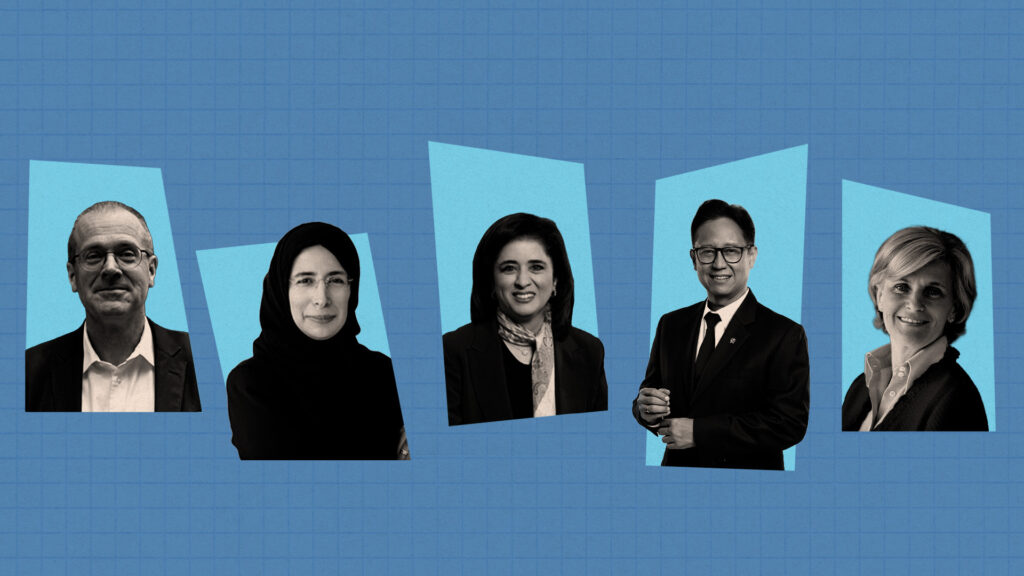
At least five candidates are in the running to become the next director-general of the World Health Organization, a job that will come with extraordinary challenges. The withdrawal of the WHO’s largest funder — the United States — and an overall contraction of international spending on global health has raised crucial questions about how the Geneva-based agency will respond once a successor to Director-General Tedros Adhanom Ghebreyesus takes office. Among many significant issues awaiting this individual will be deciding whether or how to entice the U.S. to either return to the fold, or at least interact more frequently and collaboratively with the WHO. Tedros’ successor will take office on Aug. 16, 2027. “I think this DG election is the most consequential DG election in modern WHO history,” said Lawrence Gostin, director of Georgetown University’s World Health Organization Collaborating Center on Public Health Law and Human Rights “Because the organization is more vulnerable, in a more perilous position, than it’s been at any time in the last 25 years that I can recall.” The nomination period closed Thursday. Five candidates are listed on the WHO’s website, including late entrant Maria Neira, director of the WHO’s environment, climate change, and migration division, who was nominated by Spain. In theory, additional candidates could be named over the coming weeks. The WHO will not release the official list of candidates until all the regional WHO divisions have had their fall meetings; they conclude in early November. These are the five known candidates: Hanan Mohammed Al-Kuwari Qatar’s former public health minister (2016-2024) Al-Kuwari also served as managing director of Qatar’s largest public health provider, Hamad Medical Corporation from 2007 to 2024. She has previously served on the WHO’s Executive Board. She received a Ph.D. in health care management from Brunel University in the United Kingdom. Hanan Balkhy Director of the WHO’s Eastern Mediterranean region since early 2024 Balkhy previously worked at WHO headquarters as assistant director-general for antimicrobial resistance. She is a pediatrician who trained in Saudi Arabia and the U.S. Balkhy was born in the United States and has dual citizenship, a fact she doesn’t emphasize. “I’m Saudi,” she told STAT in an interview in April. Hans Henri P. Kluge Director of the WHO’s European regional directorship since early 2020 A family physician, he received medical degrees from Belgium’s Catholic University of Leuven and the Institute of Tropical Medicine in Antwerp. Prior to joining WHO, he worked internationally for Doctors Without Borders in Africa, Asia, and Russia, where his work focused on tuberculosis and HIV. He led the WHO’s Europe region through the Covid-19 pandemic and the emergence in Europe of mpox. Maria P. Neira Director of the WHO’s environment, climate change, and migration division A last-minute entry into the race, Neira was nominated by Spain, where she worked previously as vice minister of health and consumer affairs and as president of the Spanish Food Safety and Nutrition Agency. Neira has worked for the past 21 years at the WHO. She is a physician who trained in endocrinology and metabolic diseases. Budi Gunadi Sadikin Indonesia’s health minister since late 2020 If he is successful, Budi (Indonesians generally use their first name on second reference) would be the first director-general with neither a medical degree nor an advanced degree. Budi has a bachelor of science degree in engineering physics from the Bandung Institute of Technology. He has had a long and successful business career, primarily in banking. He steered his country through the Covid pandemic. Thomas Bollyky, director of the Council on Foreign Relations’ global health program, said he wasn’t surprised by the number of candidates, but he had expected a field that was more geographically diverse. There has never been a director-general from the Eastern Mediterranean region. (Before Tedros, there had never been a director-general from Africa either.) But experts told STAT they thought it was unlikely that would be a factor in the race. Suerie Moon, director of the global health center at the Geneva Graduate Institute, said with two candidates from the Eastern European region and two from the Europe region, it seems likely votes within at least one of those regions will be split. “I doubt most regions will vote as unified blocks, in any case, and the idea of ‘taking turns’ across the regions is no longer carrying much weight,” she said. Bollyky doesn’t believe there is a current frontrunner. Gostin believes there is a groundswell of support for Budi. “WHO really needs a technically excellent person, and it seems to me that, rather than the usual person that’s got mostly the health/public health/science chops, having a former banker and corporate executive is quite attractive,” Gostin said. “I think having a technocrat, particularly an economic and corporate technocrat, might be very appealing to countries, particularly since he’s from the global south and a very powerful mover on the equity front.” The U.S. withdrawal from the WHO — attributed largely on Trump’s belief that the agency had mishandled the response to the Covid pandemic — left a gaping hole in the agency’s coffers. It was the single largest funder of the agency, with assessed contributions for 2025 of $130 million — which the country did not pay before departing. (Though the congressional resolution that allowed the U.S. to withdraw from the WHO stipulated that it should pay all outstanding monies owed first, the Trump administration left nearly $278 million in unpaid fees when it quit.) In addition to assessed contributions, which are effectively dues, the U.S. was a major provider of voluntary contributions, used to fund work deemed of importance to the donor country. In the 2022-2023 budget period, the U.S. contributed nearly $1.3 billion in dues and voluntary contributions. The next largest contributor was Germany, which added $856 million. This year has seen major cost-cutting at the WHO and the financing issue will continue to be daunting, said Moon. Bollyky agreed. “I absolutely think that finding a WHO leader who can stabilize institution financing, rebuild its credibility, and make hard choices about its future role is going to be key,” he said. Another major challenge the next director-general will face is what to do with the United States. While there is still some communication between the country and the WHO — Tedros recently told a group of reporters that he speaks at times with health secretary Robert F. Kennedy Jr., and the agency interacted regularly with the U.S. during this spring’s hantavirus outbreak — there are no official ties. “Everybody I talk to thinks that this is one of the factors going on: Will there be somebody that can work with the United States?” said Gostin. There appears to be little hope of a rapprochement while President Trump is in office. And Moon said she isn’t sure there’s even universal willingness among the WHO member states to try to change that. “I think views are divided on how big a priority it is for the next DG to be able to rebuild bridges with the United States. But I think that decision is much less in the hands of the DG and much more in the hands of the U.S.,” she said. Another looming question is whether the U.S. — or Trump himself — might try to influence the outcome of the election through political horse-trading in response to requests for help from a nominating country. That could backfire, several experts suggested. The next phase in the election process occurs in mid-November, when a candidates’ forum will be held. When the WHO’s executive board, a committee of 34 members from around the globe, meets in January, it will shortlist five candidates to interview, then whittle the list down to three. The election will take place by secret ballot in May during the WHO’s annual general meeting, the World Health Assembly.
At least five candidates vie to become the next WHO leader, as questions over U.S. role loom
Full Article
Original Source
Read the full article at Statnews →KhanList aggregates and links to publicly available news content. We do not host full articles from third-party sources. Always verify important information with original sources.