
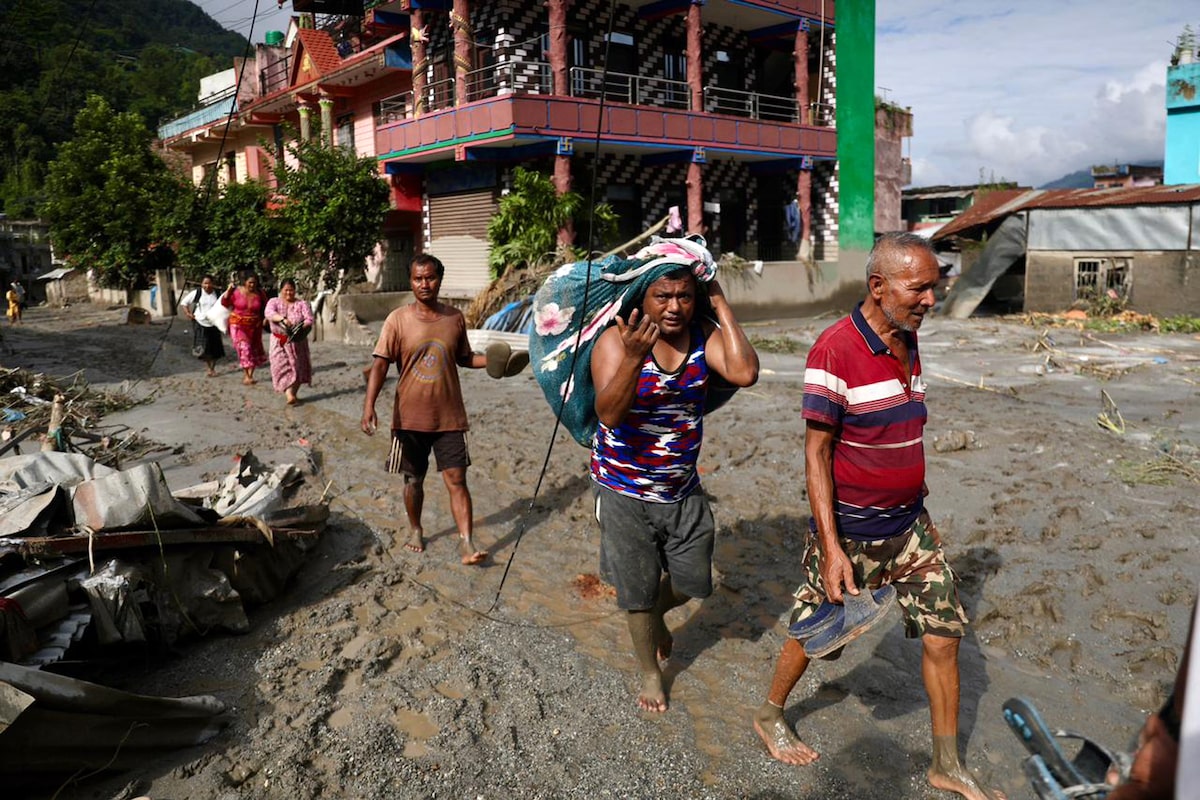
Rescuers are searching for around 1,500 people after a torrent of water, ice and mud caused by a glacial collapse smashed through a river valley on the mountainous border of Nepal and China, destroying buildings and sweeping away bridges. Some 800 foreigners, including at least 25 Canadians, are among the missing, according to the Nepalese authorities. Nepalese police said Thursday that 270 bodies have already been found by authorities. Police expect that number to rise significantly as they pick through the rubble and debris left in the flood’s wake. Popular with mountaineers and pilgrims travelling from Lhasa in Tibet to the Nepalese capital of Kathmandu, the remote nature of the region is hampering rescue efforts, with supplies having to be dropped by helicopter for the thousands now effectively cut off by Wednesday’s disaster. Mudslides have blocked roads leading to Gyirong, in China’s Tibet Autonomous Region, according to Chinese state media. Some 800 rescue workers and dozens of vehicles, along with dogs, scanners and speed boats, have been dispatched to the region, after Chinese President Xi Jinping ordered “all-out efforts” to respond to the disaster. Speaking to state broadcaster CCTV, soldier Chang Kun said roads in the region had been “completely destroyed, communication was cut off and contact with the outside world was lost.” Heavy rains could mean further landslides could occur “at any time,” he said. Open this photo in gallery:Police personnel rescue stranded residents from houses after flash floods at Trishuli in Nepal's Nuwakot district on Aug. 27.ARUN SANKAR/AFP/Getty ImagesThe disaster in Nepal and Tibet is not a one-off. The Lhende Khola river system has now flooded twice in just 14 months and the increasingly unstable Himalayan ice system threatens communities, infrastructure and water supplies across one of the world’s most densely populated regions. Wednesday’s floods were likely triggered by the partial collapse of a glacier, with a huge piece of ice falling hundreds of metres into the river below, creating a massive wave which swept down the valley. The impact was equivalent to a 5.2-magnitude earthquake, according to the U.S. Geological Survey. The region saw similar flash floods in August last year, when a glacial lake in Tibet overflowed because of high temperatures. Nine people were killed, and critical infrastructure, including a bridge connecting Nepal and China, was damaged.Drone footage in Nepal showed roads destroyed and buildings buried by thundering water the colour of wet cement. There was little time for anyone to flee.“When I reached Dhunge bazaar, in half an hour, the flood came and damaged all the market. People were preparing to go to office then,” resident Shoyam Rajbhandari said. “How many people are missing or dead, we don’t know.”Tula Bahadur BK, a health worker in Rasuwa, said there was “devastation everywhere.” “The settlements next to the river have been completely swept away,” he said. “Five of my own relatives are missing.”Open this photo in gallery:A woman cries as she waits for updates on whereabouts of her missing family member outside the Maithali Barrack, an army training centre which serves as a primary base to airlift survivors from Rasuwa at Trishuli in Nuwakot district, Nepal, on Thursday.Navesh Chitrakar/ReutersIn a statement, Global Affairs Canada (GAC) said there are hundreds of Canadians registered as being in Nepal, and five in Tibet, but since such declarations are voluntary and not made by all travellers, it may take time to ascertain just how many Canadians have been affected by Wednesday’s disaster. “Due to power outages in the region, establishing full communication with those on the ground may be challenging and may take time,” the statement added. Nepalese authorities said they were aware of at least 25 Canadians among the missing, as well as 177 Indians, 63 from the United States, 34 from Australia and 33 from Britain. China’s foreign ministry said Thursday that at least 260 foreigners were reported missing in the affected area of Tibet, without giving a breakdown by nationality, while some 100 Chinese citizens are reported missing in Nepal.Among the Canadians affected are 10 who were on a trip with adventure-travel company Himalayan Glacier, sales director Sanket Pandey told The Globe and Mail in a phone interview. Mr. Pandey said the company lost contact with its Nepal team leaders at roughly 8:30 a.m. local time on Wednesday and have since failed to re-establish communication. The company’s chief executive officer, Sagar Pandey, surveyed the damage by helicopter on Wednesday morning but the aircraft was unable to land.Open this photo in gallery:An aerial view of the aftermath at Devighat, Bidur Municipality, along the confluence of the Trishuli and Tadi rivers in Nepal's Nuwakot district on Thursday.PRABIN RANABHAT/AFP/Getty ImagesPrime Minister Mark Carney said Canada “stands ready to provide support” and encouraged Canadians in the region to register with the Global Affairs service, which lets the federal government contact and assist citizens during emergencies in other countries.“The flash floods along Nepal’s Bhotekoshi River are absolutely devastating,” Mr. Carney said on social media. “Canadians are thinking of all those in distress right now, those who have lost a loved one, and all those who are still waiting for answers.” Leaders from across Europe and Asia have also pledged assistance for Nepal, a developing country which just over a decade ago was struck by a magnitude-8.0 earthquake which killed almost 9,000 people and destroyed villages across the Himalayas. Shisir Khanal, Nepal’s foreign minister, compared Wednesday’s disaster to the 2015 earthquake, and said “at the end of the day” the country was highly resilient, and “every time there’s been a disaster, we’ve come back.” He urged foreigners considering to travel to Nepal not to be put off by the floods, which Mr. Khanal emphasized were localized in a very specific region of the country. “One way in which you can support us is to spend your tourism dollars in Nepal in the next few months,” he added. The Himalayan mountain range spans several countries in South Asia and has many of the world’s highest peaks and remaining glaciers.The steep slopes and the lush valleys below the Himalayan mountain range are especially vulnerable to flooding and landslides, and extreme weather events like intense monsoons and melting glaciers have become more common because of warming due to human-caused climate change.Researchers in Kathmandu found earlier this year that glaciers across the Hindu Kush Himalaya region are melting faster, with ice loss rates doubling since 2000. With reports from Reuters, the Associated Press and the Canadian Press
At least 25 Canadians among 1,500 missing in Nepal and Tibet after catastrophic floods
Full Article
Original Source
Read the full article at Theglobeandmail →KhanList aggregates and links to publicly available news content. We do not host full articles from third-party sources. Always verify important information with original sources.