
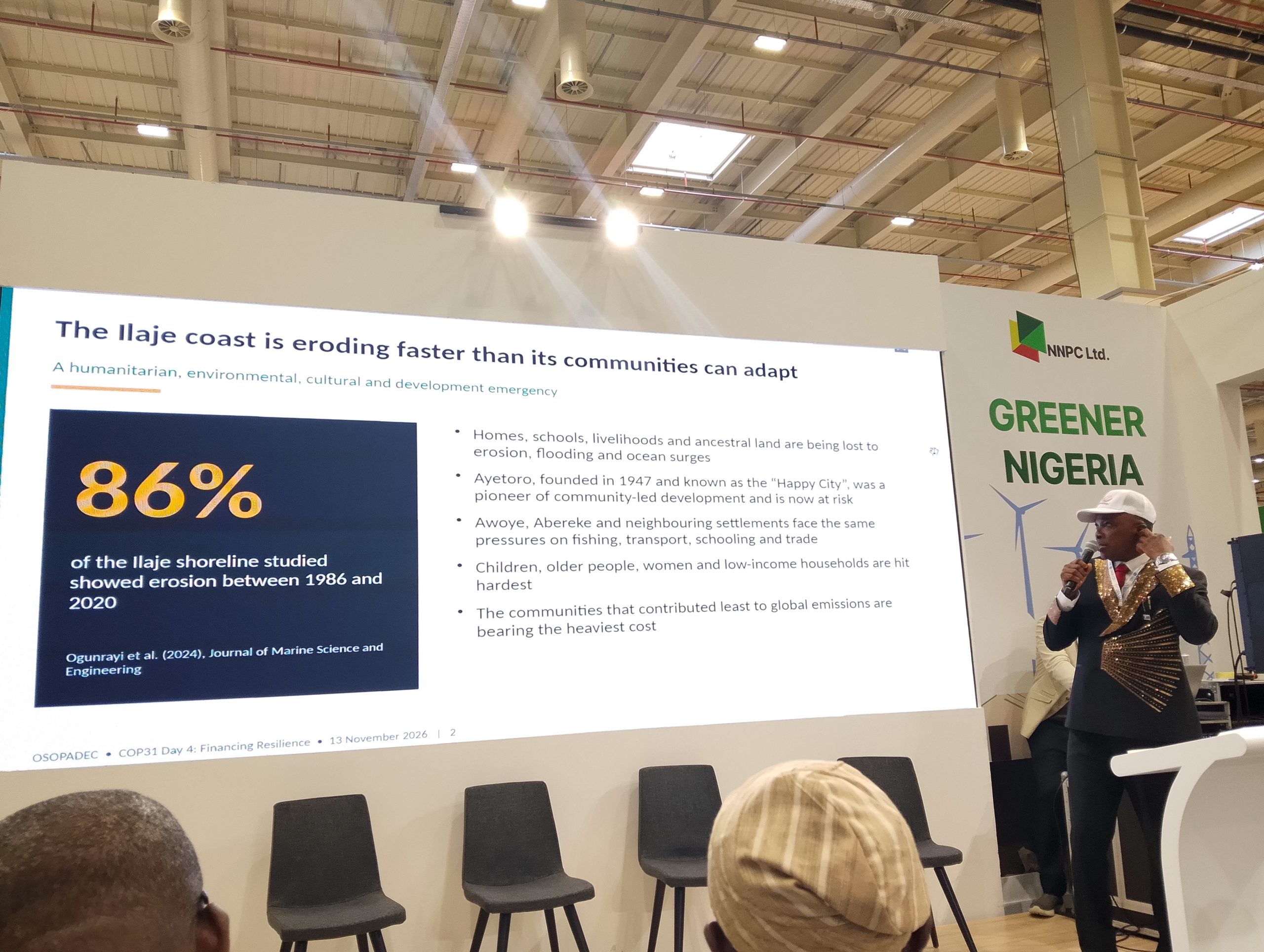
Chiemelie Eze in Antalya, Turkiye The people of Ayetoro, a coastal community in Ilaje Local Government Area of Ondo State, are watching the sea gradually take away more than their land. With homes, schools, livelihoods and ancestral heritage increasingly threatened by coastal erosion, flooding and ocean surges, the future of the community and neighbouring settlements has become a growing humanitarian concern. For generations, the people of Ayetoro have depended on the Atlantic Ocean for their livelihoods, with fishing, marine transportation, trade and other economic activities sustaining families and connecting communities. But the same coastline that has shaped their identity and supported their economy is now threatening their continued existence. Founded in 1947 and popularly known as the “Happy City”, Ayetoro was once celebrated for its community-led development and social organisation. Today, however, its survival is under threat as coastal erosion and rising environmental pressures continue to undermine the foundations of community life. The situation extends beyond Ayetoro to Awoye, Abereke and other vulnerable settlements in the Ilaje coastal belt, where families face similar challenges, including the loss of homes, disruption of education, declining livelihoods and increasing exposure to flooding and ocean surges. Presenting the situation at COP31 in Antalya, Türkiye, the Director of Budget at the Ondo State Oil Producing Areas Development Commission (OSOPADEC), Dr. Frank Menukuro, described the situation as a humanitarian, environmental, cultural and development emergency requiring urgent and coordinated intervention. According to Menukuro, research findings show the scale of the threat, with 86 per cent of the Ilaje shoreline studied experiencing erosion between 1986 and 2020. He cited a 2024 study by Ogunrayi and other researchers, published in the Journal of Marine Science and Engineering, to underscore the extent of coastal degradation confronting the area. The consequences, he explained, go beyond the physical disappearance of land. Every stretch of coastline lost potentially means another home displaced, another livelihood disrupted and another part of the communities’ history placed at risk. The most vulnerable, he noted, are children, older people, women and low-income households, who often have fewer resources to recover when homes and sources of income are destroyed. Menukuro observed that the situation presents a troubling climate justice question: communities that have contributed least to global greenhouse gas emissions are bearing some of the heaviest consequences of climate change. For families in these settlements, the challenge is not simply how to protect the coastline but how to preserve their communities, maintain access to essential services and secure a future for the next generation. Learning From Other Coastal Communities Menukuro said the experience of other coastal communities across Africa and beyond demonstrates that the challenge confronting Ilaje is not without solutions, provided interventions are properly planned and adequately financed. He cited the West Africa Coastal Areas Resilience Investment Project (WACA ResIP 2), which received $246 million in International Development Association financing in December 2022 for interventions in The Gambia, Ghana and Guinea-Bissau. He also referenced Senegal’s Saint-Louis coastal protection programme, which received a $30 million IDA credit to reduce vulnerability to coastal hazards along the Langue de Barbarie, including plans for dignified relocation where necessary. In Mozambique, he pointed to interventions in Beira involving drainage improvements, rehabilitation of the Chiveve River and the development of a green park incorporating restored mangroves, supported through climate funds and financing from KfW. Bangladesh, he added, offers another example, with a $400 million World Bank programme designed to protect more than 400,000 people from tidal flooding and storm surges through embankment interventions. For Menukuro, these examples demonstrate the importance of combining different approaches rather than relying on a single coastal protection structure. He stressed that Ilaje requires a portfolio of interventions encompassing shoreline engineering, improved drainage, ecosystem restoration, early warning systems, livelihood protection and, where unavoidable, planned relocation. He was, however, careful to clarify that Ilaje is not currently a beneficiary of WACA, noting that the experiences of other countries should serve as lessons for developing a locally appropriate programme. A Coordinated Plan to Save Ilaje Against this background, Menukuro proposed the Ilaje Coastal Resilience and Restoration Initiative (ICRRI), a coordinated programme designed to address the environmental, economic and humanitarian dimensions of coastal vulnerability. The proposed initiative has six pillars, beginning with coastal protection through site-specific breakwaters, groynes, revetments and shoreline stabilisation. He explained that the choice of engineering solutions must be guided by rigorous scientific studies to ensure that interventions respond to the particular conditions of each location. The second pillar focuses on ecosystem restoration, including mangroves, wetlands and dune systems, which could provide nature-based protection against coastal hazards. The third addresses the living conditions of vulnerable communities through climate-resilient housing, improved drainage, water infrastructure, schools and health facilities. Menukuro said livelihood security must also form a central part of the intervention, given the dependence of many coastal households on fishing, aquaculture, boat-building, marine transportation and related enterprises. He identified humanitarian safety as another priority, proposing early warning systems, emergency response arrangements and dignified relocation where communities can no longer be safely protected. The sixth pillar focuses on governance, with emphasis on community participation, environmental and social safeguards, transparent procurement, maintenance and the preservation of cultural heritage. The proposed geographical coverage includes Ayetoro, Awoye, Abereke and other vulnerable Ilaje settlements, subject to scientific assessment and consultation with affected communities. For Menukuro, the involvement of residents is particularly important because the success of any intervention will depend not only on engineering decisions but also on the needs, experiences and acceptance of the people whose lives are directly affected. From Climate Appeal to Sustainable Investment However, he acknowledged that turning the proposal into reality would require substantial financial resources, careful preparation and a phased approach capable of attracting climate and development financing. He outlined a four-phase pathway, beginning with technical preparation involving satellite and field surveys, bathymetric studies, wave and tidal modelling, environmental and social assessments, and feasibility designs. According to him, preparation grants and technical assistance would provide the initial financing required to establish the scientific and engineering basis for the project. The second phase would involve demonstration projects, including priority coastal protection, drainage improvements, ecosystem restoration and urgent safeguards for vulnerable communities. This stage would be supported through adaptation grants and concessional financing. The third phase would expand the interventions through coastal infrastructure, resilient housing, livelihood recovery and ecosystem restoration across the wider coastal corridor, using blended climate and development finance. The final phase would focus on sustaining the investments through maintenance, monitoring, community management and independent evaluation, supported by domestic budgetary provisions and long-term resilience funds. Menukuro emphasised that no project cost should be announced before the necessary engineering and feasibility studies are completed, stressing the importance of developing a credible investment proposal rather than making financial projections without adequate technical backing. A Future Beyond Disappearing Shorelines At the heart of Menukuro’s presentation is a concern that extends beyond infrastructure and funding: the possibility that communities with deep historical and cultural roots could gradually lose the places they call home. For the people of Ayetoro, the threat is not an abstract discussion about climate change. It is about the security of their homes, the continuity of their livelihoods, the education of their children and the preservation of a community founded nearly eight decades ago. Menukuro argued that climate finance must translate into practical interventions for communities already experiencing the consequences of environmental degradation, rather than remain a promise deferred through international discussions and policy commitments. He maintained that the experiences of other coastal communities demonstrate that solutions are possible, provided there is the political will, technical preparation and financial commitment to implement them. His appeal at COP31 was therefore both a call for international support and an appeal to recognise the human cost of inaction. As he put it in the closing message of his presentation: “The people of Ayetoro did not create the climate crisis, yet they are losing homes, livelihoods and heritage.” He urged stakeholders to ensure that climate financing becomes a lifeline for vulnerable communities rather than another unfulfilled promise. The message was captured in the closing appeal of his presentation: Save Ayetoro. Protect Awoye. Restore Ilaje.
At COP31, OSOPADEC Champions Climate Financing for Ilaje Communities Facing Displacement as Rising Seas Threaten Homes, Livelihoods and Heritage
Full Article
Original Source
Read the full article at Thisdaylive →KhanList aggregates and links to publicly available news content. We do not host full articles from third-party sources. Always verify important information with original sources.