
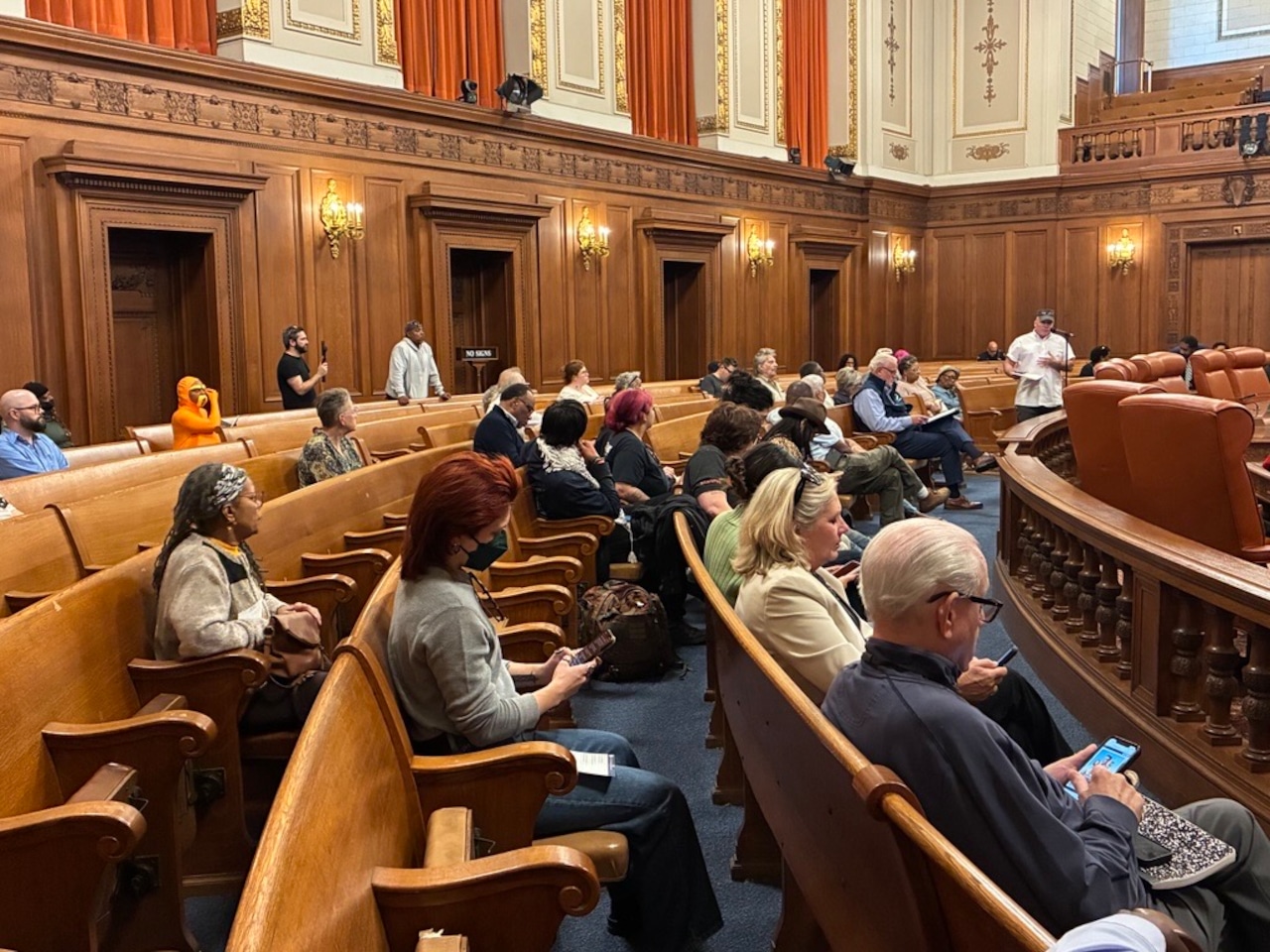
CLEVELAND, Ohio — Jurnee Weeams came to Cleveland City Hall on Tuesday night dressed as the Lorax, the Dr. Seuss character who she says cautions what greed can do to the natural world.Weeams was one of about 50 people at the second of three public hearings Cleveland City Council is holding as it considers how data centers should be regulated before the city’s temporary moratorium on new standalone facilities expires Oct. 20.“I feel like it’s kind of a warning and I want to give that warning to our politicians,” Weeams told cleveland.com before the hearing. “This can be our future if we allow the AI race greed to consume our resources and our neighborhoods.”Residents of different ages and from neighborhoods across Cleveland, as well as people who live outside the city, weighed in on how the facilities should be regulated. Their comments repeatedly returned to electric bills, water, noise, environmental impacts and what Cleveland neighborhoods would get in return.About half of council’s members attended, along with Kate Nielson, who is leading the administration’s work on data centers. Councilman Brian Kazy, who moderated the hearing and chairs council’s Utilities Committee, said the feedback is intended to help shape legislation council may ultimately consider.“We’re in the process of educating ourselves, learning, hearing from residents and then working with the administration to come up with a plan for data centers,” Kazy said at the hearing.He stressed that council has not taken a position for or against data centers and pushed back on online claims that members have already decided whether to allow or block them. The hearings so far also have raised potential ideas for legislation that officials had not previously considered, Kazy said.No data center legislation has been introduced yet. In a phone interview Wednesday, Kazy said council wanted to first hear from the public “to help guide us in assuring we do what’s best for the residents.”Not all data centers are alikeThe hearing opened with a presentation on electricity, water, zoning, planning and the distinction between types of data centers.City officials have sorted the facilities into four types: edge, enterprise, colocation and hyperscale. Edge facilities can be less than 5,000 square feet and handle things such as real-time data processing. Enterprise facilities serve a single organization, while colocation facilities house equipment for multiple customers.At the other end are hyperscale facilities, which can range from 100,000 to 1 million square feet and are built for massive computing loads, including artificial intelligence and cloud computing.Cleveland currently has no hyperscale, standalone data centers, according a city press release. But officials are trying to determine what rules should govern them if one is proposed. Kazy said the difference in resource demand can be significant, which is why it is important for the public to understand how the impacts differ from one type of facility to the next. Concerns shared at the first two hearings have largely focused on the potential effects of the largest facilities, he said.Many residents asked whether data centers could drive up electric bills or put more strain on the city’s electric system.Kazy said City Council moved to protect Cleveland Public Power customers before it approved the moratorium. He said an ordinance passed by council requires large customers seeking to connect to Cleveland Public Power to pay for the necessary assessment and any required interconnection or system upgrades.“There would be no cost to public power, no cost to the city and no cost to the residents,” Kazy said.He said that protection applies to loads up to about 50 megawatts.‘It should not just be about money’During the public comments that followed the presentation, speakers raised concerns that went well beyond the technology itself.“It should not just be about money. It should be about our lives, our health and for generations to come,” one speaker said. She pointed to the mayflies that return every year as a sign of healthy water. “We don’t need somebody coming here polluting.”Another speaker said the shows she has seen about people living near data centers suggest they “don’t find it to be a positive at all.” She asked why Cleveland would tap Lake Erie, “a natural resource for us,” and strain its electric grid. She also asked whether the companies would get tax breaks.“We’re taxpaying citizens, but it seems like in some locations they are not paying taxes,” she said.One attendee called for a requirement that developers demonstrate their environmental impact and monitor it continuously. He also suggested that council require developers to invest in the community, for example through STEM education or emergency power infrastructure.Most speakers raised concerns, but not everyone opposed data centers. One speaker called it a “positive movement” and said that the expansion of data centers is inevitable.“There’s going to be more data centers. It’s just going to happen, but we’re going to perfect it,” he said. He praised the city’s presentation and urged officials to do more to educate the public.Before the hearing, Lametria and Timothy Kinney, who have lived in their Collinwood home for nearly 20 years, told cleveland.com that they try to stay involved in their community and have spoken out about issues they believe affect their neighborhood.Timothy, 75, has lived in Cleveland his entire life. From his perspective, the process can look like wealthy interests are able to take what they want.“It’s just take what you want. If you’re rich, I guess,” he said.Their concerns Tuesday included data centers’ effects on health, the environment, plant life, noise and costs, as well as what benefits could come to Cleveland residents.“I want to know who’s paying for them and what do we get from being here?” Lametria said. “Because so far, it seems like nothing.”What comes nextThe city’s temporary moratorium, approved in July, prevents Cleveland from reviewing or issuing permits for new standalone data centers that would be the principal use of a property, as well as expansions of existing standalone data centers. Existing data centers can continue operating.The city has said the pause is intended to give officials time to study data centers’ potential effects on neighborhoods, infrastructure and natural resources. Council has the authority to extend the moratorium if it needs more time.Kazy said council has not predetermined what policy it will pursue or whether the moratorium will be extended.“We will not make a final decision until we have all the information and everybody has been able to provide input on this, no matter if it’s October 20th or if there needs to be an extension,” he said. He said council members also are examining how other cities, states and communities have handled hyperscale data centers and their potential impacts.“We are doing our due diligence,” Kazy said. “We just want to make sure that we get it right.”Council members are taking notes on residents’ comments and plan to publish a summary of the council’s findings, according to Kazy. He added that council will continue to engage residents after the initial process is complete “for further discussion on data centers in general.”For now, the city is still gathering information. The final hearing is scheduled for 6 to 8 p.m. Oct. 7 at Gunning Recreation Center.
At Cleveland data center hearing, residents ask who pays — and what they get in return
Full Article
Original Source
Read the full article at Cleveland →KhanList aggregates and links to publicly available news content. We do not host full articles from third-party sources. Always verify important information with original sources.