
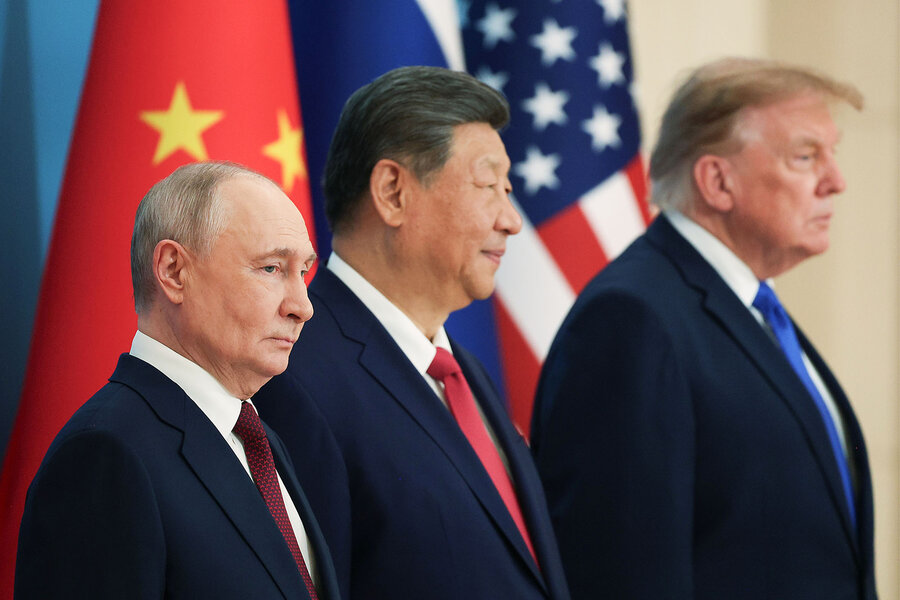
Washington | Nov. 20, 2026, 4:42 p.m. ET | 5 min read And the winner is ... Vladimir Putin.The first-ever trilateral meeting between Chinese leader Xi Jinping, U.S. President Donald Trump, and Russia’s President Putin in China had something for each leader to crow about.Mr. Xi can say he showcased China’s rise to preeminence on the world stage by hosting the strongman meeting Thursday and standing shoulder to shoulder with the post-World War II era’s legacy powers. Mr. Trump, after arguably the worst political drubbing an American president has suffered in midterm elections in seven decades, can argue he reasserted his unequaled power in global affairs – while advancing the issues, like nuclear arms control, for which he hopes to be remembered decades hence.But it was the Russian leader who hands down benefited most from the trilateral encounter, analysts say.Despite his country’s lack of a claim to great-power status, save for the world’s-largest nuclear arsenal, Mr. Putin managed to impose himself at the table with the two legitimate superpowers to create the image of a club of three determining world affairs. Another clear plus for Mr. Putin came on the issue of Ukraine and Russia’s nearly five-year war there. Once again, he was able to use a meeting with President Trump to sway him to Moscow’s perspective.While still in the air on his return to Washington, Mr. Trump put in a surprise call to Ukraine’s European allies meeting in Berlin to say he was convinced Mr. Putin was ready to negotiate an end to the war. What’s more, he blasted the Europeans for continuing to send billions in military aid to Kyiv, something he reportedly claimed was prolonging the fighting and costing lives.Strikes on Kyiv and PolandRussia appeared to waste no time in acting on the warm bond with President Trump – and an enhanced confidence that the U.S. is adopting its perspective. Just hours after the leaders’ spoke in Shenzhen, Moscow unleashed one of its heaviest airstrikes on Kyiv, targeting bridges and energy infrastructure and killing at least eight civilians. Vyacheslav Prokofyev/APPresident Trump shakes hands with President Putin during a meeting on the sidelines of the Asia-Pacific Economic Cooperation summit in Shenzhen, China, Nov. 19, 2026. Poland, meanwhile, reported that a Russian missile struck its territory, an act it called a “provocation” and which continued a pattern of unclaimed drone and cyber attacks in Europe, in particular on NATO members formerly part of the Soviet Union.Mr. Putin was able to accomplish all that he did at Shenzhen despite being the clear junior partner in the troika, analysts say.“Putin is the big beneficiary of having a big-three meeting because, as everyone recognizes, he’s not really entitled to be in the big three, except by the size of nuclear arsenals,” says Stephen Sestanovich, senior fellow for Russian and Eurasian studies at the Council on Foreign Relations (CFR) in Washington.The U.S. and Chinese economies far surpass Russia’s, which just barely squeaks into the global top 10, while its military is stuck in a ruinous war. Yet Mr. Putin also comes out the winner because the image of a privileged few powerbrokers managing world affairs appeals to Mr. Trump, Dr. Sestanovich notes, adding that the Russian leader can only view positively any alignment of his and Mr. Trump’s outlooks.“There is no doubt that Trump likes the idea of a club of great powers,” he says. “From Putin’s point of view, that’s a big plus.”In the run-up to the Shenzhen trilateral, diplomats and analysts concurred that just a photo of the three leaders standing side by side would be enough for Mr. Putin. The summit’s Xi-Trump-Putin portrait offers a sharp contrast with how the Russian leader has been shunned at major international gatherings since Russia’s invasion of Ukraine.Concerns in EuropeBut in the end he got much more.Mr. Trump made a point of publicly addressing the Russian leader as “my friend.” Before entering a bilateral sit-down with Mr. Putin, he told assembled media that “we’ve had a great relationship for many years ... and I think a lot of wonderful things can come out of this, or at least start.”A bigger surprise was inclusion in a joint statement issued by the three leaders of language declaring immunity for state officials “of fundamental importance” – a stab at the rules-based international order the U.S. has led in the postwar era. Additional wording declaring that the “International Criminal Court and other similar bodies should not abuse their powers” was sweet music for Mr. Putin, who is accused by the ICC of committing war crimes in Ukraine. Virginia Mayo/APFrom left, Ukrainian Defense Minister Evgeniy Khmara, U.S. Undersecretary of Defense Elbridge Colby, German Defense Minister Boris Pistorius, and British Defense Secretary Wes Streeting attend a meeting of the Ukraine Defense Contact Group at NATO headquarters in Brussels, Nov. 17, 2026. Yet if the Shenzhen trilateral summit had a big winner in Mr. Putin, it’s also true the meeting had its big losers, and two in particular, analysts say: Europe and Ukraine.“There is a bit of a fear [in Europe] that this is the beginning of a new format, of a sort of new concert of great powers,” says Matthias Matthijs, senior fellow for Europe at CFR in Washington. “The idea that Europeans fear is that Trump will start freelancing on Ukraine,” he adds, “and that [Xi and Putin] will somehow get Trump to go along with some of” their views on great-power international governance.The three leaders’ discussion of Ukraine comes just a week after Russia convinced the U.S. to take up the question of a “redesign” of European security architecture – long a Russian priority – as a key to ending the war in Ukraine.“Modern-day Yalta”The three leaders’ 80-minute summit hardly allowed for an in-depth discussion of Ukraine. Yet Mr. Putin scored just by getting the topic of Ukraine and broader European security on the agenda of three great powers inclined to favor a spheres-of-influence vision of the world, some analysts say.“Putin has this ambition [of] a modern-day Yalta Conference where the big three carve up the world and decide their perspective spheres of influence over the heads of, in [Russia’s] case, Europe and Ukraine,” says John Hardie, Russia program deputy director at Foundation for the Defense of Democracies in Washington. “He wants recognition of Russia’s self-declared right to dominate its near abroad and dictate policy in Europe.”European leaders got a taste of the Trump administration’s advancing favoritism towards Moscow earlier in the week when the Pentagon’s chief strategist, Undersecretary of Defense Elbridge Colby, told a gathering of Ukraine’s Western backers at NATO headquarters in Brussels that Kyiv’s deep strikes into Russian territory have been counterproductive and should stop. Deepen your worldviewwith Monitor Highlights.Politics with respectGet political stories with respectful analysis.There‘s a world of new ideas in everyBooks newsletter.There‘s more to life, enrich yours withCulture & Learning weekly.Follow humanity‘s discoveries withScience & Nature stories in your inbox.Gain a spiritual perspectivefrom the stories in your inbox.Want to understand the deeper impact of critical events? Learn the Monitor‘s insight.Already a subscriber? Log in to hide ads. Mr. Colby said that while the U.S. is “very focused on supporting Ukraine’s ability to defend itself, “it considers the air strikes “have not been effective in driving an end to the war” but instead have “hardened ... the Kremlin’s willingness to escalate.”German Defense Minister Boris Pistorius said after the meeting that criticism of the deep strikes was “quite a stupid thing,” and he questioned why the U.S. officials did not “talk about the terroristic strikes [by Russia] every night and every day on civilian energy ... water and heating infrastructure in Ukraine.” ALREADY A SUBSCRIBER? LoginReal news can be honest, hopeful, credible, constructive.The Christian Science Monitor was founded in 1908 to lift the standard of journalism and uplift humanity. We aim to “speak the truth in love.” Our goal is not to tell you what to think, but to give you the essential knowledge and understanding to come to your own intelligent conclusions. Join us in this mission by subscribing.
At China summit with a sympathetic Trump, the big winner was Putin
Full Article
Original Source
Read the full article at Csmonitor →KhanList aggregates and links to publicly available news content. We do not host full articles from third-party sources. Always verify important information with original sources.