
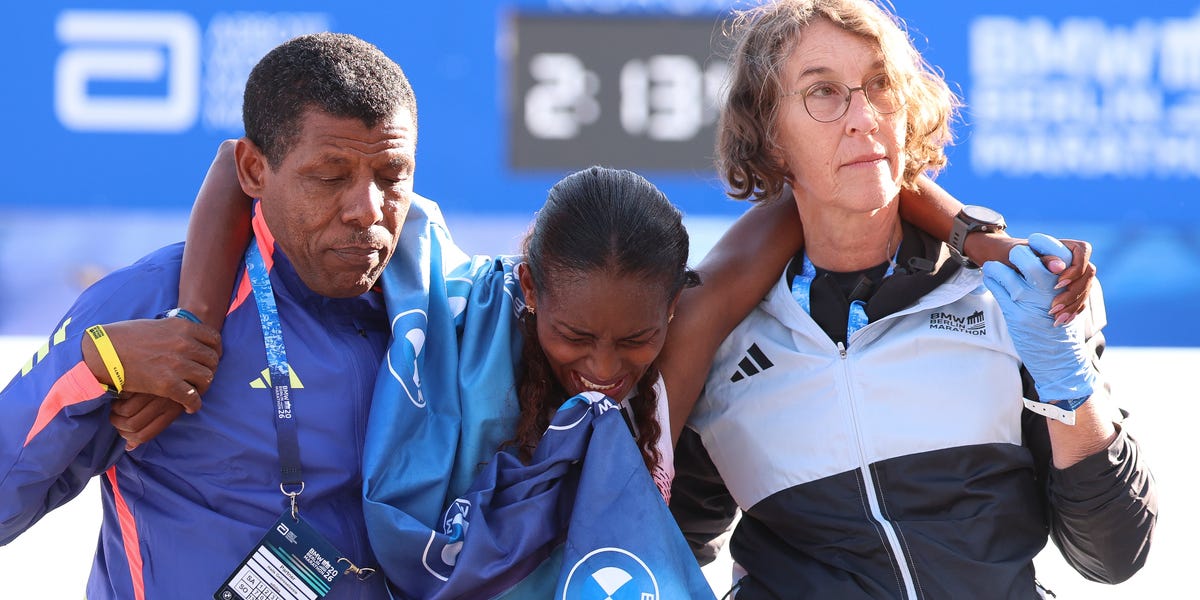
Anyone who watched Tigst Assefa over the final stretch of Sunday’s Berlin Marathon knew her win came at a cost. What wasn’t obvious was just how brutal that cost was.Assefa still crossed the finish line in 2:11:04, the third-fastest women’s marathon ever, but according to her team, she did it after her right Achilles gave out near the 40K mark—and then somehow kept moving toward the Brandenburg Gate for another two kilometers. There was no time wasted: She underwent surgery the next morning.That ending looked nothing like the race Assefa had been having. She hit 30K in 1:32:19 and, with five kilometers left, was still tracking toward roughly 2:09:36. Ruth Chepngetich’s world record of 2:09:56 was in her sights. But instead, Assefa’s stride fell apart and the closing minutes became a fight simply to get herself across the line.Her team said the warning signs had started much earlier, with Achilles pain first showing up back at 31K. Gianni Demadonna, Assefa’s representative, told the Associated Press that the tendon finally ruptured around 40K, and continuing from there made an already awful situation worse. His description of the very end is particularly grim, calling out that Assefa may have covered the final 500 meters “only with the heel,” calling what happened “a disaster.”Maja Hitij//Getty ImagesAnd yet, the crazy part is that 2:11:04 was still 49 seconds faster than her own former world record of 2:11:53 from Berlin in 2023. It was also her third win on the course, and she’s now set a course record in each of those victories.Unfortunately, there was barely a chance to celebrate any of it, as Assefa collapsed after finishing and missed out on the usual postrace appearances. Her team laid out exactly how quickly things moved from the finish line to getting her treated, noting that “after the race, Adidas immediately arranged a private jet to ensure she received urgent medical care.”Demadonna told AP that Assefa was flown to Munich before undergoing what he described as “very complex surgery,” and her team later confirmed that “Assefa successfully underwent surgery yesterday morning following her injury during the marathon.”Everyone has high hopes for a comeback, wishing Assefa “a smooth recovery and a strong comeback,” but first comes a whole lot of rehab. Demadonna told AP that she’s expected to spend about six weeks on crutches before gradually working back toward walking and cycling. Running could potentially resume in around three months, while another marathon may be roughly seven months away.London 2027 has already been floated as one possibility, but Demadonna made clear that nobody is circling dates just yet. Assefa, he said, “is very sad” and knows “it’s a long way to recover.”For now, her team is looking much further ahead than her next start line.“[Assefa] is a champion, and we believe in her strength, courage and determination,” the statement read. “We look forward to seeing her recover and return to the track and roads.”Find Your Next Running PlaylistSean Abrams was the Senior Editor, Growth and Engagement at Men’s Health. He’s a former hip hop dancer who likes long walks on the beach and large glasses of tequila. You can find his previous work at Maxim, Elite Daily, and AskMen.
At Berlin, Tigst Assefa Ran the Third-Fastest Women’s Marathon Ever—on a Ruptured Achilles
Full Article
Original Source
Read the full article at Runnersworld →KhanList aggregates and links to publicly available news content. We do not host full articles from third-party sources. Always verify important information with original sources.