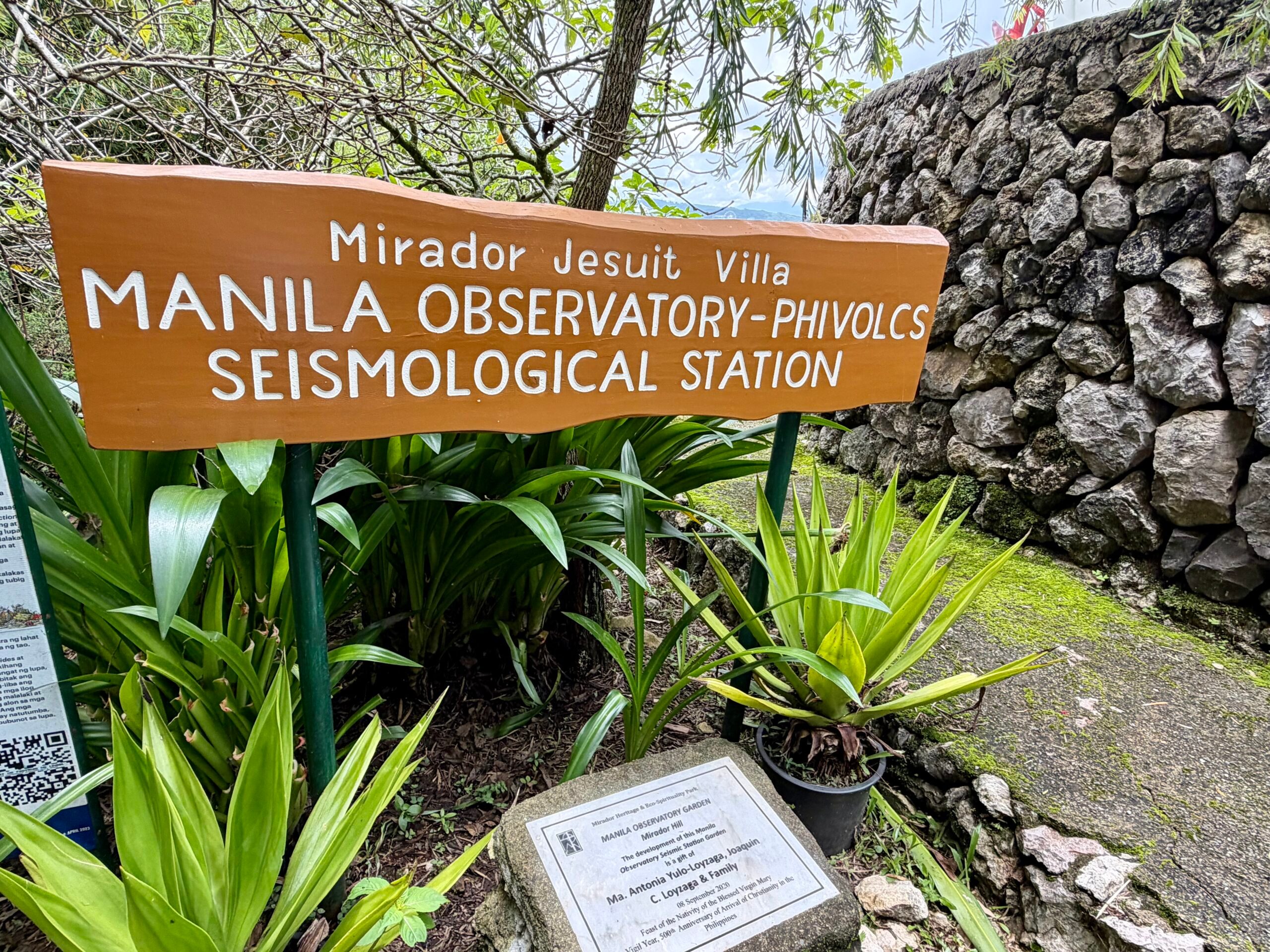
BAGUIO CITY, Philippines – Long before smartphones could warn people about earthquakes, before satellites tracked storms, and before digital sensors quietly streamed data across the world, a hill overlooking Baguio had already begun listening to the Earth and watching the skies. For nearly 120 years, Mirador Hill has been home to one of the Philippines’ oldest earthquake observation sites. Hidden inside the Mirador Jesuit Villa, the seismic station has survived war, reconstruction, technological revolutions, and even the devastating July 16, 1990, Luzon earthquake that crippled much of the city. Today, the instruments have changed. The mission has not. “The Mirador seismic station occupies a distinguished place in the history of Philippine science,” said the Rev. Jose Quilongquilong, S.J., rector of Loyola Vista de Baguio, formerly known as the Mirador Jesuit Villa and Retreat House. “It symbolizes the long-standing Jesuit commitment to integrating science, faith, and public service.” A lookout with a scientific mission That commitment traces its roots to the turn of the 20th century. Officially known as the Baguio House of Retreats of St. Joseph, the Mirador Jesuit Villa stands on a hill once named El Mirador, or “the lookout,” by Spanish colonial official Don Manuel Scheidnagel because of its commanding views of Lingayen Gulf, La Union, and what is now known as the West Philippine Sea. Quilongquilong said Jesuit leaders had envisioned establishing a mountain sanatorium in Benguet as early as 1890, believing the cool climate would help restore the health of missionaries serving in the tropics. The Philippine Revolution delayed those plans, but under the American colonial government, the Manila Observatory eventually established a meteorological and seismic station on Mirador Hill in the early 1900s. Fr. Jose Quilongquilong, SJ, shows the historic telescope that once formed part of the Manila Observatory’s scientific work at Mirador. Though still functional, its view of the night sky has been diminished by the city’s lights. Mia Magdalena Fokno/Rappler Its elevated location, stable geological setting, and panoramic view made it an ideal site for observing earthquakes and weather, extending the Manila Observatory’s scientific work beyond Manila. The station became the observatory’s northern field site, expanding what was already regarded as one of Asia’s leading scientific institutions. Founded in 1865, the Manila Observatory pioneered research in meteorology, astronomy, geomagnetism, and seismology long before disaster science became part of government planning. For engineers, navigators, scientists, and eventually disaster managers, Mirador quietly supplied data that helped explain how the Earth behaved. Then came July 16, 1990. The earthquake that overwhelmed the machine When the magnitude 7.7 Luzon earthquake struck, the observatory’s mechanical seismograph shook so violently that it eventually failed. But not before doing its job. The instrument managed to record the earthquake’s crucial first moments, allowing scientists to triangulate the epicenter together with data from the Manila Observatory in Loyola Heights and other stations in the country’s seismic monitoring network. The paper seismogram showed violent oscillations for more than 20 seconds before the recording needle was thrown off the rotating drum. The machine became another casualty of the earthquake. Its record became part of Philippine earthquake history. From paper drums to nanometers The old mechanical recorder has since given way to a sensor that looks deceptively simple. Placed atop a stable pedestal is a Nanometrics Trillium 120PA broadband seismometer, roughly the size of a motorcycle helmet. A small sign beside it reads: “PHIVOLCS Seismic Sensor. Please Don’t Touch.” Unlike the bulky mechanical instruments of the past, the modern sensor continuously records ground motion digitally. “It can detect movements as small as a nanometer,” Quilongquilong said. “A nanometer is about 100,000 times smaller than the diameter of a human hair.” The Nanometrics Trillium 120PA broadband seismometer at Mirador Jesuit Villa detects ground movements as small as a nanometer, continuously transmitting earthquake data to the Manila Observatory, PHIVOLCS, and international seismic monitoring networks. Mia Magdalena Fokno/Rappler The instrument records motion along three axes, allowing scientists to detect nearby earthquakes, distant earthquakes, and even the Earth’s constant background vibrations. Its data are transmitted continuously to the Manila Observatory, DOST-PHIVOLCS, and international seismic monitoring networks. Even power interruptions do not stop the station. The instrument operates on a dedicated solar backup system while consuming very little electricity. A scientific mission that never left Many assumed Mirador’s scientific role ended when the Manila Observatory transferred its main headquarters to Loyola Heights in Quezon City in 1962. It never did. Quilongquilong said Mirador continued hosting seismic, solar, and geomagnetic observation stations because its location remained valuable for long-term geophysical monitoring. After World War II destroyed much of the original Manila Observatory, Mirador also became one of the principal sites where Jesuit scientific work was rebuilt. When the present complex was constructed between 1951 and 1952, a dedicated wing was designed for the observatory, complete with a separate public entrance so scientific work could continue without disrupting the Jesuit community. The hill also carries another chapter of Jesuit history. In 1952, Jesuits expelled from Communist China relocated Bellarmine College, a house of theological studies originally founded in Shanghai, to Mirador. The institution remained there until 1967 before eventually becoming part of Fu Jen Catholic University in Taiwan. “It became a place of refuge, learning, and continuity for Jesuits displaced from China,” Quilongquilong said. Looking beyond the Earth Mirador’s scientific work was never confined beneath the ground. Inside the old weather station stands an astronomical telescope that remains operational more than a century after the observatory first began studying the skies. The telescope once formed part of the Manila Observatory’s broader scientific mission, which combined meteorology, astronomy, seismology, and geomagnetism to better understand the natural world. Time, however, has brought a new challenge. “The telescope is still working,” Quilongquilong said. “But its range and viewing quality have been affected by the city’s light pollution.” Instead of the dark mountain skies that early Jesuit scientists once observed, the telescope now looks out over the glow of an expanding city. Even so, Quilongquilong said local residents have expressed interest in helping preserve and revive the telescope so future generations can continue exploring the night sky from Mirador. Science, faith, and heritage on one hill Today, Mirador is best known to many visitors for its heritage park, meditation spaces, and the Lourdes Grotto built in 1913. Yet beneath the pine trees and above the city’s skyline lies another legacy. Few places in the Philippines bring together science, spirituality, ecology, education, and cultural heritage in a single landscape. That history was formally recognized in 2018 when the National Museum of the Philippines declared the Mirador complex, including the Lourdes Grotto, an Important Cultural Property. The scientific tradition also continues to evolve. In 2024, the Manila Observatory, DOST-PHIVOLCS, and Academia Sinica of Taiwan installed a new generation of seismic instruments at Mirador, reaffirming the site’s contribution to earthquake science more than a century after the first instruments were placed on the hill. The Mirador Jesuit Villa. Mia Magdalena Fokno/Rappler The bulky paper-drum recorder that documented the 1990 earthquake now belongs to history. Its successor has no moving pen, no sheets of paper, and almost no sound. Nearby, the telescope still points toward the heavens, waiting for darker skies. Together, they tell the story of a place where Jesuits have spent more than a century studying both the Earth beneath their feet and the skies above them. For nearly 120 years, Mirador has remained true to the meaning of its name. It is more than a lookout over Baguio. It is one of the country’s quietest witnesses to the forces that continue to shape both our planet and our understanding of it. – Rappler.com
At Baguio’s Mirador, Jesuits have spent more than a century watching the Earth and skies
Full Article
Original Source
Read the full article at Rappler →KhanList aggregates and links to publicly available news content. We do not host full articles from third-party sources. Always verify important information with original sources.