
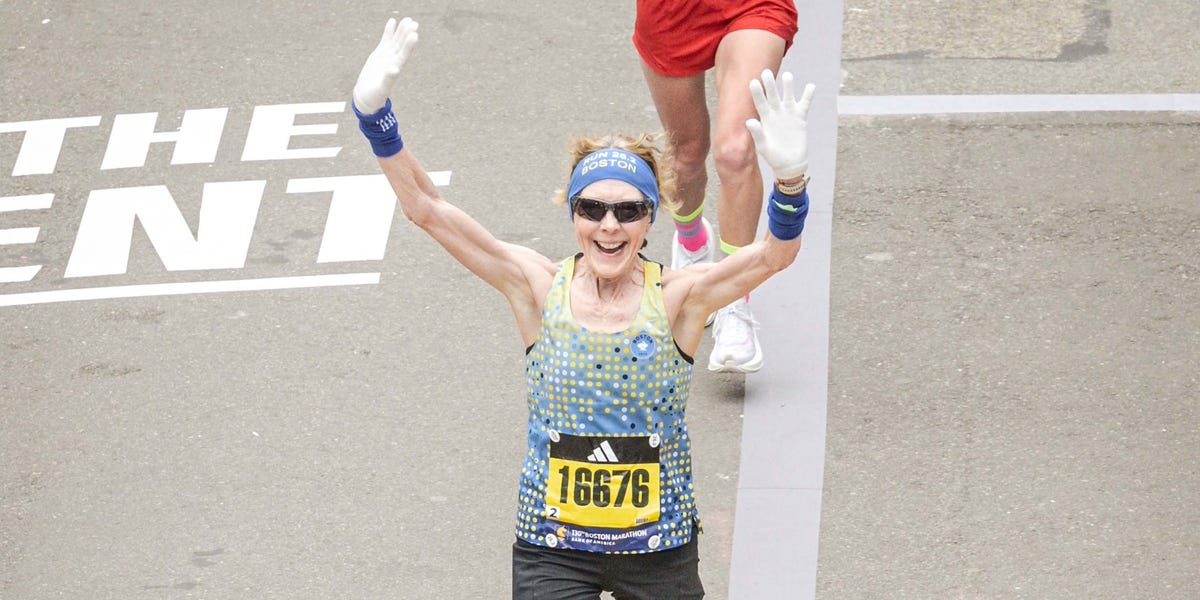
I first started running at age 52, about 16 years ago. I hadn’t been super athletic in high school, and while I tried running once in my 30s when my kids were little, I didn’t feel like I had time for it, especially as I was working, too.Shortly after all my kids graduated high school, I joined a group of coworkers who decided to train for a spring 5K to support families affected by cancer, specifically one of my coworkers’ husbands. My goal was to be able to finish that 5K without walking—and I did, crossing the line after about 30 minutes.Immediately, I thought, “this is kind of fun,” and figured I could start picking up local charity 5Ks every month to keep me consistent with running.I was probably less than a year into running when a coworker suggested I sign up for Grandma’s Half Marathon in Duluth, Minnesota, in June 2011. I was excited to try the longer distance as I had gradually started running longer.Before signing up, I had done a five-miler and two 10Ks, and I ran in a relay event where I took over for another runner’s leg and wound up running 13 miles instead of my planned six-mile leg. Grandma’s Half Marathon was a lottery system back then, and I got in! I trained with a half marathon plan that I downloaded somewhere online and felt good about the distance.I ended up finishing in 1:54:05. I was so excited that I had met my goal of running sub-two hours and I felt great through the race. My favorite part was cheering on my friends who ran the full marathon. They were excited for my accomplishment and the atmosphere at Grandma’s finish line is one of the best. After that, I remember thinking I could train for a full marathon next; I was already halfway there anyway, right?I had my eye on the Twin Cities Marathon in Minneapolis that October, but was disappointed when I found out it had already sold out. However, a weekly run club here in Rochester, Minnesota, offered guaranteed entries for joining their marathon training program, so I took advantage of that and joined.The club hosted guest speakers on topics like race day nutrition, postrun stretching, and how to prepare for race day. They had runners who had run the marathon speak about their experience and gave great advice, like wearing throwaway clothes to the start line to stay warm and practicing my race-day breakfast and nutrition with weekly long runs. I’m still a member of the club to this day because of the friends and running partners I have met over the years.I was very nervous on marathon morning, but I had experienced runners from the club who made sure I got to the start line. They encouraged me and reminded me I was trained and ready to run the distance. My goal for my first marathon was a four-hour finish. I started with the four-hour pacer and by mile four, I felt it was too fast for me, so I dropped back and tried to settle in at a pace I felt I could hold on to.I was really surprised by how hard the final 10K was in that race. My legs were tired and because I had not run farther than 20 miles in training, the final miles were so unknown for me. But I loved the course, and I remember my family cheering me on, wearing special shirts that had my race number on them. That motivated me to keep running strong.I finished in 4:06:46. Even though my goal was to be under four hours, I wasn’t disappointed because I had just run 26.2 miles!After the race, a fellow runner told me I had missed qualifying for the Boston Marathon in the 50 to 54 age group by one minute. Once I knew what qualifying for Boston meant, it became a goal I knew I wanted to achieve. I’m a highly motivated person by nature, so all you have to do is give me a goal and I’ll go for it. In running, setting a time goal for a race or running a qualifying time is something specific you can train for and helps me stay focused on the end result.When Training Got Tough and How I Dealt With InjuriesIn May 2012, when training for my second marathon—Grandma’s Marathon—at 54, I noticed a little twinge in my left hip during a 5K, but nobody could tell me what it was. I had been running seven days a week, 60 miles a week, with no strength training or cross-training, and my nutrition wasn’t as good as it is now.A month later, the race came around. My goal was to run around 3:50 to qualify for Boston. I reduced my mileage slightly in hopes it would help the twinge, stopping my runs whenever it started to hurt. But about halfway through the marathon, the twinge in my hip turned into intense levels of pain. I struggled through that and wound up finishing in 5:07:48, heading straight for the medical tent.I couldn’t put any weight on my left hip, so I went to the hospital.At first, the doctors couldn’t find anything in the bone scan or MRI. I didn’t understand how that was possible. Then, I asked around for other recommendations and found a doctor about an hour away from me who specializes in older women and female runners, and got an appointment with her. She found the stress fracture immediately.If the fracture had been just a couple of millimeters closer to my femoral neck (the bone that connects the upper end of the thigh bone to the ball of the hip), I might not have ever been able to run again. She told me that my 60-mile weeks weren’t feasible for my age, and we started working together to find ways I could train smarter. But first, I had to heal.After six to seven weeks of no physical activity, I had to rebuild my base very slowly throughout the rest of the year. As hard as it was to hold myself back, I followed my doctor’s orders to run/walk and only increase it by 10 percent as long as I felt good. For example, I started with a 15-minute run/walk and would increase that to about 17 minutes the next day (though sometimes I pushed the 10 percent rule just a little bit). It’s really hard when you are injured to follow what your doctor says, but you’ll be better off if you do.I built my base back for more than two months until I was able to get my mileage back up, and started averaging 35 to 40 miles a week instead of 60. Then, I signed up for Grandma’s Marathon again in June 2013. My running club training program kicked off in mid-February and I followed it until the first week of April when I broke my left ankle. I had to stop running, took up swimming and aqua jogging to make up for it, and didn’t run again until three weeks out from race day.I was very apprehensive going into the 2013 Grandma’s Marathon because the farthest run I did was only 14 miles during peak week. This is when I really learned to appreciate that swimming and pool running can help you maintain your cardio fitness when you are injured.I still met my goal of running sub-four, finishing in 3:58:42, with tears in my eyes when I crossed the finish line, which qualified me for the 2014 Boston Marathon, the first one back after the Boston bombing.I started my first Boston training block in January 2014 and then joined up with the run club that February. (The run club program is a 16-week training window so I got some base training in before that.) I included a weekly 10K treadmill workout with hill simulations and trained injury-free, so I felt much more prepared going into Boston. You have to earn your way to Boston, so getting to the starting line is an accomplishment in itself.At Boston 2014, you could tell runners were beyond excited to return. There were hand-knit scarves given out at local churches and yellow daffodils everywhere. We wrote our names on our legs so people could cheer for us. I still remember turning onto Boylston Street and the crowd was so loud that I couldn’t hear anything. I crossed the finish line in 3:53:23 and I just started crying.I’ve run the Boston Marathon every year since then. Every time I turn the corner onto Boylston and see the finish line, I get emotional.How I Went From Sub-4 to Sub-3:30 Marathons in My 60sFor the first few years of my running career, most of my marathons (I’ve run more than 100) were between 3:40 and 3:50, and it just seemed like I wasn’t getting out of that range. Along the way, I dealt with more injuries after the stress fracture in my hip, including a broken ankle and a stress fracture in my lower left leg. Somewhere along the line, my doctor recommended cross-training, so I started swimming once a week.I never really started strength training until 2018, after I retired in my early 60s and got a part-time position working at a gym. I had access to strength training classes, Pilates, and yoga, and it really became a habit from that point forward. I typically spend an hour or more in the gym four days a week using different machines to work my whole body.If you look at my times, I started getting faster when I took on strength training. In 2019, I started running around 3:30 pretty regularly, and in 2021, I finally broke 3:25 at the Leading Ladies Marathon in Spearfish, South Dakota, with a time of 3:24:55 when I was 63.My PR right now is a 3:16:04 from the 2023 Chicago Marathon, though my unofficial fastest time was a 3:04:28 on a downhill course at the Revel Big Bear Marathon in San Bernardino, California, that year as well.I still follow my typical training protocol of a weekly long run and a speed workout, balancing between intervals and hills, especially if I have a hilly race coming up. Occasionally, I might do both a hill workout and an interval workout in a given week, but usually I alternate. I’m kind of a creature of habit. (My go-to interval workout is eight to 12 reps of 400-meter repeats on the track.) If I’m racing a shorter race like a 5K, I treat that as my speed workout during marathon training.Now, instead of reaching 60 miles a week like I did when I started out, I’m running 35 to 40 miles per week maximum while strength training at least four days a week. Maybe some runners, like Jeannie Rice, who I admire so much, can handle 60 miles a week, but I can’t because of my injuries. But I don’t let that stop me.Over the years, running has become a part of who I am. It makes me happy. I just love being out in nature. I love the support of people cheering and the joy and sense of accomplishment that comes when crossing the finish line.One of my favorite running quotes is from Joy Johnson, an American marathoner: “Each run I took every single day was guaranteed to be different. Every day began with the most beautiful thing in the world: possibility.”To me, every run is a new possibility. You never know what it’s going to bring you. It may bring you sadness because you had to stop in the bathroom three times, or it may bring you incredible joy, like winning your age group in the Sydney Marathon.How to Keep Running Fast After 601. Continue Setting Really Big GoalsIn 2014, after running New York, Chicago, and Boston, I realized I was halfway to my six-star World Major Marathon medal and decided to go for the other three. I ran London at the Age Group Championships in 2021 and Berlin in 2022, then earned the medal at the Tokyo Marathon in 2023. (In 2025, I earned another six-star medal in one year, and because I had already run Sydney, I got the seven-star too!) Since then, Abbott added the Cape Town Marathon back in, so I ran that as part of the age group, so I also got my eight-star medal.This has helped me complete my goal of running marathons on all seven continents as well. This year, I ran a marathon in Argentina and Antarctica, which was an amazing race experience and overall trip. The weather was only about 37 degrees, and the course was a figure-eight loop. Because the marathon was in the early part of the trip, we got to spend the rest of the week enjoying a continent most people never get to see.Setting goals like this is a natural habit for me. It gives me something specific to work toward and makes my everyday training feel more purposeful because it is one step closer to something meaningful to me. Reaching a goal gives me a sense of accomplishment and confidence and encourages me to set the next one. Plus, the social aspect of this is not lost on me. I’ve never met a runner I haven’t liked.Right now, my next goal is to complete a 50-miler ultramarathon at Comrades, and I’d like to complete a 70.3 Ironman before I’m 70.2. Strength TrainNow, I swear by strength training. I really started to improve my marathon times and even my shorter distance times once I started doing it, and I don’t feel as fatigued when I’m done with the race because I’m stronger going into it.At least four times a week I go to a local gym where I move between 10 different stationary weight machines; five focus on lower-body and five on upper-body. I aim for five sets of 10 repetitions.I also regularly complete a 15-minute Pamela Reif core workout video that I found during the pandemic. It’s the type of workout that’s really challenging at first, but as I got better at it, I started altering it for myself, like adding little challenges to each of the exercises.The last time I was injured, probably four years ago, I also started doing three different single-leg exercises: a Bulgarian split squat, a wall sit with a heel raise, and a single-leg calf raise. I do five sets of 10 for those movements as well, with just my bodyweight.3. Take Sleep and Nutrition SeriouslyI really pay attention to how much sleep I get, and focus on my nutrition. I get eight to nine hours of sleep every night on average. I have a sleep reminder on my phone set for 7:45 p.m. so if I’m not on my way to bed by then, I better be.I aim for 100 grams of protein a day, and 150 grams or more of carbohydrates. (My prerace meal the night before a race is white rice with a grilled chicken breast.) I’m conscious of getting enough protein as a runner even though it’s really hard, because that’s what rebuilds your muscles. I generally eat a lot of rice, potatoes, fish, and chicken, and I also have a staple recipe for a banana protein muffin to go along with a protein shake after my runs.Of course, my protein-to-carb ratio switches to more of a carb-focus the closer I get to a race. I use a nutrition tracker to make sure I hit my macronutrient goals, but also track how much calcium I’m getting for my bone health, and I think it’s made a big difference in how well I recover.4. Remember Cross-Training CountsBecause I’m limited to how many miles I log on the road, I add swimming to supplement it. When I’ve been injured and unable to run in the past, I’ve also incorporated aqua jogging into my routine. It’s low-impact, but you still get your heart rate up if you do it right.When I volunteer-coach at one of my local high schools’ cross-country teams, I find that athletes who didn’t log a lot of miles over the summer wind up with shin splints consequently, so I tell them to aqua jog in the pool while they recover. This serves as a reminder that cross-training helps you get to your running goals.Kristine Kearns, a writer and avid runner, joined Runner’s World and Bicycling in July 2024. She previously coached high school girls cross country and currently competes in seasonal races, with more than six years of distance training and an affinity for weightlifting. You can find her wearing purple, baking cupcakes, and visiting her local farmers market.
‘At 68, I Can Still Break 3:30 in the Marathon. Here’s How I Train to Keep Running Fast.’
Full Article
Original Source
Read the full article at Runnersworld →KhanList aggregates and links to publicly available news content. We do not host full articles from third-party sources. Always verify important information with original sources.