
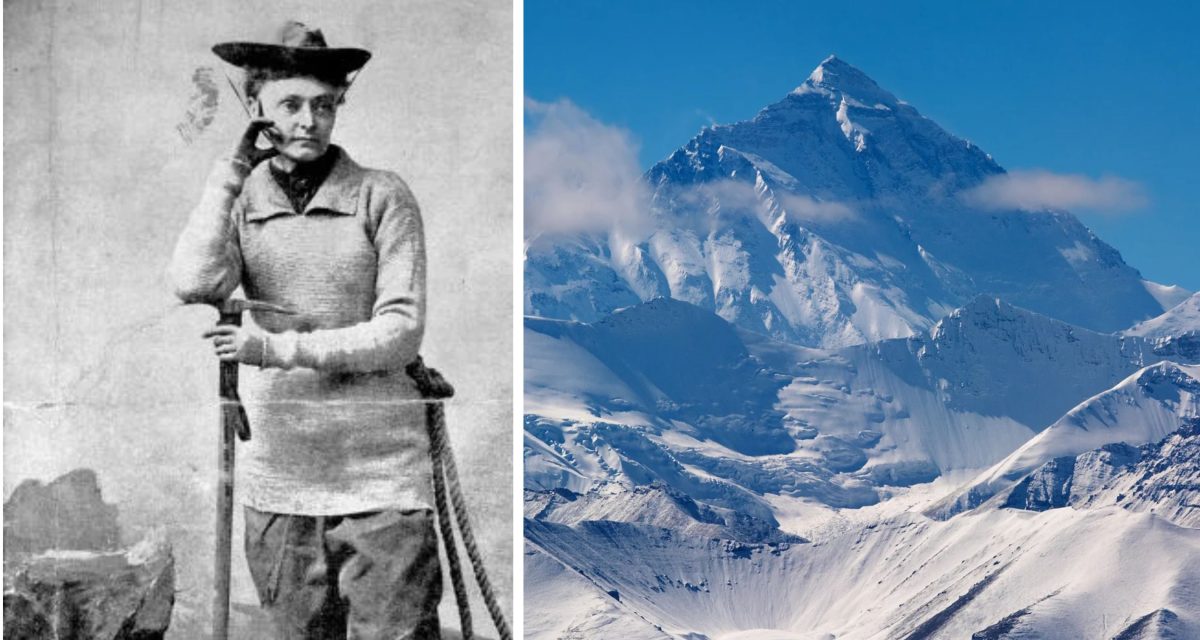
Annie Smith Peck was a trailblazer in every sense of the word. A renowned speaker, suffragist, and mountaineer, she used her record-breaking 1909 climb to bring women everywhere to new heights. Born in 1850 into a family with three brothers, Peck quickly developed strength, resilience, and a healthy appetite for competition. Not to mention the skill of not taking “no” for an answer. Peck graduated from Rhode Island Normal School, a prep school for teachers. However, she wanted to continue her education at Brown University, where her father and brothers had studied. Even though she was denied admission, Peck remained determined to live independently and support herself. She did so by teaching languages and mathematics in Michigan for many years. She was told higher education was “perfect folly” Annie Peck on a collectible card. Photo credit: Wikimedia Commons Still, she wanted to continue her education. When she wrote to her family back in Rhode Island that she planned to pursue an undergrad degree, they were less than enthusiastic. They called the plan “perfect folly,” to which Peck replied: “Why you should recommend for me a course so different from that which you pursue, or recommend to your boys is what I can see no reason for except the example of our great-grandfathers and times are changing rapidly in that respect.” Peck eventually earned a master’s degree in Greek and Latin. She made a living teaching and lecturing at universities. She also traveled to Europe to study archaeology, where she discovered a passion for mountain climbing. Her climbing clothes became almost as famous as her climbs The scandalous frock in question. Photo credit: Wikipedia In 1895, she became an international sensation when she summited the Matterhorn in the Swiss Alps. This feat had previously been achieved by only one other woman, Lucy Walker. But Peck’s accomplishment didn’t make headlines; her outfit did. Rather than a long skirt, Peck wore a tunic and trousers. Naturally, this ruffled many feathers and had people clutching their pearls. The public discourse seemed only to deepen Peck’s resolve. She climbed 18,406-foot Pico de Orizaba, the highest ascent in the Americas ever made by a woman. Three years later, in 1900, she climbed peaks in Italy’s Dolomites, Switzerland’s Alps, and Austria’s Fünffingerspitze. After four years and five attempts, she became the first mountaineer to conquer Mount Huascarán in Peru, one of the highest peaks in the Western Hemisphere. Unfortunately, controversy would also overshadow this milestone. Peck mistakenly estimated the mountain’s height at about 24,000 feet. In truth, it was closer to 21,812 feet. Peck was then accused of purposely exaggerating the mountain’s size. She would lament that the public vitriol was harder than the climb itself—a climb where one of her Swiss guides lost a hand and half a foot to frostbite. At 61, she took her message to the top of a mountain Then, in 1909, at age 61, she made her greatest climb yet. Peck was back in Peru, this time atop its 21,083-foot Mount Coropuna. There, she famously planted a banner that read “Votes for Women.” For Peck, who described herself as “a firm believer in the equality of the sexes,” she felt that “any great achievement” she accomplished would lead towards “great advancement to my sex.” “We should be free to do whatever we think we are qualified to do,” she said. It took nine more years for Peck’s dream of equal voting rights to be realized, but she lived to see it…and she climbed mountains into her 80s. .
At 61, suffragist Annie Smith Peck climbed a 21,000-foot mountain and planted a ‘Votes for Women’ banner
Full Article
Original Source
Read the full article at Upworthy →KhanList aggregates and links to publicly available news content. We do not host full articles from third-party sources. Always verify important information with original sources.