
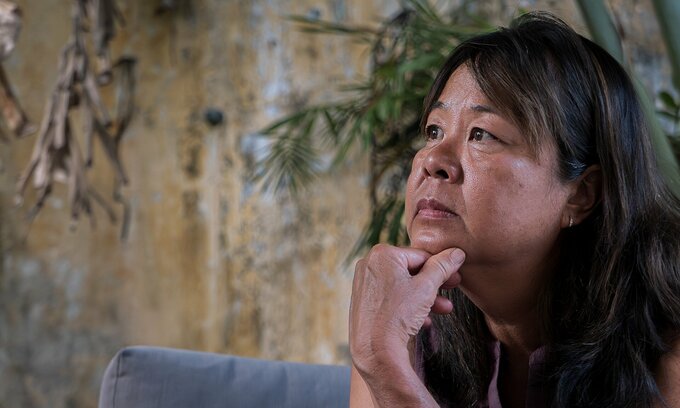
Born in Vietnam as Nguyen Thi My Phuong, Murch was one of 150 children who survived the C-5A military aircraft crash during Operation Babylift, the 1975 campaign that evacuated over 3,300 presumed orphans from southern Vietnam to the United States. Devaki Murch as a little girl in Hawaii, U.S. Photo courtesy of Devaki MurchAs a generation of war orphans, they all left Vietnam when they were too young to make their own decisions. In the minds of many, there remains a constant yearning to fill the memories they "always never had" about where they came from and who gave birth to them.Time is running out, but the children and many mothers are still waiting to find each other.'Who am I?'In 2005, Murch decided to return to Vietnam for the first time with a group of Babylift adoptees.She had felt "strangely comfortable."Unlike others in her group, she was not intimidated by her inability to speak Vietnamese and felt deeply welcomed. For the first time, the American adoptee saw so many people who "looked just like me."She reunited with pre-1975 orphanage workers to express her gratitude."Because of them, we are alive. I printed out a photo taken with them and thought, 'Oh, I am Vietnamese.' That lingered in my mind," she says. Devaki Murch during an interview with VnExpress in Ho Chi Minh City in May 2026. Photo by VnExpress/Phung TienDuring that trip, she visited the field in District 12 where the C-5A crashed and held a small memorial.Standing there, she felt more clearly than ever the fragile line between life and death that she and her companions had crossed.She also returned to Vinh Long Province in the Mekong Delta, where she was born, and visited a local shelter, seeing her own reflection in the eyes of the children there.However, she did not expect much from her search for her biological family, as there were few clues to offer hope.Returning to the U.S., questions about her identity weighed more heavily. She did not know exactly where she was taken from or how old she was when she was separated from her mother.Between her birth in June 1974 and admission to an orphanage in January 1975, intense fighting had swept across the Mekong Delta. No one knew what might have torn a child from their family."You realize you don't belong anywhere. I grew up in the United States, but I was born in Vietnam. So what country do I belong to?" she asks.A series of questions haunted her: If the children are still struggling, can their mothers truly be at peace? A mother separated from her child, whether she chose to let the baby go or for another reason, might have thought about her child her entire life.In 2024, after talking with a friend battling cancer, Murch realized that surviving the plane crash was a miracle."Death cannot take you away, as if you have a superpower and it defies death," the Babylift survivor says.This inspired her to organize an event in Colorado called "Secret Ability to Fly," honoring those who had cared for, protected and raised the Babylift children. It was the first time she had met other Vietnamese adoptees."I realized the desire to be with one's biological family is truly powerful," she says. Devaki Murch (R) at an exhibition about the Babylift Operation. Photo courtesy of Devaki MurchAt a "War Orphans" gathering in Boulder in March 2024, Murch received a gift: a piece of C-5A insulation material from the very plane that had crashed.The gift came from Sister Mary Nelle, who worked for Friends For All Children (FFAC) in Saigon from 1972 until April 1975, assisting director Rosemary Taylor.They received, cared for, and organized the evacuation of orphans. When FFAC closed at the end of the war, all documents, letters, and keepsakes that families had sent with their babies were destroyed.However, Taylor had recovered the files that survived the destruction, and stored them at the Colorado office along with adoption-related items entrusted to her by others. After Taylor's death, Nelle took over the collection.Soon afterward, Murch visited her in a Colorado basement, and the nun handed her a file to look for clues about her identity.Murch recounts: "I randomly opened the file on top. Miraculously, out of all 33 boxes of documents, my file appeared right before my eyes."Caregivers at the To Am orphanage had given her the name Mimosa, after the flower.She found documents detailing the exact day she arrived at the Vinh Long orphanage, her adoptive mother's handwritten letter, crossed-out adoption options leaving only her name, photos from second and third grades, health records, and U.S. immigration adoption updates.Taylor of FFAC had documented about Mimosa from St. Paul de Chartres Orphanage, Vinh Long, Vietnam.The child had been issued a birth certificate by a Vinh Long court on Aug. 15, 1974, confirming her status as an orphan with parents unknown.The child was placed in FFAC's care for adoption on Jan. 15, 1975, and cared for until her departure on April 5, 1975.Another document from FFAC director Wende S. Grant said: "I hereby certify that Nguyen Thi My Phuong, born on June 24, 1974, in Vinh Long, was surrendered to Friends For All Children for adoption. Her parents have never inquired about her since that day."Murch says: "For the first time, I saw my name on an official list, on a faded hard copy rather than hearing it through someone else's words. I felt like a missing piece of the past had been put in its right place." Documents about Devaki Murch from the storage of Friends For All Children note that she was born in Vinh Long in Vietnam's Mekong Delta on June 24, 1974 as Nguyen Thi My Phuong and was accepted to an orphanage as Mimosa. Photos courtesy of Devaki Murch The surprise for her was that, for years, she only knew her Vietnamese name to be Nguyen Thi My Phuong from her adoption registration.But after seeing the papers Taylor had left, she found that a girl named Tran Ngoc An, born Dec. 28, 1973, who had been raised at St. Paul's Convent in Vinh Long, had also been transferred to the FFAC facility in Saigon on Jan. 15, 1975.But she did not have a birth certificate, and had been matched with documents bearing the name Nguyen Thi My Phuong.Murch agonizes: "Am I Phuong or An? That is a missing piece I never knew."When she was 82, Nelle wanted to find a home for the remaining 33 boxes, hoping they would help connect adoptees searching for their biological families."I’ll do it," Murch told her, accepting the responsibility to do something for others like her.The boxes contained more than just adoption files: There were survivor and casualty lists from the plane crash, convoy manifests of transport companies, flight departure dates, destination addresses, child condition reports post-crash, volunteer lists, personal letters, news articles, film rolls, birth certificates, intake records, and early childhood photos.Murch says: "These files are a heartbreaking, beautiful, and astonishing testament to war, life and death. They are a piece of my personal history and that of thousands of other adoptees."She began sorting, categorizing, cross-referencing, and transcribing the records of Babylift children evacuated in April 1975.One day, she suddenly realized that if it was so important to her, someone who had not even been searching for her past, what could it mean to others?As if by destiny, Murch had been entrusted with a project to preserve thousands of records and documents from the wartime child-welfare organization.She joined the Society of American Archivists.She is now learning about cataloging, data management, descriptive formatting, risk management, privacy protection, and regulations for personal documents.By organizing, digitizing, and indexing this collection, she hopes to preserve it for future generations.Mother searchFinding her biological parents brought healing to Huyen Friedlander, the last child placed aboard the final flight of Operation Babylift. Huyen Friedlander (R) with her biological mother Le Thi Dem in Vietnam. Photo courtesy of Huyen FriedlanderFollowing a trip to Vietnam in 1996, she became a therapist specializing in trauma, grief, and loss.In graduate school, she focused her research on transracial adoption.She says: "Most people do not understand the inner world of adoptees. These were the same painful experiences happening inside me before I found my mother."Based on attachment theory, she says caregivers are the first to mirror a child's sense of self through interaction. For Friedlander, all her caregivers abruptly vanished in April 1975."I didn't know who I was anymore. That was deeply traumatic, even though I couldn't articulate it at the time."A 2000 study by Ohio State University involving 169 Vietnamese war adoptees across 10 U.S. cities highlighted similar struggles. While 76% wanted to meet their biological fathers upon arriving in the U.S., only 30% knew their fathers' names. About 22% attempted contact, and only 3% succeeded.Born to American military personnel and Vietnamese civilians, most of these children never knew their fathers' names or addresses.Often, they possessed only a faded photograph or stories passed down from their mothers.The cross-continental flights effectively closed the door on the past for many, particularly those aged four to nine. Initially fluent in Vietnamese, they lost their mother tongue entirely.When Friedlander first arrived in the U.S., she could still sing a Vietnamese song. She later realized that her cultural detachment was the result of severe psychological trauma. Huyen Friedlander (R) meets her adoptive parents Pamela and Dan Friendlander for the first time in the U.S. in 1975. Photo courtesy of Huyen FriedlanderNow in her 50s, Friedlander looks at photos from her early days in America and sees a profoundly traumatized, dissociated child avoiding eye contact with strangers. A psychological wall separated her past from her present, shielding her from the deep pain of her losses while allowing her to feel safe in a new life.Despite having a loving adoptive family, she had felt isolated growing up mixed-race in the U.S. Surrounded by taller peers, having a different skin color, and facing discrimination at school, she constantly felt inadequate."When my biological mother left me at four, my true self died. I became a compliant child, seeking safety, fearing conflict, and terrified of displeasing people because I feared rejection. I lost myself," Friedlander says.Within the roughly two weeks between leaving Vietnam and meeting her adoptive family, she lost everything familiar: her mother, relatives, home, language, food, and culture.Later, when she visited Little Saigon in California, people spoke to her in Vietnamese. Unable to understand, she felt a heavy burden of guilt when asked why she could not speak her native language.Working with hundreds of adoptees, Friedlander observes parallel traumas. Many share a collective pain of feeling unloved, rejected, or believing they had caused something terrible.Common struggles include identity crises, self-rejection, racism, isolation, difficulty assimilating, feelings of inferiority, and body image issues.For Friedlander, reclaiming control of her life meant reconnecting with her homeland. Adoptees from Operation Babylift gather in Ho Chi Minh City in 2025, 50 years after the campaign sent them away from Vietnam. Photo provided to VnExpressIn September 2025, she and a group of Babylift adoptees cycled through the Mekong Delta. Most were still searching for their biological mothers.During a rest stop in Can Tho, 52-year-old group member Le My Huong suggested an idea: actively approaching Vietnamese families to find their mothers.Adopted in Australia and surviving an abusive childhood, Le had endured her own traumatic search. She was kidnapped as a child and deceived for 47 years by her captor, who claimed to be her biological mother.When she returned to Vietnam in 2004, she met with a family that falsely claimed her as theirs. It took 14 years for the truth to be known.She says: "I was completely broken. Fortunately, I eventually found my real mother. That was the healing. After decades of living a lie, I am still learning how to carry the weight of the truth."Over the past two decades, Le has helped many adoptees return to Vietnam to search for their families after being struck by the realization that the answers usually lie within the community and not in adoption paperwork.Because most documents contain false information, many adoptees do not even know if their recorded names are real.Le concluded that the only reliable way to find biological families is through DNA testing and cross-referencing global genetic databases.The group agreed.Friedlander, Le, Era Goodland, and Jane Joy went on to co-found Mother Search, a non-profit facilitating family reunions through DNA matching.Launched in September 2025, Mother Search seeks to connect searching children and parents by sharing photos and information. Participants receive free DNA testing kits, which normally cost upwards of $50.The samples are uploaded to major European and American databases, such as MyHeritage, which holds around 9 million profiles, and Ancestry, which has over 30 million, to increase the matching potential. (From L) Jane Joy, Le My Huong, Era Goodland, Ngoc Vang and Huyen Friedlander, founders and managers of Mother Search. Photo provided to VnExpressSo far, five pairs of relatives have been matched and three reunifications involving two adoptees in France and one in the U.S. have been facilitated."If it weren't for DNA matching, they would never have found each other because all their paperwork was wrong," Le says.Rather than rely on one-to-one matches, the project aims to expand the pool of DNA profiles from overseas adoptees while simultaneously collecting samples from mothers in Vietnam.She notes that a Vietnamese family recently sent her a photo of an 83-year-old mother who is still searching for her long-lost son. Seeing the profound sadness in her face reaffirmed the urgency of their work."Mothers and children are still waiting to be found."The organization believes that reconnecting with roots is essential for adoptees to reclaim their identities after an immeasurable loss. It hopes governments will eventually facilitate widespread, affordable, and accessible DNA testing."If state agencies in both Vietnam and the U.S. provided easily accessible archival information, it would help heal the wounds caused by this separation," Friedlander says. Babylift adoptees meet in Ho Chi Minh City in 2025. Photo by Le Thi HuyenMurch is pursuing the same goal.Her questions and the 33 boxes of newly discovered files brought her back to Vietnam for a second time in May 2026. She visited national archives, locating thousands of documents related to wartime adoptions. At the end of her journey, she returned to Vinh Long simply to sit in quiet reflection in her birthplace.She ruminates: "I know the chances of finding any clues are very slim, and I don't expect much. I just went there to walk around and reflect on what my life in 2026 would look like if I hadn't left Vietnam in the final days of the war."Deep down, she still yearns for the memories she never had. For adoptees like her, discovering their origins is a form of validation.Using the Friends For All Children archives, Murch and her colleagues are now tracking down Babylift adoptees across the U.S. to hand-deliver their personal files.She says: "Witnessing history appear like a miracle, seeing your own name in the legacy of war, is incredibly important. A tiny piece of truth means everything to someone who knows nothing."She says there are many other individual adoption cases beyond the records she has collected, highlighting the need for a central archive to consolidate records from various sources and help women find their children easier."I hope the governments of both countries can establish an agency to support the children of the war."And we need a compassionate community so that the complex legacy of the war isn't treated merely as a personal problem for those born at the intersection of history."As the youngest victims of the conflict, these former orphans are still searching for an answer to the question that has vexed them for nearly six decades: Who am I?Story by Hong Phuc, Kim Hoa
At 60, Vietnam's war orphans in US still search for their mothers
Full Article
Original Source
Read the full article at E →KhanList aggregates and links to publicly available news content. We do not host full articles from third-party sources. Always verify important information with original sources.