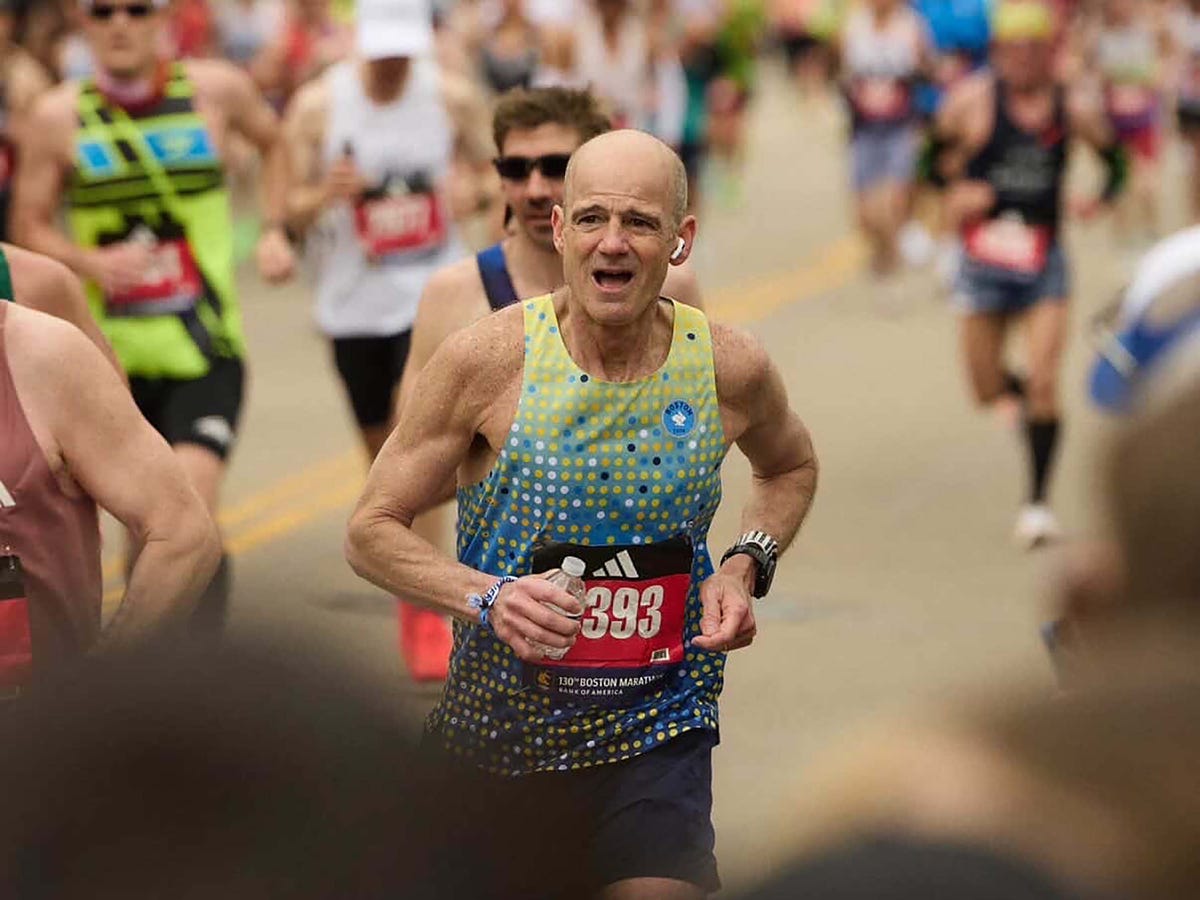
I remember when running 10 miles seemed out of the question. It was October 2021, and my friend Rachel “Rae” Butz, who I know through the Nazareth, Pennsylvania, school district where I work in the IT department, invited me to join her running group, Breakfast Club Runners (BCR). My son was her student, and he had mentioned to her that I’d started running again for the first time in 30 years.When she told me her group typically runs six to 10 miles every Sunday, I balked and said something like, “That’s too far for an old man!” I was regularly logging three, maybe five, miles at a time. But 10? I’d never been a long-distance runner and wasn’t sure I really wanted to be.As a kid, I ran on the high school track and cross-country teams. After graduating high school in 1984, I joined the Air Force and moved to Germany, where I continued to run while enlisted and after my service ended. I was a solid middle-distance runner and participated in some European competitions. I ran 5K races and the 3000-meter, but the 1500-meter was my absolute favorite event. I loved running on the track.In the late 1980s, when I was still living in Germany, I ran a half marathon on a whim. I’d never raced that long of a distance. I definitely didn’t train for it properly. But I was young, reckless, and overly confident that I could pull it off. I went in way too aggressively and ended up injuring my knee so badly that I couldn’t run. I met with a couple of doctors, but nothing really worked; it never fully healed. I took up mountain biking as my main form of exercise and stopped running altogether.When COVID-19 hit, I picked it up again. Working in IT at that time was incredibly stressful, and I wasn’t in great shape. Running was a reliable form of stress relief, and it felt like something positive that I could control.How Group Runs Got Me Marathon ReadyBefore joining BCR, I kept my mileage on the low end and did most of my runs solo.During those first few runs with the group, I definitely struggled more than I let on. But I didn’t want to show weakness. I didn’t want to be the guy who complained or cut runs short. I just kept showing up and doing what everyone else was doing.Over time, my body adapted and I became part of their close-knit community. Everybody was there to work hard, have a good time, and encourage one another.The whole dynamic brought me back to my days running in Germany with my friend Klaus, who was also in his 20s at the time. We trained hard, but it never really felt like it because we were joking around and talking about our lives the whole time. We’d go out for a run, then grab dinner and head to the discotheque, back when discotheques were a thing.Running with the group had a similar, lighthearted vibe. I would just show up and ask, “What are you doing today?” And then I’d join them. I was running longer and longer distances, and before I knew it, my new running buddies had convinced me to sign up for the 2022 Jim Thorpe Area Running Festival, my first-ever marathon.When it came to training, I tapped my more experienced friends for advice. I regularly run with Chris Mertz, who’s finished 32 consecutive Boston Marathons, and Michael Brown, a.k.a. “Brownie,” the cross-country coach at a nearby high school. They have so much running knowledge and are familiar with the marathon distance, so I basically just did what they told me to do.About a month before the race, I felt a twinge in the knee I’d injured decades prior. I thought to myself, “Well, that’s it. It’s over.” But Rae insisted I see her physical therapist who had helped so many of the runners in our group with their injuries.The PT worked on me and gave me some hip- and glute-strengthening exercises to do, like single-leg Romanian deadlifts, hip thrusts, side planks with a leg lift, and single-leg chair squats. Thankfully, I started to feel better and working with a physical therapist made a huge difference in my training. I didn’t have to give up running for a second time.I think my body was just adjusting to something it had never experienced before. I had only been running for about a year, and suddenly I was putting my legs through 20-mile runs. My quads and hamstrings have always been naturally strong, but I think my glutes, hips, and other muscles surrounding my IT bands were the weak link.I ended up having a great first marathon experience at Jim Thorpe. Even though it was really hot that day, I felt strong and managed to pick up my pace a little over the last few miles. I finished in 3:22:31, earning second place in my age group. I immediately started thinking about my next race and whether I could do even better.Thanks to all the crowdsourcing I’d done, I had a solid training foundation that I could build upon and tweak to make it more personalized to me. Because my physical therapy exercises had been so effective, I started strength training, which I’d never done before.I really like TB12, which is Tom Brady’s strength-training program. It's mostly a core-focused workout with a lot of resistance band exercises, leg strengthening, and stability work. The program is broken into four phases that are each four weeks long, so it fits almost perfectly into my marathon training cycle. I’ve added a couple extra exercises like push-ups, situps, and calf raises to each phase.I also introduced speedwork into my training. One of the perks of working for the school district is that I have access to the track behind our middle school, which I now hit up every Wednesday night.Rae has shared a bunch of her workouts with me, but sometimes I use artificial intelligence tools to come up with different speed workouts. I’ll say, “Hey, chat, what kind of intervals should I do?” And it will come up with some different options based on the training information and performance goals I provide. One workout it suggested was 16 x 200 meters, which I loved. (The 200s are short enough that you can really push yourself, but they’re over before they become too painful.) As someone who works in technology, I know how scary A.I. can be. But in this case, I’ve found it to be really useful.Courtesy Mike UelsesConsistent training, along with these refinements, paid off in my next few races. In 2023, I ran Boston in 3:09:38. That year, I did what I call the “two-fer” and ran Jim Thorpe a couple of weeks later, finishing in 3:03:31. (It kills me that you put so many weeks into training for just one day, so I like to get more than one race out of a training cycle whenever I can!)The Quest to Break 3After that Jim Thorpe race, I started to think that maybe I could break three hours. For the first time since I’d started running again, it seemed realistic. Mathematically, it all came down to shaving off less than 10 seconds a mile. That felt possible, considering I’d upped my running frequency from five to six days a week.Plus, I’d become more willing to challenge myself as a competitor. Early on, I always tried to be very realistic with my marathon goals because the marathon is such an unforgiving event. When you’ve invested over 20 weeks of training into one race, it’s scary to take a chance and risk blowing up. There are also so many things outside your control: the weather, staying healthy, avoiding injury, race-day logistics, and even whether you sleep well the night before.As I gained more experience and confidence, I became more willing to take calculated risks in training and on race day. I think that, along with increasing my mileage, is what really helped me improve.The first time I broke three hours was at the Erie Marathon in 2023. I stuck with the three-hour pacer for most of the race. Using a pacer isn’t a perfect strategy, but it gave me an indication of where I was at all times. Ultimately, it worked out, and I got a new PR of 2:59:05.Since I started running again five years ago, I’ve finished 12 marathons and PR’d nine of them. I know that, at some point, I won’t be able to get any faster. But at 60 years old, it’s been incredible to keep improving and having new experiences through my running.This year I ran the Tokyo Marathon (it was a blast, but I missed a PR by a few seconds), and two years ago, I went back to Germany to run the 2024 Berlin Marathon. That was a really special trip because I was able to reunite with Klaus and meet some of my longtime Strava and Garmin friends in person. I also got to see where my Dad was born.Still, Boston is my all-time favorite race. When I think of everything that goes into that event, I get goosebumps. The energy of the crowd is phenomenal. Brownie and I trained for the 2026 race together. We ran most of it side by side, too, which definitely pushed me to go faster. We’re competitive with each other. It's a friendly competition, but both of us want to win.I remember at the start of the race he kept telling me we should probably slow down. And every time he said something, I would pick up the pace. But once we hit Heartbreak Hill, I could feel him pulling ahead. I told him, “Hey, you can go faster if you need to,” and he did. He ended up beating me by about 30 seconds, but I set a new PR of 2:48:16.Next up is round two of the New York City Marathon, which I ran in 2025 in 2:51:34. That course, with all the bridges, is a beast. My plan is to bump up my total mileage. During my last training cycle, my peak week maxed out at 88 miles. This time, I’m going to try to push it to 95 miles. I’ll also prioritize hill repeats, which I absolutely hate. But it’s non-negotiable. Our group has a saying: “Hills pay the bills.”Sometimes, I think I’d like to do an ultra. Years ago, I did a 24-hour mountain bike race, and it was one of the most fun events I’ve ever done. And, honestly, after a 24-mile training run, sometimes I’ll come home, eat, sleep, and feel like I could run another 24 miles the next day.I know I’m fortunate to have a lot of natural endurance. And like I said, I know the day will come when I’ll stop setting new PRs. But it hasn’t happened yet.3 Tips for Setting PRs in Your 60s Courtesy Mike UelsesRun With a Group Find a good group of people that’s going to encourage you to stay consistent and keep improving. I think being in a supportive environment really helps you grow. And if you can connect with more seasoned runners who are willing to share their knowledge, you’ll benefit.I train with people who have been running a lot longer than me, and they’ve helped me to continue to PR by offering invaluable training advice and pushing me to keep challenging myself. Also, I have a blast every time I get to run with them. We’re like a big family.Be Realistic Yes, I’ve continued to get faster and set new PRs, but my improvement has been gradual and incremental. Whenever I set a new goal, I look at all the data I collect through Garmin, Strava, and Runalyze. I track everything: weekly mileage, heart rate, training readiness, sleep, stress, VO2 max, marathon shape, endurance score, and race predictions. That way, I can get a picture of what I’ve done and ask myself, “Is this goal realistic?”At my age—or any age, really—you can’t make big leaps. You can’t go from running 50 miles a week to 80 miles a week. If you push too hard or progress too quickly, you’re going to get hurt. And coming back from an injury at 60 is a lot harder than it is at 30.Make Time to Strength Train Strength training probably would have helped me a lot when I was younger. Now that I’m 60, I think it’s absolutely necessary. As you age, your muscles just aren’t the same, and you have to do more to take care of yourself.I believe that sticking to a structured, twice-a-week program has helped me become a better runner and has probably kept me from getting injured.
At 60, I’m Still Setting PRs Like My 2:48 Boston Marathon Finish. Here’s How I Keep Getting Faster.
Full Article
Original Source
Read the full article at Runnersworld →KhanList aggregates and links to publicly available news content. We do not host full articles from third-party sources. Always verify important information with original sources.