
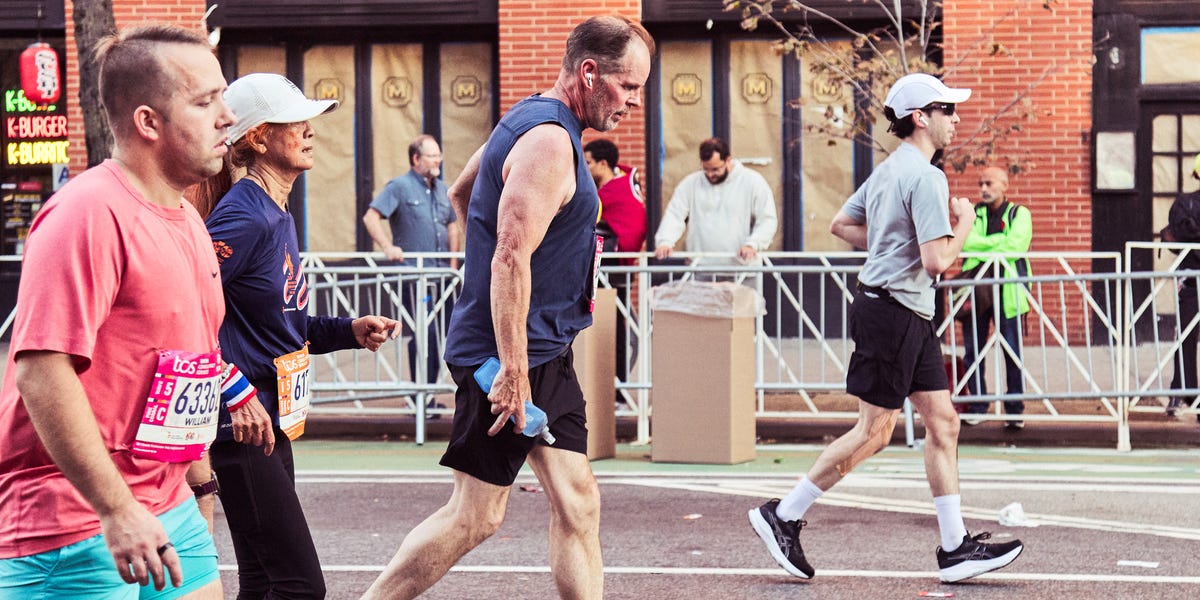
I’ve never been a runner. Before this past year, the last time I ran was a local 5K on a whim with my daughter about a decade ago. I didn’t prepare for it at all, so it was challenging, and I never ran again after that.Then, this past May, I signed up to run another local 5K, two months before I turned 60. Working in an office full of runners—I’m an editor at Popular Mechanics and we share an office with Runner’s World—I just wanted to prove that I could do it.I went on a handful of runs before the race in an attempt to prepare, but I couldn't really make it past 1.5 miles. I got really frustrated. Leading up to race day, I saw how hilly the course was and decided to just wing it. If I had to walk at some points, I’d walk… and that’s what I did on most hills, because I didn’t quite have the stamina to make it through.But all the runners around me were so inspiring; it felt like we could all make it through together. I saw someone in front of me going about the same pace, and that helped pull me to the finish line. I finished in 35:16, averaging an 11:20 pace.A few months later, I got the opportunity to run the New York City Marathon. I was hesitant to accept, because I didn’t think I could run that far, but a few of my colleagues pushed me to say yes and really believed in me. So I signed up.GET YOUR ZERO-TO-MARATHON TRAINING PLAN HEREHow I Trained to Go From Zero to Marathon at 60When I started marathon training, I followed the Runner’s World six-month zero-to-marathon training plan. I skipped a few weeks ahead because I had already worked up to running five miles and the plan starts with walking.My training experience was far from perfect, but I learned that as a beginner, you have to just start and go from there.To be totally honest, I didn’t train for the marathon as much as I probably should have. I started training around early August by running three times a week on local trails in the evenings, averaging three- to five-mile easy runs. I also made sure to add hills to most of my runs to get my quads ready for the hills in New York.My training came to a bit of a halt after the first few weeks of training, when I realized I probably needed to contact my cardiologist. A couple of years ago, the doctors told me I have an enlarged aorta (the largest artery in your body that carries blood from your heart to the rest of your body), which the doctor attributed to my physically demanding years as an ironworker.The problem with an enlarged aorta is that if it ruptures, you could have a fatal heart attack with little to no warning signs. Thinking about this made me nervous to train out of fear I might put too much stress on my heart.So I called the doctor and scheduled an appointment, but they had to reschedule it for the last week of October and I wouldn’t be able to do imaging until November. But I told the nurse practitioner about my marathon training, and the doctor gave me the go-ahead to continue running with caution. I decided to stick with it knowing I didn’t have any symptoms or immediate concerns.However, I did miss many of my long runs and I was pretty stressed that I wasn’t keeping up with the training plan. Once race day got closer, I grew tired of being hesitant and ran a 15-mile long run, which is the minimum distance run coaches recommend to cover in marathon training. Thankfully, I felt really strong through every mile and fueled well, which gave me reassurance for race day.I also did about four of the threshold interval workouts in the beginning of the zero-to-marathon training plan, naively thinking they would be easier than easy runs because they included two-minute breaks…but they were not. I remember one workout in particular: eight sets of one-minute threshold efforts with one minute of recovery between each, along with a two-mile warmup and cooldown and some 30-second pre-workout strides. It was harder than I thought, but I got through it.Toward the end of my training block, I noticed my pace naturally getting faster, which boosted my confidence and made me think I could potentially aim for sub-five hours on race day.I also have a very basic strength routine that I do three to four times a week with a 35-pound kettlebell, which I kept up with throughout training, and I think that helped keep me strong and durable enough for the race.I typically do a combination of 20 to 50 kettlebell swings, 10 weighted goblet squats, and 10 push-ups. I think the kettlebell is one of the greatest weight tools there is; I don’t have to go to a crowded gym and I can fit in a sufficient strength workout at home. The key with my strength routine is to not stop and complete the reps continuously.I also incorporated two to three sets of five to 10 minutes of continuous jump rope between some of my strength sets at least once a week. This meant I snuck in some plyometric work to build my power and durability.For people out there who think that they can’t train for and run a marathon, you can. I loved reading Runner’s World articles and training plans. If you follow a plan, even loosely, you can get to the finish.How Race Day WentWinston ZhouThe morning of the race, I felt very anxious. I traveled from Princeton, New Jersey, that morning, making a stack of six large pancakes (my go-to fuel source) and ate three before I left my house, saving the rest for the bus ride to the start line.I felt a sense of imposter syndrome at the starting line, which I think goes hand in hand with being a writer. Whether it was my early years of being a screenwriter or adjusting to a new job at Popular Mechanics, I constantly dance with a feeling of “why am I here?” Those feelings came flooding back at the marathon. I thought to myself, “I’m not a runner…what am I doing here?” But I’ve learned the only way to work through that is to just do it, and take the first step.With 12 gels on me and a 17-ounce handheld bottle of electrolyte mix, I made my way through the race, maintaining an easy effort. I felt like I could breathe through my nose if I wanted to for most of the time.Some of my favorite parts of the race were running past buildings I’ve worked on and listening to the crowds. I didn’t turn on my music once during the whole race because the cheering was so loud and gave me so much energy.There’s something particularly special about the creative, weird, and wonderful energy in the New York City Marathon. It was touching to see how such a big city comes together on this day, and not out of tragedy. I had never even been to a marathon before this, so that part felt really powerful. We’re living in a time of uncertainty, so it’s nice to know that people are still there for each other in the way they should be.By the time I got past the halfway mark of the race, I realized sub-five was out of reach and I adjusted to sticking to my goal of simply finishing. I found my family around mile 17, which gave me the courage to keep going despite miles 19 and 20 hitting me hard.I finished in 5:18:56, greeted by my colleagues holding my medal for me at the finish line. I felt like I proved that you can do anything you put your mind to, and I was so glad that my family was there to watch me finish, too.My 5 Tips for First-Time Marathoners Over 501. Use Runners Around You as MotivationThe same thing that pulled me through my 5K happened around mile 18 or 19 of the marathon. I looked up and saw a woman wearing a hydration vest with a sign on her back printed in pink that read, “22 weeks pregnant.” I thought to myself, “Oh my god. I’m following you because you’re my new inspiration.” If she was running this race pregnant, there was no way I was giving up.2. Lean On Your CheerleadersAt mile 20, I knew I wasn’t going to be able to break five hours, but I’m grateful and proud I made it past mile 15 because that was the farthest distance I’d gone. I saw my family spectating at mile 17, and I think if I had seen them at an earlier mile, I would’ve struggled more to keep going.My family really believed in me along the way. They made “Team Smith” shirts, and a bunch of my friends and family members came in to watch, including my son FaceTiming in from Paris. I only got to see them for a minute, but that’s what carried me for the last nine miles.3. Take Baby StepsFor me, half the battle of the race was mental. I thought to myself that anything after 15 miles would feel like driving at night: Your headlights only show you 50 feet in front of you, so only focus on that. You can’t see the whole road out to where you’re going, but you can keep going bit by bit. I told myself I could go another two miles at a time, and before I knew it, I was at the 23-mile mark.4. Never Give UpMy marathon experience brought me back to an early point in my career, when I graduated from film school in Los Angeles in 1988, then moved back home to New Jersey. People told me I would never sell a script living in New Jersey, but I sold four. Then, people told me I would never get a movie made, but I did. I really wanted to prove these things to myself, and I treated 26.2 miles the same way.I also have three kids in their early and mid-20s. I wanted to set an example for them that you can do anything you set your mind to, and to reiterate a value that holds up in our family: to never, ever give up.5. Be Prepared to FailWhen I think about what my kids experience, I notice a lot of pressure on their generation on social media to not fail at a goal they set. In my work life, the only way I ever learned anything new with tools or construction was by trying, messing something up, and then trying to do it better. The entire marathon experience emulated that belief for me: The only way to succeed at anything is to fail a lot. That’s how you learn, grow, and get better.Kristine Kearns, a writer and avid runner, joined Runner’s World and Bicycling in July 2024. She previously coached high school girls cross country and currently competes in seasonal races, with more than six years of distance training and an affinity for weightlifting. You can find her wearing purple, baking cupcakes, and visiting her local farmers market.
‘At 60, I Went From Zero Running Experience to Finishing the NYC Marathon Within a Year. These 5 Strategies Got Me to the Finish.’
Full Article
Original Source
Read the full article at Runnersworld →KhanList aggregates and links to publicly available news content. We do not host full articles from third-party sources. Always verify important information with original sources.