
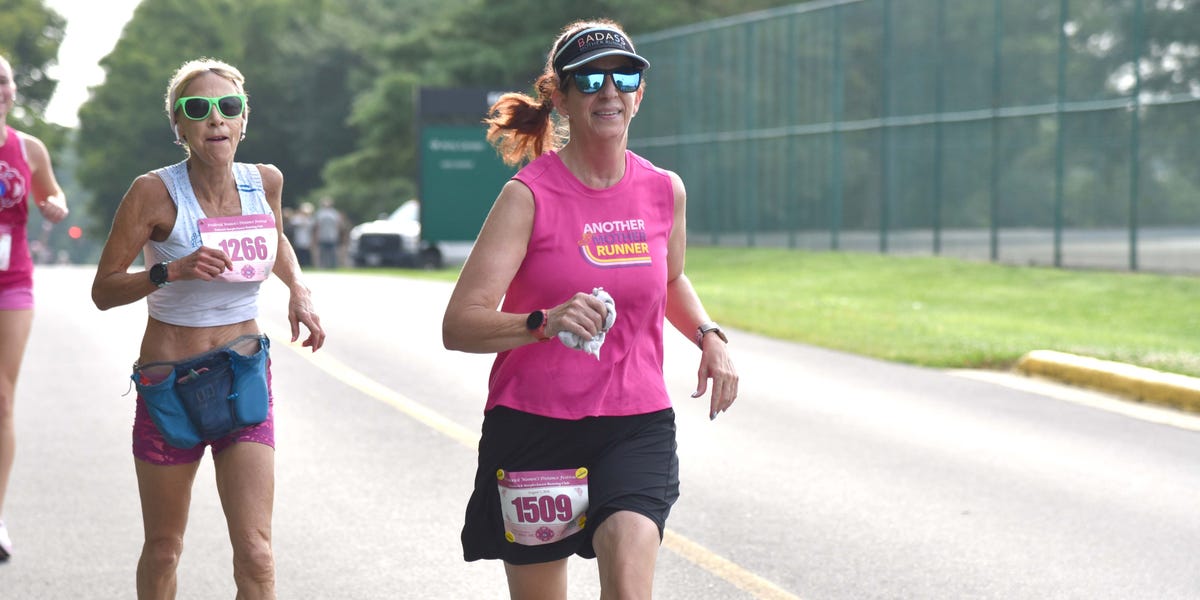
When Sue Redding crossed the finish line of the 2022 Marine Corps Marathon in 5:01:12, she knew she’d return to break the 5-hour mark. But the 2023 race was unseasonably hot and humid, leading to a time of 5:49:43, followed by a 5:28:09 finish in 2024.Although Sue, who lives in Frederick County, Maryland, had been “getting to that age where every joint hurts” and marathoning is “a big time commitment,” she wouldn’t give up marathoning until she ran sub-5.Sue started running almost 40 years earlier and raced her first 26.2 miles at the 2002 Baltimore Marathon. “I just turned 35, and I was like, ‘I can do anything!’—no, you can’t without proper training,” she says. “I finished [in 5:24:57] and all, but it was very painful and very humbling.” It would take 11 years for Sue to return to the marathon distance; she raced the 2013 Marine Corps Marathon—with the help of a coach—and after that, returned to the same race a few times until, in 2022, she came so close to the 5-hour mark.The 2025 Marine Corps Marathon was her seventh attempt—but this time, the 58-year-old was using a new training technique, and she was excited to see how far it would take her. “My pace was just steady as can be the whole time—I didn’t go above 11 minutes, and I didn’t go below 10; it was just right there the whole time,” she says. Sue crossed the finish line in 4:55:54—and set a new PR. “It’s one of my prouder moments,” she says.That technique that led to her shiny new personal best? Running by optimal cadence.The idea of cadence training, which helps adjust and optimize step rate and generally targets 160-180 steps per minute (but can be lower or higher based on the individual), was not new to Sue; she had just always dismissed it as something she didn’t need to pay attention to. But then, two years ago, she attended Another Mother Runner running retreat and, during a book exchange, received a copy of Born to Run, where Christopher McDougall explained cadence in a way that clicked for her. He links cadence training to the song “Rock Lobster” by the B-52s, Sue says, asking readers to start by standing up with their back against the wall and trying to run to the beat of the song with their knees high and without kicking the wall. “It’s really hard to get used to it, your foot touching on each of those beats,” she says. “But once you get it, it’s amazing.” Sue practiced to the beat of the song during training runs, measuring her cadence with her Garmin watch—and then tested it during a half marathon. “It was a game changer for me,” she adds.The experience made her believe that she could pace a marathon the same way. “The cadence gave me the confidence,” she says. Now, Sue runs faster than she did in her 30s.Increasing your cadence can be a slow process, but one that can bring many benefits. Here’s how to do it.Why Is Cadence ImportantCadence is directly linked to running efficiency, says Alison Freeman, a triathlon coach based in Boulder, Colorado, cofounder of NYX Endurance coaching, and the author of Unlocking Triathlon: Training Plans and Coaching Support for a Confident Race Day. “If you have better efficiency or economy—they basically mean the same thing—then you can run faster with less effort.”Over time, cadence training will produce a number of benefits. “When your energy return improves, then you become fatigue resistant; your muscles aren’t working as hard, so they last longer,” Freeman says. “What that will mean is that the second half of a workout or a race, you have more energy left in your muscles. You can run stronger or faster on race day.”Cadence training has also been linked to injury prevention. A 2025 study published in The Cureus Journal of Medical Science concluded that increasing your running cadence by 5 to 10 percent reduces lower-body impact forces and decreases the risk of common overuse injuries like runner’s knee and shin splints. “That doesn’t mean you should shoot for 200 steps per minute, but getting up into that kind of preferred range really does decrease your injury risk,” Freeman says.What Your Cadence Should Be“Your ideal cadence really depends a lot on your body geometry,” Freeman says. “There’s no formula for ‘this is your height and therefore this is your ideal cadence;’ you mostly want to increase it toward 180—and possibly above that if you’re an athlete with shorter legs.”Start by reviewing your current cadence, which you can find under the activity data in most apps and on most devices. With that knowledge, you can start looking into increasing the number.Your ideal cadence will remain relatively the same, no matter the workout, type of run, or pace you run. “You’re changing your pace by increasing your stride length,” Freeman says. “Your cadence stays the same regardless of pace.” What you’ll want to work toward is reducing your stride length at the same time. “Your running pace is a direct mathematical equation between your stride length and your stride rate, so stride length times stride rate yields the pace,” she adds. “If you’re going to increase your stride rate, you need to decrease the stride length to keep your pace the same.”How to Actually Train CadenceBefore you implement any changes to your cadence, Freeman recommends working on your posture. “The first thing I have athletes do is start to move their hips into a more forward position,” Freeman says. “A lot of athletes, when they run with their hips back, they’re collapsing into their stride, and their muscles are absorbing the foot strike, and then they have very low energy return.” Freeman describes the posture as standing like Superman with hands on hips, chest forward, and shoulders back as the foundation, and once you practice that for a few weeks, you can move toward increasing your cadence.Most smart devices have a built-in metronome you can set up to buzz with every step or every other step, and help you stay on cadence. Start by reviewing your historical cadence in your fitness app. On your next run, increase it by no more than four steps per minute, then “stay there for a week to two weeks until that new cadence feels natural and then go up another four steps per minute,” Freeman says.The biggest challenge when training cadence is reducing the stride length. Freeman held a running clinic at FeistyFest, a three-day movement and educational festival for women held in September in Breinigsville, Pennsylvania—which Sue Redding attended—teaching dozens of women how to increase cadence. Freeman started the exercise by having the women run in place, then leaning forward to help them see they can run a 14- or 15-minute mile with a high cadence.Next, she told the runners to visualize running with their grandmother—or Betty White because she’s a national treasure, and you cannot possibly leave her behind—to help them picture just how short their steps should be. “You have to really over-exaggerate this, and you’ll almost feel like you're not going anywhere, and that's how you know you’re doing it right,” Freeman says.Cadence training is a slow and gradual process. In Freeman’s experience with her athletes, it takes two to three months before higher cadence feels natural. But as Sue Redding’s experience proves, the payoff will be worth it.Don’t be concerned if…... your runs suddenly feel harder. “Most people don’t reduce their stride length, and so they’re running faster, but at a higher effort level, and they feel like that’s unsustainable,” Freeman says, adding that it may make runners feel like it’s not working. Make sure you’re not leaving Betty White behind and trust the process.... your heart rate increases. When you reduce your stride length while running at the same pace, your heart rate will likely temporarily increase just because it’s a more cardiovascularly driven run form, Freeman says. That’s okay, your body will get used to the new normal, adjust, and your heart rate will come back down.Additional Tips and Tricks from FreemanIf you’re finding yourself slightly off the beat, it can be a little easier to get your arm swing in time with the metronome than your feet.You don’t necessarily want to change your cadence while you’re already training toward a key event. Training cadence while doing interval or tempo work, or a long run, is really challenging, therefore best done during your off-season.Having a metronome beeping or buzzing on your wrist tends to be the best thing to keep you on the right beat. You can also utilize playlists built around a specific beats-per-minute frequency that corresponds to the cadence you’re currently aiming for. Pavlína Černá, an RRCA-certified run coach and cycling enthusiast, has been with Runner’s World, Bicycling, and Popular Mechanics since August 2021. When she doesn’t edit, she writes; when she doesn’t write, she reads or translates. In whatever time she has left, you can find her outside running, riding, or roller-skating to the beat of one of the many audiobooks on her TBL list.
At 58, She Is Running Faster Than in Her 30s—Thanks to This Misunderstood Running Technique
Full Article
Original Source
Read the full article at Runnersworld →KhanList aggregates and links to publicly available news content. We do not host full articles from third-party sources. Always verify important information with original sources.