
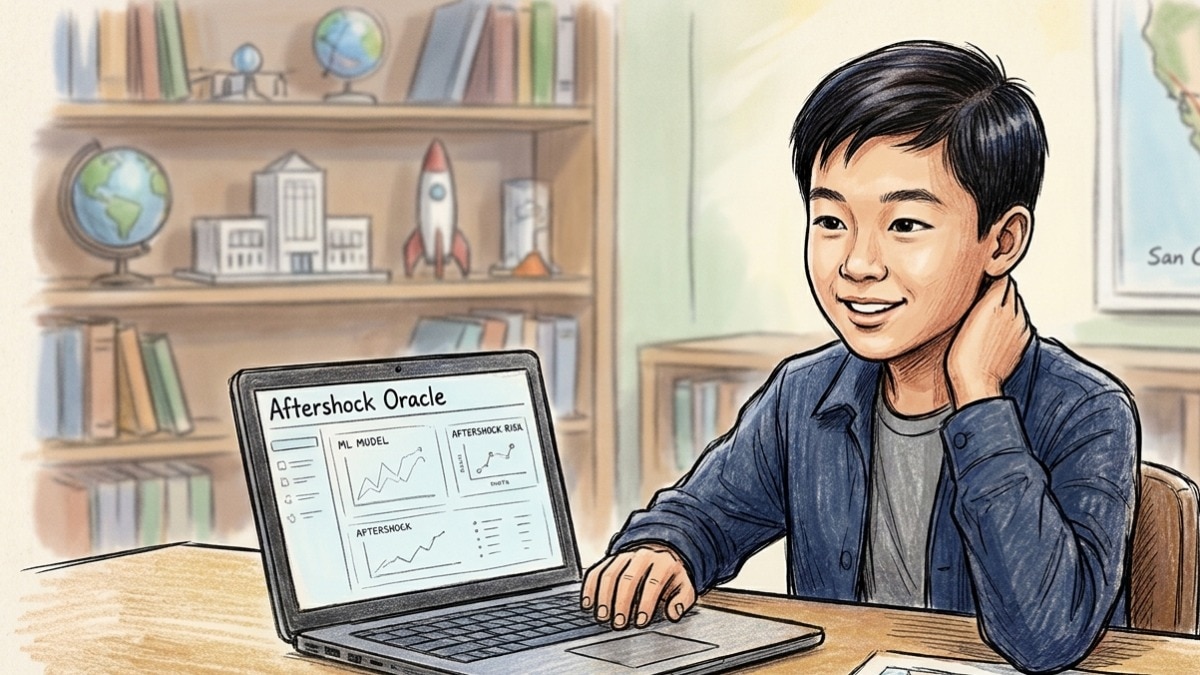
Bowen Wang built Aftershock Oracle after earthquakes near the San Andreas Fault disturbed his sleep. The award-winning student project shows machine learning's potential for assessing aftershock risks.California seventh grader Bowen Wang has built an AI tool to forecast earthquake aftershocks and won a national technology award (AI-generated image)New Delhi,Oct 29, 2026 11:55 ISTFor Bowen Wang, earthquakes were not just something he read about in science books. Living near California’s San Andreas Fault, the seventh grader had experienced tremors that woke him up at night. But instead of letting those unsettling experiences remain just that, he turned them into a question: Could artificial intelligence help people better understand what happens after an earthquake?That question led him to build Aftershock Oracle, a machine learning tool designed to forecast earthquake aftershocks. His work has now earned him a first-place Technology Award at the 2026 Thermo Fisher Scientific Junior Innovators Challenge, along with a $3,500 educational stipend.According to the Society for Science’s official profile, Wang is a seventh-grade student at Central Middle School in San Carlos, California. His project explores how machine learning can help estimate the magnitude, frequency, and location of aftershocks following a major earthquake.FROM SLEEPLESS NIGHTS TO A SCIENCE PROJECTWang’s motivation came from living in an earthquake-prone region. In his official competition profile, he explained that his home is only a few miles from the San Andreas Fault and that several earthquakes over the past year had woken him up at night. While the initial earthquake often receives the most attention, the tremors that follow can also pose risks to people, damaged buildings, and emergency response efforts. Wang wanted to investigate whether machine learning could help researchers better understand these subsequent quakes.Rather than treating the problem as a purely theoretical exercise, he used publicly available earthquake records to explore whether historical patterns could help estimate aftershock risk.THREE AI MODELS, ONE WINNING APPROACH Wang trained and compared three machine learning models: XGBoost, Logistic Regression, and Random Forest.His research used historical earthquake data from the United States Geological Survey (USGS), covering the period from 1950 to 2025, alongside information about tectonic plate locations. He separated mainshocks from subsequent aftershocks and tested how effectively each model could identify aftershock risk.All three models performed well in his experiments, but XGBoost delivered the strongest results, according to his project profile.Wang then used the model to develop Aftershock Oracle. The tool allows users to enter information about an initial earthquake and receive estimates of the location, frequency, and strength of possible aftershocks.The project demonstrates how machine learning can be applied to earthquake risk assessment. However, its reported results should not be interpreted as proof that the tool is ready for operational use or can predict earthquakes with certainty.A NATIONAL AWARD FOR A YOUNG INNOVATORWang’s research earned him the first-place Technology Award at the 2026 Thermo Fisher Scientific Junior Innovators Challenge, organised by the Society for Science. The competition recognises promising research by middle school students across the United States.According to the official awards announcement, first-place winners in the competition’s STEM categories received $3,500 educational stipends.His recognition places the project among the student-led innovations showcased at a national science and technology competition, where young researchers explore ways to apply scientific thinking to real-world problems.ICE HOCKEY, BOOKS AND AMBITIONS BEYOND SCHOOLAway from research, Wang plays competitive ice hockey and enjoys reading. In his Society for Science profile, he said the sport helps him develop mental discipline and stay focused under pressure. He also described reading as an important part of his identity.Looking ahead, Wang hopes to become a civil engineer and establish his own firm, combining modern design with environmental responsibility.For the seventh grader, the journey from an earthquake that interrupted his sleep to an award-winning research project illustrates how a personal experience can inspire scientific curiosity. His work is still a student research project, but it offers a glimpse of how young innovators are exploring the potential of artificial intelligence to address challenges in their communities.- Ends
At 12, he built an AI tool to forecast earthquake aftershocks and won a national award
Full Article
Original Source
Read the full article at Indiatoday →KhanList aggregates and links to publicly available news content. We do not host full articles from third-party sources. Always verify important information with original sources.