
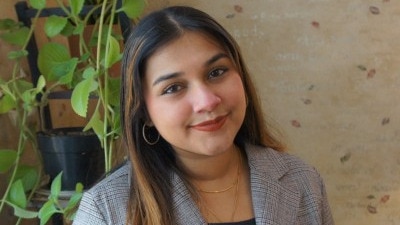
When Gitanjali Rao was 10, the Flint, Michigan, water crisis sparked a powerful question: Could technology make a difference? That curiosity led her from a lead-detection invention to AI and health innovations, MIT research, and ultimately the first Stephen Hawking Junior Medal for Science Communication.At 10, she built a lead detector for water. At MIT, she became first Hawking medalist (Image: LinkedIn/@Gitanjali Rao)What if a child could use science to solve a problem affecting thousands of lives? For Gitanjali Rao, that question became a mission. At just 10, after learning about the Flint, Michigan, water crisis, she began working on a portable device to detect lead in drinking water.That first experiment was only the beginning. Her curiosity eventually took her from a school laboratory to MIT and, at 19, to the history books as the first recipient of the Stephen Hawking Junior Medal for Science Communication.But Rao’s journey is about more than recognition, it is about turning curiosity into action and using science to tackle problems that matter.THE WATER CRISIS THAT CHANGED EVERYTHINGThe story began with Flint. After learning about the crisis, Rao became interested in whether there could be a faster and more convenient way to identify lead in water. At around 10, she began developing what would become Tethys, a prototype named after the Greek Titan associated with freshwater. The concept was ambitious. Tethys used carbon-nanotube-based sensing technology to detect lead and was designed to communicate information about water quality to a mobile device through Bluetooth. Rao's goal was to shorten the path between taking a water sample and understanding whether it could be contaminated.It was an idea born not from a desire to win a prize, but from seeing a problem and refusing to believe that nothing could be done.AT 11, SHE BECAME 'AMERICA’S TOP YOUNG SCIENTIST' In 2017, Rao's invention moved from a school project into the national spotlight. At just 11, she won the Discovery Education 3M Young Scientist Challenge with Tethys, earning the title of “America's Top Young Scientist.” She worked with a 3M scientist to develop and test the prototype, turning an early concept into a more refined invention.The achievement was extraordinary, but it did not become the finish line.Instead, it established a philosophy that would follow Rao into her teenage years: observe a problem, ask questions, experiment, fail, improve—and keep going.FROM CLEAN WATER TO HEALTH AND ONLINE SAFETYRao's ambitions soon expanded beyond water contamination. She developed Epione, a device aimed at supporting the early diagnosis of prescription opioid addiction. She later turned her attention to another problem affecting young people: cyberbullying.Her project Kindly used artificial intelligence and natural-language processing to identify potentially toxic or cyberbullying-related language. The project eventually became part of a UNICEF initiative developing Kindly as a Digital Public Good, with the aim of making the technology available more broadly.That progression is significant. Rao was no longer simply inventing devices. She was increasingly interested in using technology to tackle problems across environmental, health and social spheres.THE TEENAGER WHO BECAME TIME’S 'KID OF THE YEAR'By 2020, Rao's work had made her a globally recognised young innovator.TIME selected her as its first-ever Kid of the Year, bringing international attention to a teenager whose work had already ranged from water safety to health technology and cyberbullying prevention. Guinness World Records later highlighted her achievements as a young inventor.But perhaps the most interesting part of Rao's story was that she increasingly began treating communication itself as a form of innovation.She did not want science to remain locked inside laboratories or understood only by specialists. She wanted young people, and ordinary members of the public, to feel that science belonged to them too.MIT BECAME THE NEXT CHAPTERThat philosophy followed Rao to MIT. By 2025, she was a rising junior studying biological engineering at MIT, while also conducting research through the institute's Undergraduate Research Opportunities Program in the Langer Lab.The transition from a young inventor experimenting with water-quality technology to an MIT researcher represents a remarkable evolution. Yet Rao's interests remained rooted in the same basic instinct that drove Tethys: curiosity followed by action.At MIT, however, another dimension of her work came into sharper focus, how to communicate science beyond the laboratory.AT 19, SHE MADE STEPHEN HAWKING HISTORYIn April 2025, Rao reached perhaps her most symbolic milestone yet.She was named the first-ever recipient of the Stephen Hawking Junior Medal for Science Communication, a new award category launched by the Starmus Festival to encourage young innovators to communicate science with the wider public. The award was presented at the Kennedy Center in Washington, D.C.The honour carries a particularly fitting connection.Stephen Hawking was renowned not only for his scientific contributions but also for his extraordinary ability to explain complicated ideas to audiences far beyond theoretical physics. Rao has embraced a similar mission in her own generation.Speaking to MIT, she noted that scientists rarely spend enough time discussing why science communication matters, and pointed to Hawking as someone who excelled at making complex scientific ideas accessible.HER BIGGEST INVENTION MAY BE THE IDEA THAT ANYONE CAN SOLVE PROBLEMSRao’s story is about more than Tethys, MIT, or a medal. Her journey shows how curiosity can lead to action. From developing a lead detector to exploring sensors, medical technology, AI, and science communication, she has used problems as opportunities to create solutions. Her story reminds young people that great ideas can begin simply by asking, “Can I do something about this?”A JOURNEY THAT IS STILL JUST BEGINNINGFrom a 10-year-old experimenting with a lead-detection concept to an MIT biological engineering student and the inaugural recipient of the Stephen Hawking Junior Medal, Gitanjali Rao's journey has already crossed extraordinary milestones.Yet at 19, she is still at the beginning of her scientific career. Her next chapter could involve research, biotechnology, entrepreneurship, or something entirely unexpected.If her earlier work is any indication, one thing is likely to remain constant: she will keep asking questions, and then try to build the answer.- EndsPublished By: Apoorva AnandPublished On: Aug 25, 2026 10:48 IST
At 10, she built a water lead detector, then became MIT's first Hawking's medalist
Full Article
Original Source
Read the full article at Indiatoday →KhanList aggregates and links to publicly available news content. We do not host full articles from third-party sources. Always verify important information with original sources.